

Artificial Intelligence (AI) has become one of the most transformative technologies in the financial industry. It is not powered by a single technology. Instead, it relies on a collection of advanced technologies working together to analyze data, recognize patterns, make predictions, automate decisions, and continuously improve performance.
From automating routine banking operations to detecting fraudulent transactions in milliseconds, AI is changing how financial institutions operate and how customers interact with money. These core technologies form the foundation of modern financial innovation.
Table of Contents
Core Technologies Behind AI in Finance: The Engine Driving the Future of Financial Services
AI in finance is not operate under a single technology. Instead, it relies on a collection of advanced technologies working together to analyze data, recognize patterns, make predictions, automate decisions, and continuously improve performance.
These core technologies form the foundation of modern financial innovation.
This guide explores the major technologies behind AI in finance, explaining how each works, why it matters, and how financial organizations use it to create smarter, faster, and safer financial systems.
1. Machine Learning (ML): The Brain Behind Financial Intelligence
Machine Learning is the most important technology powering AI in finance.
At its core, Machine Learning (ML) serves as the primary cognitive engine transforming modern financial systems.
Rather than relying on rigid, pre-programmed rules, ML allows software to analyze massive datasets, recognize intricate patterns, and continuously improve its own decision-making capabilities over time.
Here is how this digital “brain” is redefining the landscape of personal and corporate finance:
How Machine Learning Works
The process generally involves:
- Collecting financial data
- Cleaning and organizing the data
- Training mathematical models
- Testing prediction accuracy
- Deploying the model
- Continuously improving through new data
Unlike traditional software, ML adapts as financial conditions change.
Also there are different types of machine learning used in AI: Supervised Learning, Unsupervised Learning, Reinforcement Learningetc.
Core Pillars of ML in Modern Finance
To understand how this “brain” operates in the real world, we can look at its three main functions:
-
Risk Mitigation & Assessment: ML evaluates credit risk by looking beyond standard credit scores. It analyzes alternative data points—such as transaction history, business cash flow, and even behavioral patterns—to determine lending risks more accurately.
-
Intelligent Automation: From automating complex back-office workflows to power-adjusting robo-advisory portfolios, ML removes human bias and manual friction from day-to-day operations.
-
Proactive Threat Detection: In cybersecurity, the ML brain acts as an immune system. It monitors global transactions instantly, recognizing and blocking fraudulent activities or anomaly patterns the exact millisecond they occur.
The Bottom Line: Machine Learning isn’t just about faster computing; it’s about smarter computing. By turning raw, chaotic financial data into actionable, predictive intelligence, ML acts as the foundational brain powering the next generation of financial technology.
2. Deep Learning: Solving Complex Financial Problems
Deep learning is a subset of machine learning inspired by how the human brain processes information. It uses artificial neural networks — layers of interconnected nodes — to identify patterns in large amounts of data.
Each layer extracts increasingly complex features: an early layer might detect simple edges in an image, while deeper layers recognize shapes, objects, or even faces.
What makes deep learning powerful is its ability to learn directly from raw data without needing humans to manually define which features matter.
Traditional machine learning often required engineers to handpick relevant variables, but deep learning models discover these patterns on their own through repeated exposure to examples during training.
This approach has driven major breakthroughs in image recognition, speech processing, language translation, and generative AI tools like chatbots and image generators.
It requires substantial computing power and large datasets to train effectively, which is why its rise has paralleled advances in hardware (like GPUs) and the explosion of available data.
3. Natural Language Processing (NLP)
Financial organizations process enormous amounts of written information every day.
Natural Language Processing (NLP) is the branch of AI that allows computers to understand, interpret, and generate human language — whether it’s text or speech. Instead of just processing language as raw strings of characters, NLP systems try to grasp meaning, context, grammar, and even tone.
Here’s how it generally works: text is first broken down into smaller units called tokens (words or subwords). These tokens are converted into numerical representations, called embeddings, that capture semantic relationships — so “king” and “queen” end up mathematically closer to each other than “king” and “banana.” Modern NLP relies heavily on deep learning architectures, especially transformers, which analyze how words relate to each other across a sentence or document, regardless of how far apart they appear.
NLP powers many everyday tools: chatbots, voice assistants like Siri or Alexa, spam filters, translation apps, and sentiment analysis tools that gauge whether a review or tweet is positive or negative.
It’s also behind large language models like ChatGPT, which generate coherent, human-like responses.
4. Robotic Process Automation (RPA)
Robotic Process Automation (RPA) refers to software “bots” that mimic human actions to carry out repetitive, rule-based digital tasks — things like copying data between systems, filling out forms, processing invoices, or generating reports.
Unlike physical robots, RPA bots operate entirely within software, interacting with applications the same way a person would: clicking buttons, entering data, and reading screens.
In finance, this means bots can not only move data between systems but also read invoices, flag anomalies, extract information from contracts, or respond to customer queries — adapting as situations change rather than failing outright.
The result is faster processing, fewer errors, and freed-up human time for higher-value work, while AI adds the judgment and flexibility that basic automation lacks.
5. Big Data Analytics
Big Data Analytics in AI refers to the process of examining massive, complex datasets—too large for traditional tools—using AI-powered techniques to uncover patterns, trends, and insights.
AI enhances big data analytics by automating pattern recognition, making predictions, and processing structured and unstructured data (text, images, video) at scale and speed no human team could match.
Businesses use it for things like predicting customer behavior, detecting fraud, optimizing operations, and personalizing recommendations.
Essentially, AI acts as the “brain” that makes sense of massive data volumes, while big data provides the “fuel.” Together, they enable faster, smarter, data-driven decision-making across industries like finance, healthcare, and retail.
6. Cloud Computing in Finance
At its core, cloud computing means delivering technology services—including data storage, servers, databases, networking, and software—over the internet.
Cloud computing gives AI the massive processing power it needs without requiring companies to own physical hardware.
Instead of buying expensive servers, businesses rent computing resources from providers like AWS, Google Cloud, or Microsoft Azure.
This is especially important for AI, since training and running models — like large language models or image recognition systems — demands huge amounts of processing power and storage.
Cloud platforms let developers access GPUs, storage, and pre-built AI tools instantly, scaling up or down as needed. This makes AI development faster, cheaper, and more accessible, allowing even small startups to build powerful AI applications without massive upfront infrastructure investment.
Core Cloud Models in Finance
Financial firms typically deploy cloud solutions using three distinct approaches depending on their security and operational needs:
| Cloud Model | Description | Primary Use Case in Finance |
| Public Cloud | Infrastructure managed entirely by a third-party provider (e.g., AWS, Google Cloud, Microsoft Azure). | Non-sensitive data processing, customer-facing mobile apps, and running heavy data analytics. |
| Private Cloud | Highly secure cloud infrastructure dedicated exclusively to one financial organization. | Core banking systems, highly confidential asset management, and strictly regulated data storage. |
| Hybrid Cloud | A blended approach connecting private and public clouds. | The industry standard; keeping sensitive customer data in a private cloud while leveraging the public cloud’s power for app development and analytics. |
The Strategic Impact:
Ultimately, cloud computing levels the playing field.
It allows traditional legacy banks to modernize their operations and compete with agile fintech startups, while simultaneously giving small fintech companies access to enterprise-grade computational power right out of the gate.
It is no longer just an IT upgrade; it is a fundamental business strategy driving financial innovation.
7. Blockchain and AI Integration
Blockchain and AI are increasingly paired in finance to solve each other’s weaknesses.
It offers secure, transparent, tamper-proof record-keeping, while AI adds intelligence — spotting patterns, predicting risks, and automating decisions.
Together, they power smarter fraud detection on decentralized ledgers, AI-driven smart contracts that adjust terms based on real-time data, and automated compliance checks across blockchain transactions.
In DeFi (decentralized finance), AI helps analyze market trends and detect suspicious activity across thousands of wallet addresses instantly.
This integration creates financial systems that are not only secure and transparent but also adaptive — capable of learning, predicting, and responding.
8. Neural Networks
A neural network is a computer model loosely inspired by how brain cells connect, learning patterns from large amounts of data rather than following fixed rules.
In finance, neural networks are used to spot fraud, predict stock price movements, assess credit risk, and detect unusual trading behavior.
They work by passing data through layers of interconnected “nodes,” each adjusting its calculations based on past outcomes to improve accuracy over time.
Unlike traditional statistical models, neural networks can capture complex, non-linear relationships in messy real-world data — like combining spending habits, market news, and transaction timing — making them powerful tools for prediction and risk detection.
9. Explainable AI (XAI)
Explainable AI (XAI) refers to AI systems designed so their decisions can be understood by humans, not just accepted as a “black box” output.
In finance, this matters because AI often drives high-stakes decisions—loan approvals, fraud flags, credit scores—that directly affect people’s lives.
XAI techniques show why a model reached a conclusion, such as which factors most influenced a rejected loan application.
This transparency helps banks meet regulatory requirements, builds customer trust, and allows analysts to catch errors or bias before they cause harm.
Without explainability, even highly accurate AI models can become risky, unaccountable, and difficult to justify to regulators or customers.
10. Knowledge Graphs
A knowledge graph in finance is a network that connects data points — companies, people, transactions, filings, accounts — showing how they relate to each other, not just what they contain.
Instead of storing information in separate tables, it links entities together: for example, linking a company to its executives, subsidiaries, suppliers, and past litigation.
This makes it easier to spot hidden risks, like undisclosed connections between borrowers, or trace money laundering through complex ownership chains.
Banks and regulators use knowledge graphs to strengthen fraud detection, compliance checks, and due diligence, since relationships often reveal risks that isolated data points alone would miss entirely.
11. Edge AI in Finance
Edge AI in finance means running AI models directly on local devices—like ATMs, POS terminals, or mobile banking apps—instead of relying entirely on cloud servers.
This allows instant fraud detection during a transaction, faster biometric authentication (like fingerprint or face verification), and real-time risk checks even with poor internet connectivity.
It reduces latency, since data doesn’t need to travel to a distant server and back, and improves privacy, since sensitive financial data can be processed locally rather than transmitted externally.
Banks and fintechs use it for secure, instant decision-making at the point of interaction—like approving a payment in milliseconds.
12. Generative AI
Generative AI in finance refers to AI systems that can create new content — text, analysis, code, or even synthetic data — rather than just classifying or predicting.
In practice, this means AI drafting research summaries, writing compliance reports, generating personalized financial advice, or simulating market scenarios for stress testing.
Banks use it to power smarter chatbots, automate document review, and speed up analyst workflows that once took hours.
It also helps create synthetic transaction data to train fraud models without exposing real customer information. While powerful, it requires careful oversight since these systems can sometimes generate plausible but inaccurate outputs.
How These Technologies Work Together
These technologies aren’t isolated tools, they usually stack together in a pipeline where each layer feeds the next. Here’s how it typically works in a real financial institution: They form a layered pipeline, where each stage feeds the next and human judgment sits at the top.
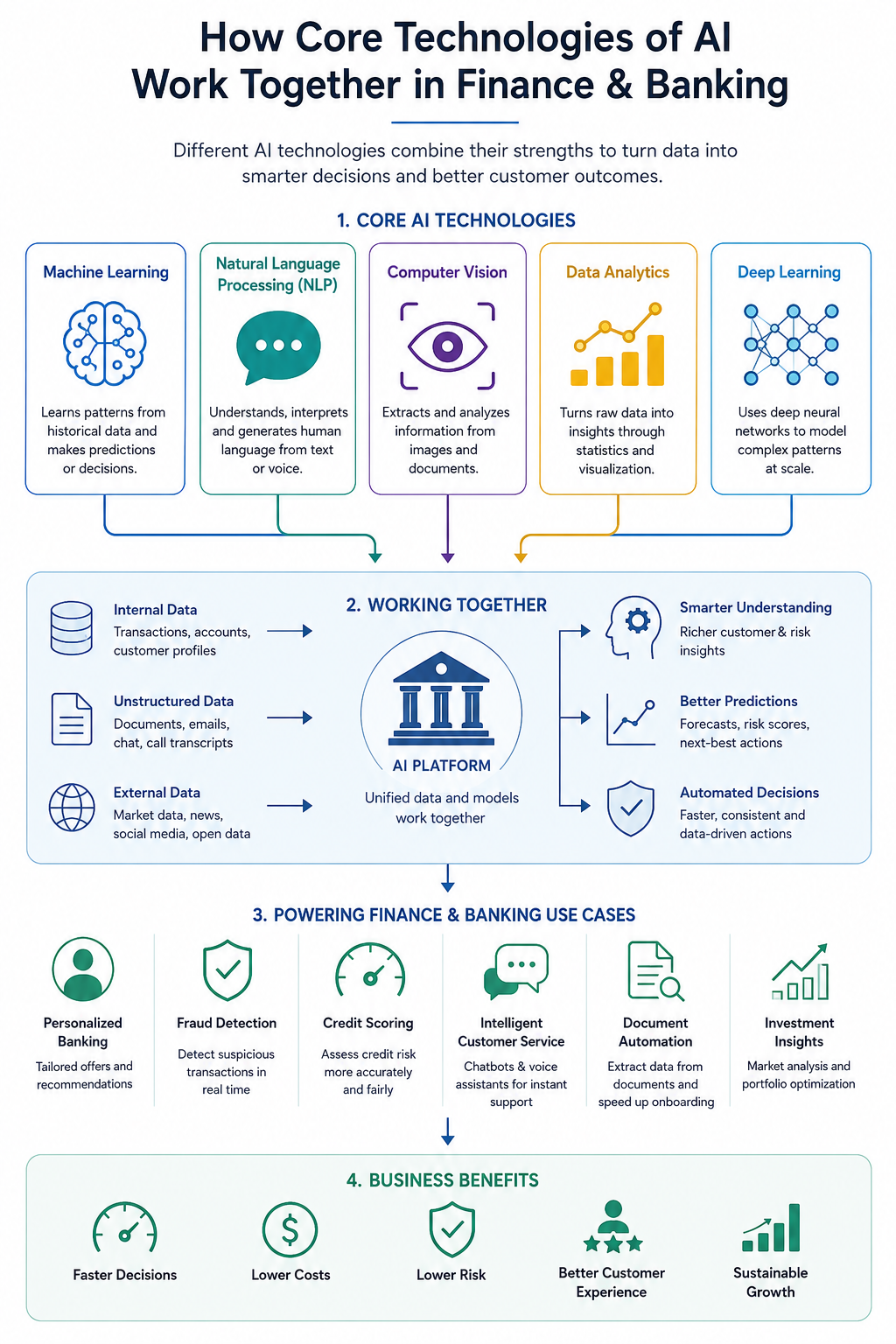
Data sources — transactions, market feeds, scanned documents, images — are the raw fuel. Everything downstream depends on this being clean and comprehensive.
Traditional machine learning (like fraud scoring and credit models) does the heavy lifting on structured, numerical patterns — this is still the backbone of core financial decisions.
NLP and computer vision layer on top to handle unstructured inputs — reading news sentiment, powering chatbots, or scanning claim photos — things plain ML can’t interpret on its own.
Generative AI sits above that, using the outputs of the earlier layers to draft reports, simulate scenarios, or generate synthetic data for safer model training.
Finally, human oversight reviews and approves high-stakes outputs — and crucially, feeds outcomes back into the system (the dashed loop), continuously retraining and improving the earlier models.
None of these technologies replace each other; they’re stacked, each covering a gap the one below it can’t.
Benefits of These Core Technologies
Organizations that successfully adopt these AI technologies can achieve:
- Faster financial decision-making
- Higher operational efficiency
- Improved fraud prevention
- Better risk management
- Greater customer satisfaction
- More personalized financial products
- Lower operating costs
- Stronger regulatory compliance
- Increased investment accuracy
- Enhanced cybersecurity
- Scalable digital banking services
- Continuous innovation and competitive advantage
The Future of AI Technologies in Finance
The next generation of financial AI will become even more autonomous, transparent, and interconnected.
Advances in multimodal AI, federated learning, quantum computing, digital twins, and autonomous AI agents are expected to expand what financial institutions can automate and optimize.
Future systems will deliver hyper-personalized financial services, detect emerging risks in real time, and collaborate seamlessly with human experts to improve decision-making while maintaining strong governance and ethical standards.
Below are the major trends that will shape the future of AI in finance.
AI is Reshaping Finance
Artificial Intelligence is revolutionizing the financial industry by making banking, investing, insurance, and payments faster, smarter, and more secure.
As AI technologies continue to evolve, financial institutions are shifting from traditional automation to intelligent systems that can analyze data, predict outcomes, and deliver personalized customer experiences.
Smarter Banking Services
Future AI solutions will offer customized financial advice, intelligent credit scoring, AI-powered investment management, and virtual assistants capable of providing 24/7 customer support.
Advanced fraud detection systems and predictive risk analysis will help banks identify threats in real time while improving decision-making and reducing financial losses.
Greater Efficiency and Transparency
AI will automate routine banking operations such as loan approvals, compliance monitoring, document processing, and regulatory reporting.
Combined with blockchain technology, AI will enhance transaction security, improve transparency, and build greater trust across financial systems.
Explainable AI will also help institutions make more transparent and accountable decisions.
Challenges and Opportunities
Although AI brings enormous benefits, organizations must address challenges such as data privacy, cybersecurity, algorithmic bias, regulatory compliance, and ethical AI use.
Responsible implementation will be essential to maintain customer confidence and meet evolving regulations.
Looking Ahead
By 2035, AI is expected to power highly personalized banking, real-time financial decision-making, intelligent investment strategies, and fully automated financial services.
Rather than replacing human professionals, AI will enhance their capabilities by handling repetitive tasks and delivering deeper insights.
Financial institutions that embrace AI responsibly and continue investing in innovation will be better positioned to improve customer experiences, reduce costs, strengthen security, and remain competitive in the rapidly evolving digital economy.