

Most business ideas don’t fail because the product was bad.
They fail because nobody checked if anyone actually wanted it — before the website went live, the inventory arrived, hiring a developer, registering a company, renting an office, or spending money on advertising.
That’s the gap this guide fills.
Not another generic “talk to your customers” checklist, but a practical, dollar-by-dollar validation system you can run this week — whether you’re launching a home-based candle business, an online course, or a local cleaning service.
By the end, you’ll know exactly how to test demand, price, and competition without spending a cent, and how the process changes depending on the type of business you’re starting. Whether it is a home-based business, online business, service business, freelance business, local business, ecommerce store, or digital product.
Key Takeaways
- Validation isn’t a formality — it’s risk management. It replaces guessing with evidence before money is on the line.
- Money-based signals beat opinion-based signals. A pre-order beats a “yes, I’d totally buy that.”
- Home-based, online, and service businesses each validate differently. A one-size-fits-all checklist misses what actually matters for each model.
- You can fully validate an idea for $0–$20. Free tools exist for every step below.
Table of Contents
What “Validating a Business Idea” Actually Means
Validation is the process of proving — with real evidence, not opinions — that:
- A specific group of people has a real, recurring problem
- That problem is painful enough for them to pay to solve it
- They will choose your solution over doing nothing, or over what they already use
Notice what’s missing from that list: your product. Validation isn’t about proving your idea is clever. It’s about proving someone else’s problem is real enough to fund a business.
That distinction matters because it flips the order most first-time founders work in. They build first, then look for customers.
Validation reverses it: find the paying problem first, then build the smallest possible thing that solves it.
A validated idea doesn’t mean guaranteed success.
Instead, validation reduces uncertainty.
You’re trying to answer six critical questions:
- Is there a real problem?
- Who experiences it?
- How are they solving it today?
- Is the problem important enough to pay to solve?
- Can I reach these customers?
- Can I deliver the solution profitably?
If you cannot answer these questions, you’re still working with an assumption—not a business.
Why Skipping This Step Is So Expensive
One of the most expensive entrepreneurial mistakes is building first and discovering demand later.
You might spend months:
- Designing a website
- Developing an app
- Buying inventory
- Creating packaging
- Renting space
- Hiring employees
- Paying for advertising
- Creating hundreds of products
- Building complicated systems
Only to discover that customers don’t care.
That is exactly why validation matters.
A business idea can fail because:
- The problem isn’t serious enough.
- The wrong customer was targeted.
- Customers already have better alternatives.
- The price is too high.
- The price is too low to make the business profitable.
- Customers cannot easily be reached.
- The business is too expensive to deliver.
- The solution is interesting but not necessary.
Validation moves these discoveries to the beginning of the journey, when changing direction is cheap.
The Zero-Dollar 10-Step Validation Framework (Works for Any Business Type)
Here’s the framework I recommend:
You don’t necessarily need to spend money at any stage.
Let’s break it down.
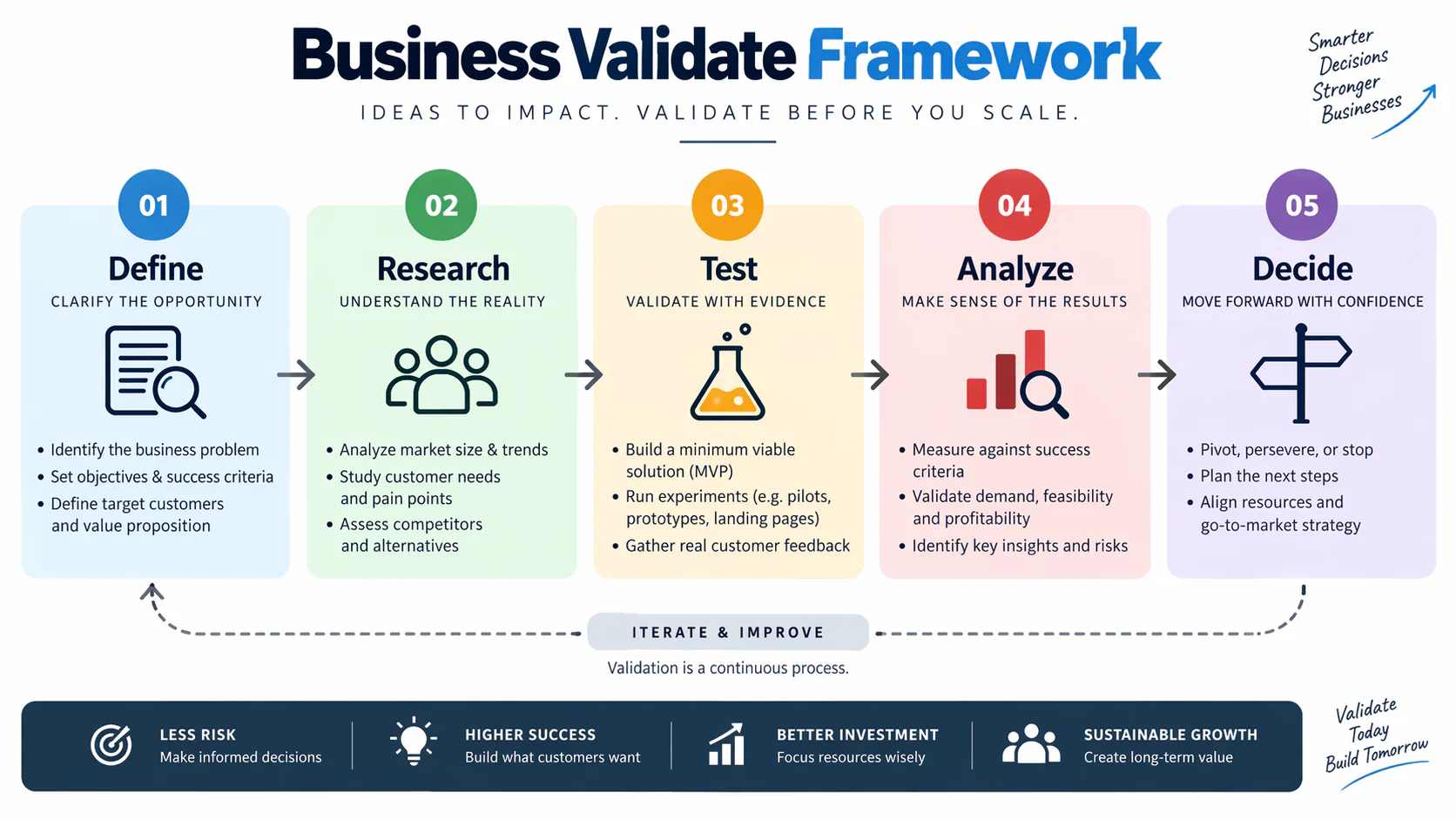
Explore the Business Validation Framework to validate ideas before scaling. Learn how to Define, Research, Test, Analyze, and Decide with minimal risk.
Before splitting into business-specific paths, run every idea through this five-step spine. It applies whether you’re selling candles from your kitchen, launching a SaaS tool, or offering bookkeeping services.
Step 1: Write the Problem in One Sentence — Without Your Solution
Force yourself to describe the problem, not your product idea. For example:
- “I want to sell a subscription box of eco-friendly cleaning supplies.”
- “Busy parents don’t have time to research which cleaning products are actually non-toxic.”
If you can’t state the problem without mentioning your product, you may be solving something that doesn’t exist yet.
Step 2: Find a 15-20 Real People Who Have That Problem
Not friends. Not family. Real strangers who match your future customer.
Sources that cost nothing:
- Facebook Groups and subreddits where your audience already complains
- Local community groups (Nextdoor, WhatsApp neighborhood groups) for home-based and service ideas
- LinkedIn, for B2B or service-based ideas
- Comment sections and reviews of competing products (read the 2-star and 3-star reviews — that’s a goldmine of unmet needs)
Business.gov.uk specifically recommends going beyond friends and family and speaking with people who represent your future customers.
Aim for roughly 15–20 meaningful conversations as an initial discovery round rather than trying to survey hundreds of random people.
Recent validation frameworks commonly recommend this range as a practical starting point.
Step 3: Research the Market Without Spending Money
Before creating anything, become a detective.
Look for evidence that people are actively searching for, discussing, complaining about, or paying for solutions.
Explore:
- Google search results
- Reddit discussions
- Facebook groups
- LinkedIn conversations
- YouTube comments
- Product reviews
- Competitor reviews
- Online marketplaces
- Industry forums
- Q&A websites
- Search suggestions
Don’t just look for people saying:
“That’s a cool idea.”
Look for statements such as:
- “I can’t find a good solution.”
- “This takes me hours every week.”
- “I’ve tried three different tools.”
- “Why is this so expensive?”
- “I wish someone would…”
- “Does anyone know how to…?”
- “I’m tired of doing this manually.”
Complaints are often more valuable than compliments.
Recent entrepreneur discussions reinforce this problem-first approach: founders report searching communities for people actively describing frustrations rather than simply asking whether a proposed solution sounds interesting.
Step 4: Ask About the Past, Not the Future
Skip “Would you buy this?” Nobody answers that honestly — it costs them nothing to say yes.
Ask instead:
“Tell me about the last time this problem actually happened to you. What did you do about it?”
If they struggle to recall a specific, recent example, the problem probably isn’t painful enough to build a business around.
Step 5: Study Your Competitors Before Building
Competition can tell you a tremendous amount.
Create a simple competitor spreadsheet.
| Competitor | Offer | Price | Target Customer | Strength | Weakness |
|---|---|---|---|---|---|
| Competitor A | Product/service | $X | Audience A | Strong brand | Expensive |
| Competitor B | Product/service | $X | Audience B | Cheap | Limited features |
| Competitor C | Product/service | $X | Audience C | Convenient | Poor support |
Then read customer reviews.
Especially read the 2-star and 3-star reviews.
Why?
Because five-star reviews tell you what customers love.
Lower-rated reviews tell you what customers still want fixed.
That can reveal your opportunity.
Step 6: Get a Real Commitment, Not a Compliment
The single biggest validation mistake is confusing enthusiasm with intent to pay. Rank commitment signals from weakest to strongest:
- “That’s such a good idea!” (weakest — ignore this)
- Filling out a survey
- Giving you their email for a waitlist
- Sharing your landing page with someone else
- Pre-ordering or paying a deposit (strongest — this is real validation)
Your goal at every stage is to push people up this ladder, not just collect compliments at the bottom.
Step 7: Look for Repeated Patterns
One person saying your idea is brilliant proves almost nothing.
But if 12 people independently describe:
- The same problem
- Similar frustrations
- Similar existing solutions
- Similar spending behavior
- Similar desired outcomes
you’ve discovered a pattern.
That’s much more valuable.
Create a simple research table:
| Person | Problem | Current Solution | Cost | Frustration | Buying Signal |
|---|---|---|---|---|---|
| 1 | ✓ | ✓ | $ | High | Strong |
| 2 | ✓ | ✓ | $ | High | Medium |
| 3 | ✓ | — | — | Medium | Weak |
Patterns become your evidence.
Step 8: Sell the Service Before Building the System
This is particularly powerful for service and online businesses.
Suppose you want to create an automated content-writing platform.
Don’t build the platform first.
Instead, offer:
Do the work manually.
If customers pay, you’ve validated part of the business.
Later, you can automate the repetitive parts.
This is often called a concierge MVP: the customer receives the intended outcome while you perform much of the work manually behind the scenes.
It’s a powerful approach because you validate the result customers want, rather than prematurely investing in the technology required to deliver it.
Step 9: Use a “Smoke Test” Before Building
A smoke test is a small experiment designed to determine whether there is enough interest to justify further work.
For example, imagine you want to launch a premium meal-prep service.
Before:
- Renting a kitchen
- Buying equipment
- Hiring staff
- Designing packaging
- Purchasing inventory
you could create a simple offer:
Healthy Weekly Meal Prep for Busy Professionals
Then show the offer to people who fit your target market.
Measure:
- How many respond?
- How many ask questions?
- How many request pricing?
- How many book?
- How many place an order?
You’re testing demand before infrastructure.
Step 10: Validate Your Price Before You Validate Your Logo
Entrepreneurs often spend hours deciding:
- Logo colors
- Fonts
- Business names
- Website themes
- Packaging
- Brand slogans
Meanwhile, they don’t know whether anyone will pay $20, $200, or $2,000.
That’s backwards.
Your early validation should focus on:
Not:
You can redesign a logo later.
It’s much harder to recover from spending thousands on a business nobody wants.
Real-World Proof: Companies That Validated Before They Built
These aren’t hypotheticals. Some of today’s biggest companies started with a validation test almost identical to the ones above.
1. Dropbox tested demand with a video, not a product. Before writing the file-syncing software, founder Drew Houston recorded a simple 3-minute video showing how the product would work and posted it to a tech community, with a waitlist link at the bottom. The beta waitlist jumped from about 5,000 to 75,000 sign-ups in a single day — proof that the problem was real and the demand was large, before a single feature was fully built.
2. Airbnb validated with air mattresses, not an app. When a design conference sold out every hotel in San Francisco, the founders put air mattresses in their own apartment and offered them up. Strangers actually paid to stay. That one small, manual test validated the core assumption the entire company was built on: that people would pay to stay in someone else’s home.
3. Buffer validated with two web pages, not a working app. Before building the scheduling tool, Buffer’s founder created a simple landing page describing the idea, followed by a second page showing pricing plans once someone clicked through. Tracking how many visitors clicked “Plans and Pricing” told him whether people were seriously interested — all without a single line of app code written.
The pattern across all three: a cheap, fast test replaced months of building, and the market’s reaction — not a hunch — decided what happened next.
Now Choose Your Path: Validation Differs by Business Type
This is where most guides stop — with one generic checklist for every business. But validating a home-based candle business is nothing like validating an online SaaS tool, and neither resembles validating a local pet-grooming service. Here’s how each one actually works.
1. How to Validate a Home-Based Business
Home-based businesses (baking, crafts, resale, home daycare, tutoring, product-based side hustles) live or die on local demand and word of mouth before they ever need a website.
What to test first:
- Kitchen-table pre-sales. Post 3–5 photos of your product in local Facebook groups or on your personal profile with a price and a simple “DM me to order” — before you’ve made a single unit beyond a sample.
- Farmers markets and pop-ups as free market research. One weekend at a local market tells you more about pricing and demand than weeks of guessing. Note what sells, what people ask about but don’t buy, and the price objections you hear repeatedly.
- Neighborhood app tests. Nextdoor and community WhatsApp groups let you gauge interest from people who could realistically become recurring customers, since proximity matters for home-based models.
Red flags specific to home-based ideas:
- People say “that’s so cute” but nobody asks the price — enthusiasm without commercial curiosity is a warning sign.
- You only get interest from people who already know you personally.
- The math doesn’t work at a price people will actually pay (calculate your true cost per unit, including your time, before you sell a single item).
Validation checklist for home-based businesses:
- Sold at least 5–10 units to strangers (not friends/family) at your intended price
- Identified a repeatable channel where buyers found you (not a one-off fluke)
- Confirmed your price covers materials, time, and a real margin
2. How to Validate an Online Business (E-commerce, Digital Products, SaaS, Content)
Online businesses can scale fast, but they can also burn cash fast on ads, inventory, and development. Validation here is about proving digital demand before digital investment.
What to test first:
- A one-page “smoke test” site. Build a free landing page (Carrd, Google Sites, or a single Canva-to-web export) describing the product and a “Join the Waitlist” or “Pre-order” button. You’re testing whether the offer converts before the product exists.
- Organic-only traffic first. Share the link in relevant subreddits, Facebook groups, and your own network with zero ad spend. If organic traffic converts to sign-ups at even 2–5%, that’s a real early signal.
- “Concierge MVP” for digital services or SaaS. Manually deliver the outcome your software would eventually automate — a spreadsheet, a template, a one-on-one session — to your first 5–10 customers before writing a line of code.
- Pre-sell digital products. For courses, ebooks, or templates, sell access to a waitlist price before the final product is finished. If nobody pre-orders at a discount, full price won’t fare better.
Red flags specific to online ideas:
- Traffic arrives but nobody clicks the call-to-action — the problem or offer isn’t compelling as stated.
- Sign-ups happen, but open rates on your follow-up emails are near zero — people gave you their email out of politeness, not genuine interest.
- You need paid ads just to get anyone to notice the landing page at all — that’s a signal to sharpen the offer, not to spend more.
Validation checklist for online businesses:
- Landing page live and shared in at least 3 relevant online communities
- Measurable conversion rate from visits to email sign-ups or pre-orders
- At least 5 people took a real action (paid, pre-ordered, or completed a manual “concierge” version)
3. How to Validate a Service-Based Business
Service businesses (consulting, coaching, freelancing, agencies, home services, professional services) validate differently because the “product” is often you and your time. The good news: this is the cheapest business type to validate, because you can test with real clients almost immediately.
What to test first:
- The “one paid client” test. Before building a website, a brand, or a pricing page, find one real client willing to pay you — even a reduced “founding client” rate — for the exact outcome you plan to offer.
- Direct outreach over advertising. Message 20–30 people in your target market directly (LinkedIn, email, local business groups) offering to solve their specific problem. This tests demand without spending on marketing.
- Package the service as a mini-offer. Instead of “I offer social media management,” test with “I’ll manage your Instagram for 2 weeks and show you the results — $150.” A smaller, specific offer is easier to say yes to and easier to validate.
- Ask why they’d choose you over their current option (an agency, a freelancer, doing it themselves). If you can’t answer this clearly, your positioning needs work before you scale outreach.
Red flags specific to service ideas:
- Prospects want free advice repeatedly but resist a paid engagement — that usually signals a “nice-to-have,” not a funded priority.
- Everyone you talk to has a different, vague version of the problem — the offer isn’t specific enough yet.
- You’re the only one who thinks the price is fair; every prospect negotiates it down significantly.
Validation checklist for service businesses:
- At least 1–3 paying clients secured through direct outreach (not referrals from friends)
- A repeatable pitch or offer that consistently gets a “yes, let’s talk pricing” response
- Clarity on why clients choose you over the alternative they’re already using
4. Validating a SaaS Business Idea
Validating a SaaS ideas are the riskiest to validate because the build cost is high and invisible until it’s too late — you can burn months of development before finding out nobody wants to switch tools. Validation here isn’t about proving people like the concept; it’s about proving they’ll actually change their workflow for it.
What to test first:
- The “concierge MVP” test. Manually deliver the exact outcome your software would eventually automate — using spreadsheets, templates, or a manual process — for 3–5 real customers before writing any code.
- A pricing page before a product page. Build a landing page with real feature tiers and prices, not just a vague description. Track how many visitors click “Subscribe” or “Start Trial” — that click is your signal, not the visit itself.
- Pre-sell an annual plan. Offer early access at a discounted annual rate before the product exists. If nobody will commit to a year upfront at a discount, monthly pricing won’t save the idea.
- Ask about their current stack, not their opinion. Find out exactly what tool, spreadsheet, or workaround they use today, and what it would take to get them to switch. “I’d try it” is not the same as “I’d migrate my data over.”
Red flags specific to SaaS ideas:
- People say they’d use it “if it were free,” but hesitate the moment a subscription price appears.
- Interest is high, but nobody can name a real reason to leave the tool they already use.
- Sign-ups accumulate, but almost nobody completes onboarding or activates the core feature during a trial.
Validation checklist for SaaS ideas:
- 3–5 design partners actively using a manual or “Wizard of Oz” version of the product
- At least 1 person willing to pre-pay before the product is fully built
- A confirmed, specific reason prospects would switch from their current tool
The Free Toolkit: Validate Without Spending a Dollar
| Tool | Best For | Cost |
|---|---|---|
| Google Forms / Typeform (free tier) | Structured customer questions | Free |
| Carrd / Google Sites | One-page landing page tests | Free |
| Reddit & Facebook Groups | Finding real prospects and pain points | Free |
| Google Trends | Checking search demand over time | Free |
| Instagram/Facebook DMs | Direct outreach for pre-sales or interviews | Free |
| Canva | Mockups, sample designs, ad creative for tests | Free |
| Existing competitor reviews | Finding unmet needs (2–3 star reviews) | Free |
Validate Your Customer Acquisition Channel
Here’s a question many entrepreneurs forget:
Even if people want your product, can you actually reach them?
Imagine there are 100,000 potential customers.
Great.
But what if:
- They are extremely expensive to reach?
- You don’t know where they spend time?
- Competitors dominate every channel?
- They don’t respond to your marketing?
- Your sales cycle takes six months?
The market may exist, but your business may still struggle.
Test at least one realistic acquisition channel.
For example:
- Direct outreach
- Search
- Referrals
- Local networking
- Communities
- Partnerships
- Social media
- Marketplaces
- Content marketing
A validated customer who can be reached is far more valuable than an imaginary customer in a giant market.
Create Your Validation Scorecard
Don’t rely entirely on feelings.
Create a simple scorecard.
| Validation Question | Evidence | Score |
|---|---|---|
| Is the problem real? | Customer interviews | 0–5 |
| Is the problem painful? | Existing spending | 0–5 |
| Is the customer identifiable? | Clear audience | 0–5 |
| Are customers actively looking for solutions? | Search/community research | 0–5 |
| Are competitors making sales? | Existing market | 0–5 |
| Will people pay? | Pre-sale/pilot | 0–5 |
| Can you reach them? | Tested channel | 0–5 |
| Can you deliver profitably? | Basic economics | 0–5 |
You don’t need a magical score.
The purpose is to force yourself to distinguish evidence from enthusiasm.
Set Your “Go, Pivot, or Stop” Rule Before Testing
This is one of the most important additions to a good validation process.
Decide beforehand what results would change your decision.
For example:
GO
- Multiple customers describe the same problem.
- At least a few show serious buying intent.
- One or more people pay for a pilot.
- You can explain how to reach similar customers.
- Basic economics look viable.
PIVOT
- The problem is real but your solution isn’t attractive.
- Customers want a different outcome.
- Your target customer is wrong.
- The price is wrong.
- Another segment shows stronger demand.
STOP
- Target customers don’t experience the problem.
- Nobody cares enough to act.
- Nobody is willing to pay.
- Acquisition appears unrealistic.
- Delivery economics don’t work.
This prevents you from moving the goalposts every time your experiment produces disappointing results.
The One-Sentence Validation Test
Before launching any business, complete this sentence:
“I believe [specific customer] will pay [specific amount] for [specific solution] because [specific painful problem]. I will test this by [specific experiment] and consider it validated if [specific measurable result].”
For example:
“I believe small ecommerce businesses will pay $300 per month for done-for-you email marketing because they struggle to generate repeat purchases. I will test this by offering a paid pilot to 20 ecommerce owners and consider the idea validated if at least three agree to pay.”
Now you aren’t simply dreaming about a business.
You’re running an experiment.
The 14-Day Zero-Dollar Validation Sprint
Everything above is the theory. Here’s the same process compressed into a two-week sprint you can run starting today, with no budget required.
| Days | Phase | What You Do | What It Tests |
|---|---|---|---|
| 1–2 | Write the hypothesis | Document your target customer, the problem, how they currently solve it, your proposed fix, your expected price, and the single riskiest assumption behind the idea | Forces clarity before you talk to a single stranger |
| 3–4 | Study the existing market | Read competitors, reviews, Reddit threads, forums, search results, and social conversations around the problem | Surfaces the exact words real customers already use — and whether alternatives exist |
| 5–7 | Hold real conversations | Talk to 10–20 potential customers. Don’t pitch your idea — ask how they handle the problem today and listen for repeated patterns | Confirms the pain point is common, not personal to one person |
| 8–9 | Build a minimum offer | Create the simplest possible version: a landing page, a service offer, a prototype, a pre-order page, a workshop, or a consultation slot | Gives people something concrete to react to instead of a hypothetical |
| 10–12 | Ask for real commitment | Reach out to your closest-fit prospects and ask them to book, pre-order, pay, pilot, sign up, or reserve a spot | Separates genuine intent from polite interest |
| 13–14 | Read the evidence | Count how many people acted — not how many people said they liked the idea | Produces a clear decision: Go, Pivot, or Stop |
The rule that makes this sprint work: at every stage, action outranks opinion. A booked call, a pre-order, or a paid pilot is evidence. A compliment is not.
By day 14, you’ll have a decision backed by real behavior — not two weeks further into a guess.
Common Validation Mistakes (Across All Business Types)
- Validating with people who love you, not your idea. Friends and family are biased and rarely represent your real market.
- Asking hypothetical questions. “Would you buy this?” gets you polite lies. Ask about past behavior instead.
- Treating enthusiasm as proof. Compliments are free. Payments are evidence.
- Building the “minimum” product for months. If your MVP takes longer than a couple of weeks, it’s stopped being minimal.
- Ignoring existing competitors. No competition often means no market — not a hidden opportunity.
- Stopping after one “yes.” One interested person is a data point, not a trend. Look for a repeatable pattern across several people before you trust it.
How Much Validation Is “Enough”? A Simple Scorecard
Before spending real money, you should be able to check off at least 4 of these 5:
- 10+ people independently described the same problem in similar terms
- At least 3–5 people took a real action (paid, pre-ordered, or used a manual version)
- You found at least one existing competitor or workaround already being paid for
- You can explain your “20% better” — what makes your version worth switching to
- Your numbers work: even a rough price × likely volume covers your time and costs
If you’re at 2 or fewer, that’s not a failure — it’s the validation process doing its job. Adjust the problem, the audience, or the offer, and test again before spending anything.
FAQs: Validating a Business Idea
How many people should I talk to before validating a business idea? There’s no magic number, but a dozen or so real conversations is usually enough to spot a pattern. If the same complaint keeps surfacing by conversation seven or eight, you’ve likely found something real — the remaining conversations are there to rule out coincidence, not to hit a quota.
What’s the fastest way to validate a business idea with no money? Direct outreach paired with a free landing page or a simple pre-sale post is the fastest zero-cost method. It takes days, not weeks, and gives you a real conversion signal instead of an opinion.
Is a business plan the same as validation? No. A business plan documents your strategy; validation tests whether the core assumptions in that plan are actually true. Validate first, then write the plan around what you’ve proven — not the other way around.
Can I validate a business idea if I have zero audience or followers? Yes. Communities you don’t own — relevant subreddits, Facebook groups, local groups, and direct outreach — let you reach real prospects without needing your own following first.
What if people say they love the idea but won’t pay? Treat this as your real answer. Enthusiasm without payment usually means the problem isn’t painful enough yet, the price is wrong, or you’re talking to the wrong audience. Revisit the problem statement before changing the product.
The Bottom Line
Validation isn’t about being cautious or slow — it’s about being deliberate with the two resources you can never get back: time and money.
You don’t need to eliminate all risk before starting a business.
That’s impossible.
Whether you’re launching from your kitchen table, building an online storefront, or offering your skills as a service, the underlying test is the same: can you get a stranger to take a real action — not just say something nice — before you’ve spent a single dollar?
If the answer is yes, you’ve earned the right to invest further. If it’s no, you’ve just saved yourself months of effort finding that out the hard way.