

Starting a business is one of the most exciting — and terrifying — decisions a person can make. You’re trading the safety of a paycheck for the uncertainty of building something from nothing. You’re betting your time, your savings, and sometimes your sanity on an idea that might not work.
Learning how to start a business means accepting risk up front, not avoiding it.

Learn how to start a business that attracts loyal customers and lasting success.
And yet, millions of people do it every year.
Some fail fast.
Some fail slowly.
And some build companies that change their lives, their families’ lives, and sometimes entire industries.
This step-by-step business startup guide exists because most “how to start a business” articles online are shallow. They give you a five-step checklist, tell you to “write a business plan” and “just believe in yourself,” and call it a day.
That’s not enough.
Starting a real, sustainable business requires understanding dozens of moving parts — legal, financial, psychological, operational, and strategic — and how they connect.
The internet has made it easier than ever to launch a business. You no longer need a large office, a big team, or a huge amount of capital to get started. Many successful companies began with a simple idea, a laptop, and the determination to solve a real problem.
This is a complete roadmap for those who are willing to build a profitable business.
Table of Contents
Key Takeaways for Starting a Business
- Validate your business idea: Make sure your idea solves a real problem and that people are willing to pay for the solution.
- Research your market: Understand your target customers, competitors, pricing, demand, and opportunities before investing heavily.
- Choose your business model: Decide how your business will generate revenue, whether through products, services, subscriptions, retainers, or another model.
- Create a practical business plan: Keep your initial plan simple and focused on your customers, offer, costs, revenue, and short-term goals.
- Select the right legal structure: Choose a structure that fits your risk level, ownership situation, tax considerations, and growth plans.
- Separate business finances: Open a dedicated business bank account and keep personal and business money separate from the beginning.
- Plan your startup finances: Estimate your costs, determine how you’ll fund the business, create a budget, and set sensible prices.
- Register and handle legal requirements: Complete the necessary business registration, licenses, permits, tax requirements, and other legal obligations.
- Build a strong brand: Define what your business promises customers before spending too much time or money on logos and website design.
- Set up efficient operations: Create simple systems for delivering your product or service, managing customers, tracking finances, and handling daily tasks.
- Market your business and find customers: Focus on practical marketing channels, build relationships, earn your first customers, and encourage referrals.
- Launch, learn, and scale: Start with a workable version, collect customer feedback, improve continuously, and expand only when your business has proven demand.
Not every business has to start from scratch. If you already enjoy a skill or craft, consider turning your hobby into a side business before going all in. It’s a low-risk way to test demand, build experience, and validate your idea with real customers first.
What Is a Business?
A business is any organization or activity built around one goal: delivering value that customers are willing to pay for. Whether it’s a corner coffee shop or a multinational tech firm, every business exists to solve a problem, meet a need, or fulfill a desire by offering products or services in exchange for revenue.
- What is a Business? A Beginner’s Guide
- 30 Reasons to Start Your Business Today
- How to Start a Service Business From Home – A Complete Guide
Behind every thriving business lies three foundational questions:
- What problem am I solving? — Identifying a genuine pain point or need.
- Who am I solving it for? — Defining a clear, specific audience.
- Why should they pick me? — Establishing a compelling reason to choose your offering over competitors.
Business size and industry vary wildly, but the formula stays constant: create real value, communicate it clearly, and deliver it consistently. Master that equation, and you have the blueprint for a business built to last.
According to the latest data from the U.S. Small Business Administration, the United States is home to more than 36.2 million small businesses, and 99.9% of all U.S. businesses qualify as small businesses under the federal definition of having fewer than 500 employees.
Together, these businesses employ over 62 million Americans and contribute significantly to the nation’s economy.
Their remarkable presence underscores why learning how to start a business with no investment remains one of the most valuable skills for aspiring entrepreneurs and business owners.
How to Start a Business? The Blueprint
Starting a business comes down to five non-negotiable moves:
- Validate a real problem worth solving
- Choose a legal structure
- Secure enough money to survive the first year
- Register everything properly
- Get your first paying customer before you obsess over logos and office chairs.
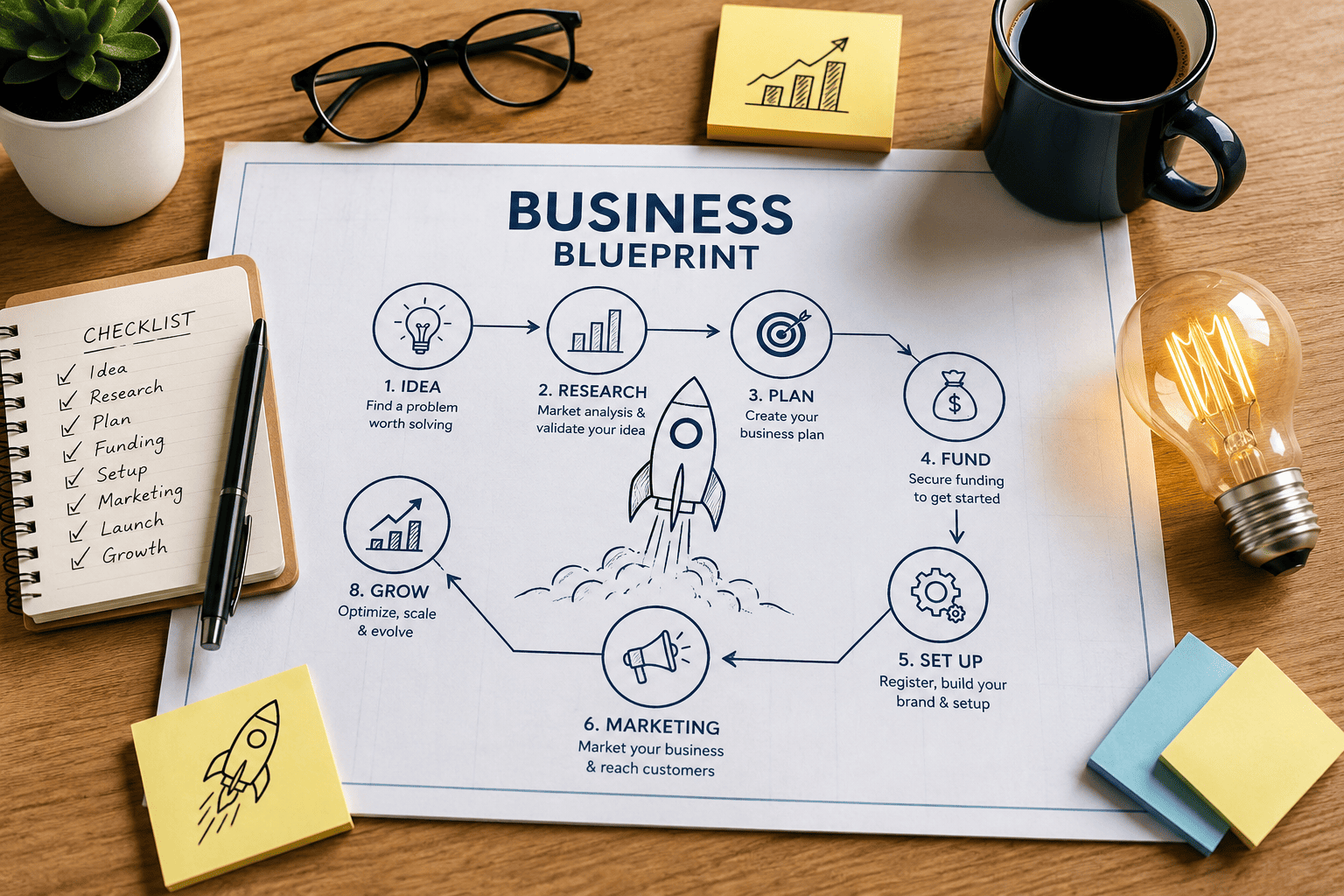
Learn how to start a business that attracts loyal customers and lasting success.
That’s it.
Everything else — the funnels, the branding decks, the “10x your growth” webinars — is noise until those five things are locked in.
This guide walks through each stage in order, the way you’d actually experience it if you sat down today and decided to build something.
No filler, no recycled advice you’ve read a hundred times.
Just the blueprint, built from what actually works when you’re starting a small business with limited time, limited cash, and a limited appetite for risk.
By the end, you’ll know exactly what to do this week, this month, and this year — and what to ignore until later.
What “Starting a Business” Actually Means Before You Write a Single Word
Most people treat “how to start a business” like it’s one giant leap. It isn’t.
It’s a sequence of small, boring, repeatable decisions.
You’re not launching a company the day you get an idea. You’re launching it the day someone pays you money for a product or service, and you deliver on that promise.
Everything before that point — the planning, the naming, the paperwork — exists to make that first transaction possible and repeatable.
Keep that definition close. It’ll save you from the trap that kills more startups than bad ideas ever do: spending months preparing instead of weeks testing.
Three things separate people who successfully start a business from people who talk about it for years:
- They pick a specific problem, not a vague industry.
- They test the idea with real money before building anything elaborate.
- They treat the first version of the business as a rough draft, not a final product.
Hold onto those three points. They show up again and again through the rest of this guide.
Think about the businesses you interact with every week — the coffee shop on your corner, the freelancer who redesigned a friend’s website, the local plumber.
None of them started with a perfect plan.
They started with one customer, one delivered promise, and a decision to keep going.
The 12-step blueprint below organizes the same messy, real process into a deliberate sequence you can follow, rather than stumbling through it.
Step 1: Find and Validate a Business Idea That Actually Works
Every business tips list starts with “find your passion.”
Skip that advice.
Passion helps you survive hard days, but it doesn’t tell you whether anyone will pay for what you’re selling.
A working business idea sits at the intersection of three things:
- A problem people already spend money trying to solve
- A gap in how that problem is currently being solved
- Something you can deliver consistently, at a price that covers your costs
Where Real Business Ideas Come From
Forget brainstorming sessions with sticky notes. The best business ideas tend to come from one of four places:
- Your own frustration. You needed something and couldn’t find a good version of it.
- Your current job. You’ve watched a company waste time or money on a process you know how to fix.
- A shift in behavior. People are suddenly doing something differently (working remotely, cooking at home more, buying secondhand), and the old options don’t fit anymore.
- A local gap. Your town or neighborhood is missing a service that exists everywhere else.
None of these require genius-level insight. They require paying attention.
Validating a Business Idea Before You Spend a Dollar
Cutting corners on validation is how six months of work turns into a product nobody wanted. Before you spend real time or money, run the idea through a fast gut-check.
- Start by writing the problem down in one specific sentence — not “people want convenience,” but exactly who’s affected and what’s actually missing for them.
- Then find real strangers in that group and ask what they currently do about it, not whether they like your idea.
- Look for proof people are already paying for a rough version of the same fix; silence in the market is a warning, not open space.
Next, build the smallest test you can — a waitlist, a pre-order link, or simply doing the work by hand for a few people.
Decide your “go” number before you start, so you’re not tempted to move it later.
Want the full breakdown by business type — home-based, online, and service? See the complete step-by-step guide →
Choosing the Right Type of Business
Once your idea is validated, decide how the business will actually make money on an ongoing basis. The type you choose shapes almost everything downstream — your pricing, your cash flow, and even your day-to-day workload.
- One-time sale model. You sell a product or service once per customer (a handmade item, a one-off consulting project). Simple to understand, but requires constant new customer acquisition to keep revenue flowing.
- Subscription or membership model. Customers pay repeatedly for ongoing access (a monthly box, a membership community, software). Harder to launch, but far more predictable once it’s running, since revenue doesn’t reset to zero every month.
- Service-retainer model. A client pays you a set fee each month for ongoing work (marketing retainers, bookkeeping, maintenance contracts). Blends the simplicity of services with some of the predictability of subscriptions.
- Product-Based Business Model. This model involves selling physical goods, whether you manufacture them yourself or source them from suppliers and wholesalers. Product businesses can scale well but typically demand more upfront investment in inventory, storage, and logistics.
- Marketplace or commission model. You connect buyers and sellers and take a cut of each transaction. Powerful at scale, but usually requires more upfront traffic or trust-building before it works.
- Franchise. Franchising allows you to run a business under an established, recognizable brand using its proven systems and operational playbook. This route reduces some of the guesswork of starting from scratch, though it usually comes with franchise fees and less creative control.
- Hybrid model. Many small businesses combine a core offer with an upsell — a one-time product paired with a subscription refill, or a project fee paired with an ongoing retainer.
There’s no universally “best” model — only the one that matches your customer’s buying habits and your own appetite for predictable-but-slower versus faster-but-choppier revenue.
Business Models Explained: Which One Fits Your Big Idea?
A brilliant idea can still fail with the wrong business model behind it. Your model determines how you make money, what you spend on, and how fast you can scale — so it deserves as much thought as the idea itself.
- What Is a Business Model? Types and Real-World Examples
- How to Create a Business Model For Your New Venture
Here’s a quick look at popular models entrepreneurs use today:
- Retail – Selling products directly to consumers, typically through physical stores.
- Wholesale – Selling in bulk to retailers at discounted rates.
- Subscription – Recurring revenue in exchange for ongoing access or delivery.
- SaaS (Software as a Service) – Cloud-based software sold via subscription.
- Marketplace – Connecting buyers and sellers on one platform (think Etsy or Airbnb).
- Dropshipping – Selling products without holding inventory yourself.
- Manufacturing – Producing goods at scale for sale or distribution.
- Consulting – Monetizing expertise through advice and strategy.
- Agency – Delivering ongoing services like marketing or design for clients.
- Affiliate Marketing – Earning commissions by promoting others’ products.
- Membership – Charging for exclusive community access or perks.
- Licensing – Earning royalties by letting others use your IP.
- Advertising – Generating revenue by selling audience attention.
- E-commerce – Selling products online across any niche.
- Direct-to-Consumer (DTC) – Skipping middlemen to sell straight to customers.
Every model comes with its own blend of startup costs, scalability, and risk — there’s no universal “best” choice, only the best fit for your resources and goals.
Popular Business Ideas Worth Considering Right Now
If you’re still searching for the right idea, look at categories where demand has stayed strong regardless of economic swings. None of these are guaranteed wins on their own — they’re starting points for your own research and validation work.
- 12 Easy Business Ideas for Women That Actually Pay
- 25 Business Ideas Without Investment to Start Today
Service-based business ideas:
- Freelance writing, design, or marketing consulting
- Bookkeeping or tax prep for small businesses
- Home organizing, cleaning, or handyman services
- Virtual assistant work for busy founders and small teams
- Personal training, nutrition coaching, or tutoring
Product-based business ideas:
- Niche e-commerce built around a specific hobby or lifestyle
- Handmade or small-batch goods sold through online marketplaces
- Subscription boxes built around a tightly defined audience
- Print-on-demand or dropshipping for testing product-market fit cheaply
Local business ideas:
- Food trucks or specialty food stands
- Pet services — walking, grooming, boarding
- Childcare or after-school programs
- Repair services (phones, bikes, small appliances)
Here’s the pattern: none of these are new inventions. They’re proven demand delivered better, faster, cheaper, or more personally than existing options.
That’s the real lesson in how to start a business the smart way — improve on something people already buy, rather than betting everything on inventing a category from scratch.
Step 2: Research Your Market and Know Your Competition
Once your idea survives real conversations, it’s time to zoom out.
Market research sounds like a corporate exercise, but at the small-business level it’s really just answering three questions with real data instead of guesses.
Who exactly is your customer? Not “everyone who needs coffee.” Something closer to “commuters within a 10-min:
| What to Check | Why It Matters |
|---|---|
| Their pricing | Tells you what customers already accept paying |
| Their reviews (especially 2–3 star ones) | Reveals exactly where they disappoint people |
| Their marketing channels | Shows you where their customers actually hang out |
| Their gaps in service or product | Becomes your opening |
Read the negative reviews of your top three competitors closely. That single habit will teach you more about your market than any expensive research report.
Why Market Research Matters
Think of market research as a roadmap before starting a long journey. It helps you avoid costly mistakes and shows you the best path to reach your business goals.
Here are some of the biggest benefits of conducting market research:
- Understand customer needs before creating products or services.
- Identify profitable opportunities that competitors may have overlooked.
- Reduce business risks by validating your ideas with real data.
- Set competitive prices based on customer expectations and market trends.
- Improve products and services using customer feedback.
- Analyze competitors to discover their strengths and weaknesses.
- Predict market demand and prepare for future changes.
- Invest with greater confidence by making informed business decisions.
Build a Simple Customer Persona
You don’t need an elaborate marketing document here — just enough clarity to make decisions faster later. Write down:
- Their age range, general life stage, and daily routine
- The specific moment they realize they need what you offer
- Where they currently look for solutions (Google, a friend’s recommendation, social media, a local shop)
- What would make them hesitate to buy, and what would push them over the edge
Keep this persona somewhere visible. Every marketing message, every pricing decision, and every product tweak should be checked against it. When in doubt, ask: “Would this specific person care about this?” If the answer is no, it’s probably not worth your time yet.
Should You Start a Business Alone or With a Co-Founder?
This question rarely gets asked early enough, and it shapes almost every decision that follows. Neither path is objectively better — they just carry different tradeoffs.
Starting solo gives you full control over decisions and full ownership of the upside. It’s simpler legally, since there’s no need to negotiate equity splits or roles. The tradeoff is that you carry every responsibility yourself — sales, delivery, admin, marketing — which can slow growth and lead to burnout if you don’t manage your workload carefully.
Starting with a co-founder splits the workload and often brings complementary skills to the table — one person handles the product or service delivery, the other handles sales and operations. The tradeoff is real: partnerships require constant communication, and a mismatch in effort, vision, or values can sink a business faster than almost any external market problem.
If you do bring on a co-founder, put a few things in writing before you start, even if you trust the other person completely:
- Who owns what percentage, and why
- What happens if one person wants to leave
- How decisions get made when you disagree
- How money gets split, and when
A handshake feels sufficient right up until it doesn’t. The written agreement isn’t a sign of distrust — it’s what protects the relationship when the business gets stressful, which it eventually will.
Online Business vs. Brick-and-Mortar: Which Fits You?
Not every business needs a physical location, and not every business can avoid one.
Matching your model to the right format early saves you from expensive backtracking.
- Online and remote businesses tend to offer lower startup costs, faster testing cycles, and the ability to reach customers beyond your immediate area. They fit well for service providers, digital products, consulting, coaching, and many e-commerce models. The tradeoff is more competition, since customers can compare you against options worldwide with a single search.
- Brick-and-mortar businesses — retail shops, restaurants, local services with a physical footprint — benefit from local trust, walk-in visibility, and less direct global competition. The tradeoff is significantly higher fixed costs: rent, utilities, staffing, and inventory all add financial pressure before you’ve proven demand.
- A hybrid approach often works best for beginners: start with a lower-cost, more flexible version of the business (online, from home, or mobile) and only add the overhead of a physical location once demand is proven and predictable. Plenty of thriving retail and restaurant businesses started as a market stall, a pop-up, or an online-only operation before committing to a lease.
Step 3: Write a Business Plan You’ll Actually Use
Most people picture a 40-page business plan stuffed with charts nobody reads twice. That version exists mainly to satisfy banks and investors — not to help you run your business.
If you’re bootstrapping or starting small, skip it for now. You need a plan you’ll actually reread and update, not one you write once and forget.
Lean Business Plan vs. Traditional Business Plan
A lean plan fits on a single page. It forces clarity instead of padding, and it covers:
- The problem you’re solving
- Your solution and what makes it different
- Who your customer is
- How you’ll reach them
- How you’ll make money
- Your core costs
- Key milestones for the next 90 days
A traditional plan goes deeper — financial projections, full market analysis, an executive summary. It’s the right tool if you’re pursuing a bank loan or outside investors. For simply testing an idea, it’s overkill.
Start Lean, Expand Later
Here’s the rule worth remembering as you learn how to start a business without drowning in paperwork before you’ve made a single sale:
- Start lean. One page. Real clarity, zero fluff.
- Expand only when asked. If a lender or investor wants deeper numbers, build that version then — not before.
- Treat the plan as a living document, not a diploma to frame and forget.
Revisit It Often
Set a recurring reminder to revisit your plan every 30 days for the first six months.
Markets shift. Customers surprise you. Competitors change their pricing. A plan that isn’t updated stops being a working tool — it becomes a museum piece, interesting to look at but useless for making decisions.
The goal isn’t a perfect document. It’s a current one.
A one-page plan you update monthly will guide more real decisions than a polished 40-pager sitting untouched in a drawer. Keep it short, keep it honest, and keep coming back to it as your business — and your understanding of it — grows.
Step 4: Choose the Right Legal Structure for Your Business
Before you take your first payment, you need an answer to one question: who is legally on the hook if something goes wrong?
Your legal structure decides that. It also shapes your taxes, your paperwork load, and how easy it is to raise money later.
Get it right now — switching structures mid-stream costs real time and real money.
1. Sole Proprietorship: The Default Option
If you do nothing, this is what you become automatically. It’s the path of least resistance, but it comes at a cost.
- Zero setup required — you’re already operating as one the moment you make a sale
- No separation between you and the business — your car, your house, your savings are all exposed if a client sues or a debt goes unpaid
- Best suited for testing a low-risk side hustle, not a business handling real money or real liability
Think of it as a free trial with no safety net. Fine for dipping a toe in. Risky the moment things get serious.
2. Limited Liability Company (LLC): The Small Business Standard
For most people learning how to start a business in the U.S., an LLC is where they land — and for good reason.
- Separates personal and business assets, so a lawsuit or unpaid debt generally can’t touch your personal savings or home
- Less paperwork than a corporation, while still offering real legal protection
- Flexible enough for solo freelancers, growing service businesses, and small product companies alike
If you’re not sure which structure fits, the LLC is usually the safe middle ground — protected, but not overly complicated.
3. Partnership: Built on Written Agreements, Not Trust Alone
A partnership works when two or more people share ownership of a business. It can work beautifully — or fall apart fast.
- Responsibilities and profit splits need to be documented in writing from day one
- Verbal agreements between friends or family are where most partnership disputes actually start
- Decision-making rules (what happens when you disagree) should be settled before the business — not during a heated moment months in
A handshake feels like enough right up until it isn’t. Put it in writing anyway.
4. Corporation (S-Corp or C-Corp): Built for Growth, Not Simplicity
Corporations bring more complexity and more paperwork — but they unlock things sole proprietorships and simple LLCs can’t.
- Useful once you’re raising outside investment or issuing stock to co-founders and early employees
- Makes sense once revenue climbs high enough that the tax treatment starts to matter more than the extra filing burden
- Rarely the right starting point for someone testing a first idea
Save this option for when growth demands it — not before.
A Simple Rule of Thumb
Still unsure which one fits? Use this quick filter:
- Testing an idea with little risk? A sole proprietorship or simple LLC covers you.
- Handling client data, physical products, or contracts? Get an LLC before you take your first dollar.
- Raising investment or issuing stock? That’s when a corporation earns its complexity.
Talk to a local accountant or business attorney before finalizing anything. A one-hour consultation costs far less than the five-figure mistake it can prevent.
A Quick Word on Taxes and Structure
Your legal structure doesn’t just protect your assets — it decides how you’re taxed, and this is where a lot of new owners get blindsided.
- Sole proprietors and single-member LLCs report business income directly on their personal tax return, and profits are subject to self-employment tax.
- S-Corps can, in some cases, reduce self-employment tax exposure once profits hit a meaningful level — but the added payroll and filing complexity rarely makes sense in year one.
- Partnerships pass profits and losses through to each partner, based on whatever split is written into the partnership agreement.
None of this replaces a real conversation with a CPA. But knowing the basic shape of it means you walk into that conversation asking sharper questions — and budgeting for tax season instead of getting ambushed by it the following spring.
The bottom line: structure isn’t paperwork for paperwork’s sake. It’s the foundation that decides how much risk you’re personally carrying, and how much of your profit actually stays yours.
Step 5: Open a Business Bank Account
Starting a business comes with a long checklist, but few steps matter as much as opening a dedicated business bank account. It’s one of those tasks that seems purely administrative on the surface, yet it quietly shapes how smoothly your company runs, how credible you look to lenders and clients, and how much stress you’ll face come tax season.
If you’ve been putting this off, or you’re still mixing business and personal transactions in one account, here’s why that needs to change — and how to do it right.
Why Separating Business and Personal Finances Matters
When you’re just starting, it can feel simpler to run everything through your personal checking account. One login, one debit card, one place to check your balance. But that convenience comes at a cost.
- Bookkeeping becomes a nightmare. Every personal coffee run gets tangled up with your business software subscriptions and supplier invoices. Come tax time, you or your accountant will spend hours combing through statements trying to separate the two — time that could be spent growing your business instead.
- You lose legal protection. If you’ve formed an LLC or corporation, one of the main benefits is liability protection — your personal assets are supposed to be shielded from business debts and lawsuits. But if you’re commingling funds, courts can “pierce the corporate veil,” meaning that protection disappears and your personal savings, car, or home could be at risk.
- It looks unprofessional. Paying a vendor from an account with your name on it, or asking clients to make checks out to you personally instead of your business, can raise questions about how established your company really is.
A dedicated business account solves all of this in one move. Every transaction that hits the account is a business transaction, full stop — making your books cleaner, your taxes simpler, and your legal standing stronger.
Step 6: Handle the Money — Funding, Budgeting, and Pricing
Money problems kill more small businesses than bad ideas do. It’s rarely that the business wasn’t viable. It’s that the owner ran out of runway before the idea had time to work.
How to Fund Your Business Without Losing Your Mind (or Your Equity)
Every founder hits the same wall eventually: the idea is solid, the plan is written, and then reality knocks — you need money to actually build the thing.
The good news is that “funding” doesn’t automatically mean pitching strangers in suits or handing over a chunk of your company before you’ve even sold your first product.
There are more paths to capital than most people realize, and the right one depends less on how much money you need and more on what stage you’re at, how fast you want to grow, and how much control you’re willing to trade for speed.
Here’s a practical breakdown of where founders actually get their money — and what each option really costs you, beyond the dollar amount.
1. Your Own Savings: The Default Starting Point
For most entrepreneurs, this is where the story begins. Funding a business out of pocket means no investors to answer to, no interest payments, no equity given away — just you and your own risk tolerance.
The upside is obvious: total control. You make every decision without needing anyone’s sign-off.
The downside is just as obvious — your growth is limited to the size of your bank account.
It’s a sustainable way to start, but it can also become the ceiling that keeps a good idea from scaling as fast as it could.
2. Friends and Family: Fast Money, Fragile Relationships
Borrowing from people who already believe in you is often the quickest way to get cash in hand. There’s no loan committee, no pitch deck required, and usually far more patience than you’d get from a bank.
But this is also the funding source most likely to cause damage unrelated to money.
The single rule that protects everyone: put it in writing, every single time.
A simple agreement covering the amount, repayment terms (or lack thereof), and what happens if the business doesn’t work out isn’t a formality — it’s what keeps a loan from quietly turning into a grudge.
Treat it with the same seriousness you’d want a bank to show you.
3. Bootstrapping With Early Revenue
This is the slow-and-steady approach: you sell something, and instead of pocketing the profit, you funnel it straight back into the business — inventory, tools, marketing, whatever moves you forward.
It’s not glamorous, and it won’t get you to scale overnight.
But it does two things at once that other funding sources can’t.
First, it forces financial discipline, since every dollar you spend has to be earned before it’s spent. Second, and more importantly, it proves market demand.
If customers are already paying you, you’re not guessing whether people want what you’re selling — you know.
4. Small Business Loans and Lines of Credit
Once you have some operating history — a few months or years of revenue, predictable costs, maybe a decent credit profile — traditional lending starts to make a lot more sense.
Banks and credit unions want evidence you can repay before they’ll extend money, so this option tends to fit later-stage founders better than brand-new ones.
A line of credit in particular is worth understanding early, even if you don’t use it right away. It gives you a financial cushion for slow months or unexpected expenses without forcing you to take on a lump-sum loan you don’t yet need.
5. Grants: The Free Money Nobody Bothers to Look For
Grants are the most underused funding source on this list, mostly because people assume they don’t qualify or don’t know where to look. In reality, there’s a surprising amount of grant money earmarked for specific industries, underrepresented founders, veterans, women-owned businesses, rural regions, and niche sectors like clean energy or agriculture.
Unlike loans, grants don’t need to be repaid, and unlike investors, they don’t take equity.
The catch is competition and paperwork — applications can be time-consuming and success isn’t guaranteed. But given the payoff, spending an hour searching state, federal, and industry-specific grant databases before ruling this out is one of the best-value hours a founder can spend.
6. Crowdfunding: Selling the Story Before the Product Exists
Platforms like Kickstarter and Indiegogo work best for a specific kind of business: physical products that are visually compelling and easy to explain in thirty seconds.
A sleek gadget, a beautifully designed accessory, a product solving an obvious everyday problem — these are the kinds of ideas that spread because people want to be part of the story, not just the transaction.
Crowdfunding does double duty as market validation.
If a campaign hits its goal, you’ve proven demand before spending a cent on manufacturing at scale. If it flops, you’ve learned that cheaply too.
The tradeoff is that it demands real marketing effort — a great product with no story or visuals to back it up usually won’t get funded.
7. Angel Investors and Venture Capital: Built for a Different Game
This is the option most people think of first when they hear “startup funding,” but it’s actually the right fit for a small slice of businesses. Angel investors and VCs are looking for companies built to scale fast and big — the kind that could realistically return 10x or more on their investment within a few years.
If that’s not your business model — if you’re building a steady, profitable local service or a lifestyle business rather than the next unicorn — this kind of funding isn’t just unnecessary, it can actively work against you.
Investors expect rapid growth and eventually an exit, and that pressure can push a business in a direction its founder never wanted.
Save this route for when fast, large-scale growth is genuinely the goal, not just because it sounds impressive.
Choosing the Right Mix
Most founders don’t end up using just one of these — they combine them as the business evolves. Personal savings might get the doors open, revenue keeps the lights on, a grant or a line of credit covers a growth spurt, and only much later (if ever) does outside investment enter the picture.
The real question isn’t “which funding source is best” — it’s “which one fits where I am right now, and what am I willing to trade for it?” Money is never free, even when no interest is attached. Every option here costs you something: time, equity, relationships, or flexibility.
Knowing that upfront is what separates founders who fund their business strategically from those who just take whatever cash shows up first.
Budget Before You Borrow a Dollar
Whatever funding source you choose, the math still has to work.
Budget for at least six months of operating costs before you expect the business to support you. Most new owners underestimate this timeline by half.
That means:
- Listing every fixed cost you’ll owe monthly, whether or not you make a sale
- Adding a buffer for the slow months every business hits early on
- Separating “money to launch” from “money to survive” — they’re not the same number
Getting this part right is arguably more important than picking the perfect funding source. A business with six months of breathing room can afford a slow start. A business without it can’t.
That’s really the core lesson behind learning how to start a business the right way: the funding source matters less than whether you’ve budgeted honestly enough to survive long enough for it to work.
Building a Simple Startup Budget
Before you approach any funding source, put together a bare-bones budget covering three categories:
- One-time startup costs — registration fees, initial equipment, website setup, initial inventory
- Fixed monthly costs — software subscriptions, insurance, rent if applicable, loan payments
- Variable costs tied to sales — materials, shipping, payment processing fees, contractor help
Add it up, then add a 20% buffer, because something unplanned always shows up in the first year — a broken laptop, a slower-than-expected launch, a client who pays late.
A business with a cash cushion can survive a bad month. A business without one usually can’t.
If a lender or investor asks for projections, keep them grounded in the research you already did rather than optimistic guesswork. A conservative, believable forecast builds more trust than an exciting one nobody believes.
Pricing Your Product or Service
Underpricing is the most common mistake first-time entrepreneurs make. It feels safe because it seems easier to get customers, but it usually backfires — low prices attract the most price-sensitive, hardest-to-please customers, and you’ll struggle to raise rates later without backlash.
A simple pricing framework:
- Calculate your true costs (materials, time, software, overhead).
- Check what competitors charge for a comparable offer.
- Price slightly above your comfort zone, then test it.
- Track your margins monthly, not just your revenue.
Revenue tells you if people want what you’re selling. Margin tells you if the business can actually survive.
A Quick Pricing Example
Say you’re launching a small candle-making business. Your materials, packaging, and shipping cost $8 per candle, and it takes roughly 20 minutes of your time to make and package each one.
If you price the candle at $12, your margin looks fine on paper — $4 profit per unit — until you factor in your time.
At $12 an hour of effective pay for your labor, that price barely covers minimum wage once you account for the 20 minutes invested, let alone the hours spent on marketing, packaging supplies runs, and customer service.
Price it instead at $22, and suddenly your effective hourly rate climbs to something sustainable, while still sitting comfortably within what competitors in handmade goods marketplaces typically charge for a comparable product.
The lesson isn’t “charge more” as a blanket rule — it’s run the actual math on your time, not just your materials, before settling on a number.
Step 7: Register Your Business and Get Legal
The SBA outlines four layers for your business name protection:
- Entity name — protects you at the state level
- Trademark — safeguards your brand nationwide
- DBA (doing business as) — doesn’t legally protect the name, but many states and structures require registration
- Domain name — locks in your web address and stops others from hijacking your brand online
One name, four separate protections — and covering all four keeps competitors from claiming what’s rightfully yours. Once you’ve validated demand and chosen your structure, it’s time to make things official.
This part isn’t glamorous, but skipping it creates problems that compound.
Important Things to Do!
- Register your business name with your state or local authority, and check trademark availability if you plan to build a national brand.
- Get an EIN (Employer Identification Number) from the IRS if you’re in the U.S. — it’s free and takes minutes online.
- Open a dedicated business bank account. Mixing personal and business finances is one of the fastest ways to create tax headaches and lose liability protection.
- Get the right licenses and permits. These vary heavily by industry and location — food businesses, contractors, and health-related services usually need more than a basic retail or service business.
- Set up basic bookkeeping from day one, even if it’s just a clean spreadsheet or an app like Wave or QuickBooks. Trying to reconstruct a year of transactions at tax time is miserable.
- Get insured. General liability insurance is inexpensive relative to the protection it offers, and some clients or landlords will require proof of it before working with you.
None of this needs to take more than a couple of weeks if you tackle it in order instead of all at once.
The US Small Business Administration (SBA) website breaks down exactly which registrations apply to your situation — a quick, reliable way to confirm you’re covered before you launch.
Here we cover the complete step-by-step procedure to registering your business easily.
A Simple Registration Checklist
To keep this stage from feeling overwhelming, work through it as a short, ordered checklist rather than trying to do everything at once:
- Confirm your business name is available at the state level and as a domain
- File your chosen legal structure with your state or local authority
- Apply for your EIN
- Open your business bank account using your registration documents
- Research required licenses or permits specific to your industry and location
- Set up bookkeeping software and connect it to your business account
- Get a basic liability insurance quote, even if you don’t purchase immediately
Each of these steps takes an hour or two on its own. Spread across two weeks, none of it feels like a heavy lift — the overwhelm usually comes from treating it as one giant task instead of seven small ones.
Step 8: Build Your Brand Before You Build Your Website
Most new founders start with a logo. That’s backwards.
Your brand isn’t your visuals — it’s the promise customers feel before they’ve spent a single dollar with you. Get that promise clear, and the visuals practically design themselves.
Start With the Promise, Not the Palette
Before you touch a color wheel or a font pairing, work through four things in order.
1. The name
Your name should pass a simple test: can someone hear it once, spell it correctly, and repeat it to a friend without stumbling?
- Keep it short and easy to say out loud
- Check the domain and social handles before you fall in love with it
- Avoid names that need explaining every time you introduce yourself
2. Positioning
This is one sentence, and it’s the hardest one you’ll write:
Who is this for, and why should they pick you over what they’re already doing?
If you can’t answer that in a single clear sentence, your marketing will always feel muddy, no matter how nice your website looks.
3. Voice
Voice is how you sound in writing — warm, blunt, playful, expert. It shows up in your emails, your captions, your invoices.
Consistency in voice builds recognition faster than any logo ever will. People remember how you made them feel long before they remember your color scheme.
4. Visual identity
Only now do colors, fonts, and a logo enter the picture.
A $200 freelance designer beats a five-figure branding agency at this stage. Nobody is scrutinizing your logo as hard as you are — customers care about the promise behind it, not the pixel-perfect execution.
Then, and Only Then, Build the Website
A business website is not where branding begins. It’s where it gets a home.
You don’t need ten pages. You need one page that does its job well:
- A headline that says exactly what you do and who it’s for — no clever wordplay required
- A clear next step — buy, book a call, or contact you
- Proof — testimonials, reviews, portfolio pieces, or case studies
- Speed — a page that loads fast on a phone, since that’s where most visitors will land
A one-page site that loads in two seconds and says exactly what you offer will always beat a beautiful five-page site that leaves people confused. Confusion costs you customers. Load time costs you patience. Both are fixable before launch.
Consistency Beats Cleverness
Here’s where most first-time business owners waste energy: chasing a clever tagline or a witty voice before anyone even knows their name yet.
Cleverness is a reward you earn after recognition — not a shortcut to it.
In year one, three habits matter far more than originality:
- Repeat yourself everywhere. Same name, same colors, same tone — on your website, your invoices, your social profiles, your email signature. Familiarity is built through repetition, not variety.
- Say your core message more than feels comfortable. Customers rarely absorb a message the first time they see it. What feels repetitive to you often lands as “the first time I actually noticed” to them.
- Resist the urge to rebrand out of boredom. A brand needs time in the market before it’s earned the right to evolve. Changing things every few months resets the recognition clock back to zero.
Your Brand Is a Promise, Not a Deliverable
The healthiest way to think about branding isn’t as a design exercise you finish once. It’s a promise you keep making, the same way, every time someone interacts with your business — the tone of your reply email, the way you package an order, the way your website talks to a first-time visitor.
Get that promise consistent, and the visuals stop being the hard part. They become the easiest, most enjoyable step in the entire process — because by then, you already know exactly what you’re representing.
Step 9: Set Up Operations, Tools, and Systems
This is the unglamorous backbone of how to build a business that doesn’t collapse the moment you get busy.
- Pick your core tools early: invoicing, scheduling, email, project management, payment processing. Don’t overbuild your stack before you have customers to justify it.
- Document your processes as you create them. A simple checklist for how you onboard a client or fulfill an order saves you hours later and makes it possible to eventually delegate.
- Set up a payment system that gets you paid on time. Late payments are one of the quiet killers of small business cash flow — automate reminders and require deposits on larger jobs.
- Build a simple weekly review habit. Ten minutes checking sales, expenses, and what’s working. Small businesses rarely fail from one bad decision; they fail from small blind spots compounding for months unnoticed.
A Simple Starter Tool Stack
You don’t need enterprise software to run a small business well. A lean starting stack usually covers:
| Function | What to Look For |
|---|---|
| Invoicing & payments | Fast payout times, low transaction fees, recurring billing support |
| Scheduling | Easy client-facing booking with automatic reminders |
| Bookkeeping | Bank sync, simple expense categorization, tax-time reports |
| Communication | One central inbox instead of scattered texts, DMs, and emails |
| File storage | Cloud-based, accessible from your phone, easy to share with clients |
Resist the urge to buy every tool with a free trial. Every new subscription is a small recurring cost and a small new habit to maintain — add tools only when a real, repeated pain point justifies them.
Step 10: Market Your Business and Get Your First Customers
You don’t need a massive budget to get your first customers. You need to show up consistently where your specific audience already spends time.
Digital Marketing Tips for New Business Owners
- Pick one primary channel first. Trying to run social media, email, SEO, and paid ads simultaneously spreads a small team too thin. Master one, then expand.
- Build an email list from day one. It’s the one channel you fully own — social platforms can change their algorithm overnight, but your email list stays yours.
- Use content to build trust before you ask for a sale. Answering the questions your customers already search for online (like this guide is doing right now) builds credibility that ads alone can’t buy.
- Ask happy customers for reviews immediately after a good experience — not weeks later when the moment’s passed.
Free and Low-Cost Marketing Tactics
- Post consistently in online communities where your target customer already gathers (forums, Facebook groups, subreddits, local groups).
- Partner with adjacent businesses serving the same customer for cross-promotion.
- Offer a referral incentive to your first ten customers — word of mouth from a real customer converts better than almost any ad.
- Show up at local events if your business serves a local audience; face-to-face trust still moves faster than digital trust.
The goal in your first 90 days isn’t massive reach. It’s 10 to 20 genuinely happy customers who’ll talk about you unprompted. That word of mouth becomes the foundation everything else builds on.
Turning First Customers Into a Referral Engine
Getting a customer is expensive. Getting a referred customer is close to free. That difference should shape how you treat your earliest buyers.
- Over-deliver on the first few orders or projects, even if it costs you a little more time or margin than planned — first impressions get repeated to other people.
- Ask directly for referrals, rather than hoping happy customers think to mention you unprompted. Most won’t, simply because it doesn’t cross their mind.
- Make it easy to share you — a simple referral link, a discount code for both parties, or just a clear, quotable description of what you do that’s easy to repeat to a friend.
- Follow up after the sale. A short check-in message weeks later shows you care beyond the transaction, and it opens the door to repeat business and reviews.
A small business with 20 loyal, vocal customers in month three is in a stronger position than one with 200 anonymous, one-time buyers acquired through ads. Loyalty compounds. Cold traffic doesn’t.
Step 11: Get Business Insurance
Starting and growing a business takes time, money, and dedication.
However, even the most successful companies face unexpected risks.
A customer could get injured at your location, a cyberattack might expose sensitive data, or a natural disaster could damage your property. Without the right protection, these events can lead to significant financial losses.
That’s why getting business insurance is one of the smartest investments any entrepreneur can make.
It helps protect your company’s finances, reputation, employees, and future growth.
Whether you operate a small online store, a local restaurant, a consulting agency, or a manufacturing company, business insurance provides a financial safety net that helps keep your operations running.
Why Business Insurance Is Important
Many business owners believe insurance is only necessary for large corporations. In reality, small businesses often face greater financial risks because they have fewer resources to recover from unexpected losses.
Business insurance helps you:
- Protect your business assets
- Reduce financial risk
- Meet legal requirements
- Build customer trust
- Win contracts that require insurance
- Protect employees
- Recover faster after disasters
- Defend against lawsuits
Without insurance, even a single legal claim or major accident could seriously impact your company’s finances.
Types of Business Insurance
The right insurance mix depends on your industry, size, and risk exposure.
Here’s what each core policy actually does:
- General Liability – Covers customer injuries, property damage, legal defense, and advertising claims. Nearly every business needs it.
- Commercial Property – Protects buildings, equipment, and inventory from fire, storms, or theft.
- Professional Liability (E&O) – Shields consultants, agencies, and other service providers from negligence or mistake claims.
- Workers’ Compensation – Legally required in most states; covers medical bills and lost wages after workplace injuries.
- Commercial Auto – Covers company vehicles; personal auto policies won’t protect business use.
- Business Owner’s Policy (BOP) – Bundles liability, property, and interruption coverage at a lower cost.
- Cyber Liability – Covers breaches, ransomware, and recovery costs for businesses handling customer data.
- Product Liability – Protects manufacturers and retailers against claims from defective products.
- Business Interruption – Replaces lost income and covers expenses during a temporary shutdown.
Start with general liability and a BOP, then add specialized coverage based on your industry’s risks.
Step 12: Launch, Learn, and Scale
Stop Waiting for “Ready.” It Doesn’t Exist.
Perfectionism is one of the quietest ways new businesses die. Not because the idea was bad — but because the founder kept polishing a product nobody had touched yet.
Here’s the uncomfortable truth: you will never feel fully ready. There’s always one more feature, one more design tweak, one more “what if” to plan for. But readiness isn’t a feeling you arrive at — it’s something you build after you launch, using real information you can’t get any other way.
A business that ships at 80% done and improves based on actual customer behavior will consistently outperform one that spends a year circling “almost ready.” Every month spent perfecting in isolation is a month spent guessing instead of knowing.
Launching early isn’t reckless. It’s how you trade assumptions for evidence.
After Launch, Your Job Changes
This is the part most new entrepreneurs miss: the skills that get you to launch are not the same skills that help you grow afterward. Building mode is about creation. Post-launch mode is about observation.
Once you’re live, your primary job is to watch, measure, and adjust — not to keep building blindly.
1. Trust behavior over opinions
What people say they’ll do and what they actually do are often two different things. Surveys, casual feedback, and even direct customer comments can be polite, incomplete, or just plain wrong.
Data doesn’t have that problem. Watch what people click, what they abandon, what they buy again, and where they drop off. That behavioral trail tells you far more about what’s working than any comment ever will.
2. Double down before you diversify
New entrepreneurs often feel the pull toward something new — another product, another channel, another marketing tactic — the moment things get slightly repetitive. But chasing novelty too early usually dilutes results instead of multiplying them.
Before adding anything new, ask: have I fully squeezed the value out of what’s already converting? Often, the fastest path to more revenue isn’t a new idea — it’s doing more of the thing that already works.
3. Reinvest in your bottleneck, not your excitement
Early profit is tempting to spend on whatever feels fun or impressive — more ads, a rebrand, a flashy new tool. But the smartest reinvestment always goes toward whatever is actually limiting growth.
If sales are strong but fulfillment can’t keep up, fixing fulfillment matters more than driving more traffic. Growth without infrastructure just creates bigger problems, faster.
4. Plan your first hire before you’re desperate for one
Waiting until you’re overwhelmed to hire almost guarantees a rushed, reactive decision. Instead, look ahead: what task is cheap for someone else to do, but expensive for you to keep doing yourself?
That’s your first hire. Not a co-founder replacement — a bottleneck remover.
The Real Definition of Scaling
Scaling doesn’t mean doing more of everything. It means systematically removing yourself as the constraint — one process, one decision, one bottleneck at a time.
The businesses that scale well aren’t the ones with the most activity. They’re the ones that learned fastest what to stop doing themselves.
When to Hire Your First Employee or Contractor
Hiring too early strains a shaky cash flow. Hiring too late keeps you stuck doing work that’s holding back growth. A few signals help you time this decision more accurately than gut feeling alone.
Signs you’re ready to bring on help:
- You’re consistently turning down work or customers because you’re at capacity
- You’re spending significant time on tasks that don’t require your specific skills — admin, scheduling, basic customer service
- Revenue has been stable for several consecutive months, not just one lucky spike
- You’ve documented your core processes well enough that someone else could follow them
Contractor or freelancer first, employee later is usually the safer sequence for a small business.
Contractors let you test whether you actually need ongoing help, with far less financial and legal commitment than a full hire. Common early hires include a virtual assistant for admin work, a bookkeeper, or a specialist contractor for tasks outside your own skill set, like design or ad management.
When you do hire, resist the instinct to hand off only the tasks you dislike. Hand off tasks that are cheap for someone else to learn and expensive for you to keep doing.
That distinction determines whether a hire actually frees up your time or just adds management overhead on top of your existing workload.
How to Build a Business That Survives Its First Year
Most business advice focuses on growth. Less of it focuses on the far more urgent job of simply staying alive long enough to grow.
A few habits make the difference between businesses that make it past year one and ones that quietly fold.
- Watch cash flow weekly, not monthly. A business can be profitable on paper and still run out of cash if payments come in slower than bills go out.
- Keep fixed costs low until revenue is proven. It’s tempting to sign a lease, hire help, or buy equipment early because it feels like progress — but fixed costs are the fastest way to turn a slow month into a crisis.
- Separate “founder salary” from “business profit.” Pay yourself a modest, consistent amount and leave the rest in the business as a buffer, rather than treating all incoming revenue as personal spending money.
- Revisit pricing every few months, especially once your costs, confidence, or demand shifts. Most first-time owners wait far too long to raise prices out of fear, even after their offer has clearly improved.
- Keep a written record of what’s working and what isn’t. Memory is unreliable under stress, and the first year involves a lot of stress. A simple weekly note — what sold, what didn’t, what a customer said — becomes an incredibly useful reference by month twelve.
None of this is exciting advice. It’s also the advice that actually keeps small businesses alive long enough to become the “overnight success” stories people read about years later.
The Founder’s Mindset: What Changes Once You Start
Nobody fully prepares you for the mental shift that happens once you go from planning a business to actually running one. A few adjustments tend to catch new founders off guard.
- Decisions get lonelier. As an employee, someone above you usually makes the final call. As a founder, that person is you, every single time, including on days you don’t feel qualified to decide anything. That’s normal, not a sign you’re doing something wrong.
- Rejection becomes routine, not personal. A customer who says no, an ad that flops, a pitch that goes nowhere — these stop being verdicts on your worth and start being data points, once you’ve been through enough of them. The founders who last are rarely the ones who never get rejected; they’re the ones who stop letting each rejection cost them a week of momentum.
- Consistency beats intensity. A weekend of frantic, exhausted effort followed by two burnt-out weeks of avoidance moves a business forward less than a modest, steady effort repeated daily. Small businesses are closer to a marathon paced in miles per day than a sprint measured in adrenaline.
- Your relationship with money shifts. Every dollar in becomes something you have to consciously decide to spend, save, or reinvest, in a way that a regular paycheck never required. That discomfort fades with practice, but it rarely disappears completely — most experienced founders just get better at making peace with it.
None of this shows up in a spreadsheet, but it shapes whether the practical steps in this guide actually get followed through on. The tactics matter. So does the mindset that keeps you executing them on the weeks that don’t feel exciting.
Common Mistakes First-Time Entrepreneurs Make
Learning from other people’s mistakes is a lot cheaper than making your own. But before going further to read these mistakes, you’ll also know the reasons why small businesses fail.
Watch out for these:
- Building in isolation for months before showing anyone. Feedback loops shrink faster than most people expect once real customers get involved.
- Chasing a perfect logo instead of a first sale. Customers rarely buy because of a beautiful brand — they buy because a problem gets solved.
- Underpricing out of fear of rejection, then resenting the business for not being profitable.
- Ignoring cash flow even while technically profitable on paper — profit and cash in the bank are not the same thing.
- Trying to serve everyone. A business that tries to appeal to all customers usually ends up appealing strongly to none.
- Skipping the legal basics because they feel boring, then dealing with a much bigger headache later.
- Waiting for permission or perfect timing. There’s rarely a perfect moment to start — waiting usually just means someone else solves the problem first.
- Confusing being busy with being productive. Rearranging a website for the fifth time feels like progress; it usually isn’t, if no customer is asking for it.
- Taking on the wrong customers just for revenue. A customer who’s a poor fit drains far more time and energy than the money they bring in is worth, and often becomes your worst review.
- Doing everything alone for too long. Even a single freelance contractor, a part-time helper, or a peer group of other business owners can catch blind spots you can’t see from inside your own business.
- Comparing your month three to someone else’s year three. Every visible success story skipped over the boring, uncertain middle — yours will look boring and uncertain too, right up until it doesn’t.
Why Most of These Mistakes Repeat Across Every Industry
Notice that almost none of these mistakes are specific to a product, a market, or an industry.
That’s not a coincidence.
The mechanics of starting a business — cash flow, customer trust, pricing confidence, personal discipline — stay remarkably consistent whether you’re opening a bakery, launching a software product, or starting a consulting practice.
The tactics change by industry. The traps stay the same.
That’s good news: it means the discipline you build avoiding these mistakes in one business carries over to any future business you start.
The Complete 12-Month Business Success Roadmap for New Entrepreneurs
Starting a business is easy. Building one that survives past year one is the hard part.
Most new founders don’t fail because they lack a good idea. They fail because they try to do everything at once — chasing sales before they’ve validated demand, hiring before they have systems, or scaling before they’ve fixed their operations.
The result is a business that feels chaotic instead of one that compounds.
This roadmap fixes that. It breaks your first year into twelve focused stages, each building on the one before it — from idea validation to legal setup, product development, launch, growth, team building, and financial optimization.
Think of it as a sequencing framework: do the right things in the right order, and momentum takes care of itself.
Whether you’re launching a service business, an e-commerce brand, or a software startup, the underlying logic is the same.
Let’s walk through it.
Month 1: Lay the Foundation
Every business that lasts starts with clarity, not code or a storefront. Month one is about thinking before building.
What to focus on:
- Define your business idea. Get specific about what you’re selling, why it matters, and what problem it solves.
- Identify your target audience. Vague answers like “everyone” won’t work. Narrow down to the specific person most likely to buy from you.
- Research competitors. Study who else is solving this problem, how they position themselves, and where they fall short.
- Validate demand. Talk to real potential customers before you invest heavily. Surveys, interviews, and pre-launch waitlists all work.
- Write a business plan. It doesn’t need to be 40 pages — a lean one-pager covering your model, market, and financial assumptions is enough to start.
- Set clear goals. Define what success looks like in 90 days, 6 months, and 12 months.
- Estimate startup costs. Know your numbers early so you’re not blindsided later.
The goal: Build a strategic foundation solid enough to support everything you do next.
Skipping this step is the single biggest reason businesses stall in year one — founders build something nobody validated wanting.
Month 2: Set Up Your Business the Right Way
With your idea validated, it’s time to make things official.
Key tasks:
- Register your business with the appropriate authority in your country or state.
- Choose a business structure — sole proprietorship, LLC, or corporation — based on liability, tax, and growth considerations.
- Open a business bank account to separate personal and business finances from day one.
- Create your branding: logo, colors, tone of voice, and visual identity.
- Purchase a domain name that’s short, memorable, and aligned with your brand.
- Build a professional business website — even a simple one — that clearly communicates what you offer.
- Set up a business email on your own domain to look credible from the start.
The goal: Become legally compliant and professionally credible before you start attracting attention.
Month 3: Build a Product or Service People Actually Want
This is where your idea becomes something tangible.
Key tasks:
- Develop your MVP (minimum viable product) — the simplest version that delivers real value.
- Test with early customers rather than waiting for a “perfect” version.
- Collect feedback relentlessly and treat it as data, not criticism.
- Improve quality based on what real users tell you, not assumptions.
- Finalize pricing using competitor research and perceived value, not guesswork.
The goal: Create something customers genuinely want — not something you think they should want.
The businesses that struggle most in this phase are the ones that fall in love with their own idea and skip the feedback loop.
Stay flexible.
Month 4: Prepare for Launch
Before you launch, you need people ready to notice.
Key tasks:
- Build your social media profiles on the platforms your audience actually uses.
- Start content marketing — blog posts, videos, or short-form content that builds trust before the sale.
- Create email campaigns to nurture your list ahead of launch day.
- Develop sales materials: pitch decks, product pages, and one-sheets.
- Optimize your website for SEO so you’re discoverable on Google from day one, not month twelve.
The goal: Generate awareness and anticipation before you officially open your doors.
Month 5: Launch Your Business
This is the moment everything in months 1–4 has been building toward.
Key tasks:
- Announce your launch across every channel you’ve built.
- Engage directly with customers — respond to every comment, question, and message.
- Collect testimonials early; social proof compounds fast.
- Monitor analytics closely to understand what’s working.
- Solve early issues quickly — first impressions during launch week shape long-term reputation.
The goal: Convert early attention into your first loyal customers.
Month 6: Improve Operations
Once the initial launch rush settles, shift your attention inward.
Focus areas:
- Automate repetitive tasks — invoicing, scheduling, follow-ups — using simple tools.
- Improve customer service response times and quality.
- Refine internal processes that felt clunky during launch.
- Document SOPs (standard operating procedures) so tasks don’t live only in your head.
- Build reporting dashboards to track the metrics that actually matter.
The goal: Operate more efficiently so growth doesn’t break what you’ve built.
Month 7: Increase Sales
With smoother operations, it’s time to focus squarely on revenue growth.
Focus areas:
- Improve conversions by refining your sales funnel and removing friction.
- Upsell existing customers with complementary products or premium tiers.
- Introduce a referral program to turn happy customers into a sales channel.
- Optimize pricing based on real sales data, not initial assumptions.
- Expand marketing channels — test paid ads, partnerships, or new platforms.
The goal: Grow consistent, predictable revenue rather than one-off spikes.
Month 8: Strengthen Your Brand and Authority
Sales bring customers. Authority brings trust — and trust brings referrals, media coverage, and better partnerships.
Key tasks:
- Publish expert-level content that showcases your knowledge, not just your product.
- Build backlinks from credible sites to boost SEO authority.
- Improve your online reputation by actively managing reviews and mentions.
- Speak at industry events or webinars to build visibility.
- Develop strategic partnerships with complementary businesses.
The goal: Become recognized as a trusted name in your niche, not just another seller.
Month 9: Build Your Team
No business scales on the founder’s time alone. Month 9 is about shifting from “doing it all” to “building people who can help.”
Key tasks:
- Hire strategically — fill gaps that limit growth, not just busywork.
- Train employees properly rather than throwing them in unprepared.
- Delegate responsibilities you’ve been holding onto out of habit, not necessity.
- Strengthen company culture early, before bad habits set in.
The goal: Reduce founder dependency so the business can function without you in every decision.
Month 10: Expand Carefully
With a team and stable operations in place, controlled expansion becomes possible.
Key tasks:
- Introduce new products or services that complement your core offer.
- Enter new markets — geographic, demographic, or platform-based.
- Improve automation further to support higher volume.
- Strengthen financial planning to fund growth responsibly.
The goal: Scale sustainably instead of overextending and burning out resources.
Month 11: Optimize Financial Performance
Growth means nothing if it isn’t profitable. Month 11 is a financial health check.
Key tasks:
- Review cash flow to understand exactly where money moves.
- Reduce unnecessary costs that crept in during rapid growth.
- Improve profit margins through pricing, sourcing, or efficiency gains.
- Analyze KPIs to separate what’s actually working from what looks good on paper.
- Prepare annual forecasts to guide next year’s decisions.
The goal: Build financial resilience that can withstand slow months or market shifts.
Month 12: Review and Plan Ahead
The final month isn’t about doing more — it’s about reflecting honestly.
What to evaluate:
- Annual achievements against the goals you set in Month 1.
- Lessons learned, especially from mistakes and setbacks.
- Growth opportunities you haven’t tapped into yet.
- Customer satisfaction trends over the full year.
- Your business strategy for the year ahead, informed by real data instead of assumptions.
The goal: Finish the year stronger than you started it — and walk into year two with a plan, not just momentum.
Frequently Asked Questions
How much money do I need to start a small business?
It depends heavily on the industry, but many service-based businesses can start with under $1,000 covering registration, a basic website, and essential tools. Product-based or brick-and-mortar businesses typically need more — often several thousand dollars minimum — to cover inventory, equipment, or lease costs.
How long does it take to start making a profit?
Most small businesses take anywhere from six months to two years to become consistently profitable. Service businesses with low overhead tend to reach profitability faster than product businesses carrying inventory and higher fixed costs.
Do I need a business plan to start a business?
Not a formal one, unless you’re applying for a loan or seeking investors. A one-page lean plan covering your problem, solution, customer, and costs is enough to guide most small businesses through their first year.
What’s the easiest type of business to start with no experience?
Service-based businesses — freelancing, consulting, coaching, local services — tend to be the easiest starting point because they require minimal upfront investment and let you test demand before committing to inventory, staff, or a physical location.
Can I start a business while working a full-time job?
Yes, and many successful founders do exactly this to reduce financial risk while validating demand. The key is protecting a consistent block of time each week for the business and being upfront with yourself about the slower pace of early growth compared to going all-in from day one.
How do I know if my business idea is actually good enough?
An idea is worth pursuing once real people — not friends being polite — show buying intent through pre-orders, deposits, waitlist signups, or direct requests to work with you. Enthusiasm in conversation means little; money on the table, even a small amount, is the real signal.
Should I start a business alone or find a partner first?
Either path can work, but the decision should be based on skill gaps and workload capacity rather than comfort or fear of going it alone. Solo founders keep full control and simpler legal structuring, while co-founders can move faster by splitting responsibilities — provided ownership, roles, and decision-making are agreed upon in writing from the start.
What licenses or permits do most small businesses need?
Requirements vary widely by industry and location, but common ones include a general business license, a sales tax permit if you’re selling taxable goods, and industry-specific permits for fields like food service, childcare, or construction. Checking with your city or county clerk’s office early prevents delays once you’re ready to open.
100 Business Growth Tips That Actually Work (No Fluff, Just Strategy)
If you want to expand each of these business growth strategies to learn more about – check out our complete and comprehensive guide about 100 Business Growth Strategies for real success.
| Strategy | Marketing |
|
|
| Sales | Finance |
|
|
| Leadership | Productivity |
|
|
| Customer Experience | Innovation |
|
|
| Growth | Success |
|
|
The Entrepreneur’s Golden Rules
Successful entrepreneurs consistently follow these principles:
- Solve problems before selling products.
- Put customers at the centre of every decision.
- Protect your reputation.
- Never stop learning.
- Build systems instead of relying on memory.
- Hire people smarter than yourself.
- Track your numbers.
- Focus on cash flow, not just revenue.
- Innovate continuously.
- Think long-term.
- Build relationships, not transactions.
- Learn from failure.
- Adapt quickly to change.
- Deliver more value than expected.
- Stay ethical in every decision.
- Protect your physical and mental health.
- Delegate wisely.
- Invest in your team.
- Keep improving your products.
- Remember that trust is your greatest business asset.
The Entrepreneur’s Daily Success Routine
Successful business owners often follow a structured daily routine:
Morning Routine:
- Review priorities.
- Check key business metrics.
- Plan the day’s top three objectives.
- Spend time learning something new.
Midday Routine:
- Focus on deep, high-value work.
- Meet customers or team members.
- Solve strategic problems.
- Review ongoing projects.
Afternoon Routine:
- Follow up with leads and customers.
- Review financial updates.
- Delegate operational tasks.
- Document improvements.
Evening Routine:
- Reflect on accomplishments.
- Record lessons learned.
- Prepare tomorrow’s priorities.
- Spend time resting and recharging.
Consistency often produces better results than occasional bursts of effort.
Final Thoughts
Starting a business is one of the most rewarding journeys you can undertake. It requires courage to begin, discipline to persevere, and humility to keep learning. Every profitable business you admire right now started as an unfinished, slightly awkward first version — a founder testing whether anyone cared enough to pay.
The blueprint doesn’t change much between industries: validate the problem, structure things properly, manage the money carefully, build trust, and get better one customer at a time.
You don’t need to have every answer today.
You need to take the next honest step — talk to a real customer, register the name, send the first pitch.
Pick one action from this guide and do it before the day ends.
That’s how every business on this list of tips actually started: not with certainty, but with a first move.
The gap between people who start a business and people who only think about starting one usually isn’t talent, connections, or luck. It’s the willingness to take the unglamorous first step before every question has an answer.
You now have the blueprint — How to build your business.
The only thing left to test is whether you’ll follow it — starting with step one, today, not “someday.”