

Starting a business comes with a long list of things to figure out: registering the business, choosing a name, setting prices, finding customers, building a website, and eventually, figuring out where the money should go. You’ve got your first client or your first sale lined up. And now your business income is sitting in the same checking account you use to buy groceries and pay your Netflix subscription.
That’s the moment most business owners realize they need a business bank account — and then they Google it, only to land on guide after guide written for the same imaginary business: a US corporation with an office, a storefront, and a lawyer on retainer.
Quick answer: To open a business bank account, you generally need to identify your business structure, gather your tax and formation documents, choose an appropriate bank and account, complete the application, verify your identity and business information, and fund the account if required. Exact requirements vary by bank, business structure, and location.
If you’re running a home-based business out of your spare bedroom, an online store with no physical address, or a one-person service business (consulting, coaching, freelancing, virtual assistance, design work), those generic guides skip right over the questions that actually matter to you.
- What address do you put down if you work from home?
- Does an online-only business even qualify for “in-person” verification?
- What happens when a bank asks for a business location, and you don’t have one?
This guide covers it all — the universal process every business needs to follow, plus the specific hurdles and shortcuts for home-based, online, and service-based businesses.
Table of Contents
What Is a Business Bank Account?
A business bank account is a bank account used specifically for business income and expenses.
Instead of sending customer payments into your personal checking account and paying business bills from the same place, you create a separate financial home for the business.
For example, imagine you run a home-based graphic design business.
A client pays you $2,000 for a branding project.
Instead of depositing the money into your personal checking account, the client pays your business account. You then use that account to pay for software, advertising, contractors, business supplies, and other legitimate business expenses.
This creates a much cleaner financial record.
The U.S. Small Business Administration recommends opening a business account when you’re ready to start accepting or spending money as a business. Common business accounts include checking, savings, credit card, and merchant services accounts.
Do You Actually Need a Business Bank Account?
Legally, if you’re a sole proprietor operating under your own legal name, no law forces you to open one. You could, technically, run your entire business through your personal checking account.
You shouldn’t, though, and here’s the real reason — not the generic “for professionalism” line every article gives you:
- It protects your liability shield. If you’ve formed an LLC or corporation specifically to separate your personal assets from business debts, mixing funds (“commingling”) can let a court disregard that separation entirely. Your house and car become fair game in a lawsuit against your business.
- It saves you at tax time. Try explaining to your accountant, or the IRS, why half your “business” transactions are Amazon orders for your kid’s birthday party. A dedicated account turns tax prep from a forensic investigation into a five-minute export.
- It makes you bankable later. Lenders, investors, and even payment processors like Stripe or PayPal look at your transaction history. A clean business account builds the track record you’ll need for a loan, a business credit card, or a merchant account down the line.
- It gets you paid faster and looks more legitimate. Clients and customers pay a “[Your Name] Consulting” business account far more confidently than a random personal Venmo handle.
If you’re an LLC, corporation, or partnership, most banks require a separate account by policy, even though it’s not a federal law either.
So functionally, for anyone beyond a solo sole proprietor testing an idea, this isn’t optional.
The Universal Checklist: What Every Bank Will Ask For
Regardless of whether your business exists in a warehouse or entirely inside a laptop, banks are checking the same three things: who you are, whether your business is legally real, and how risky your transactions might be.
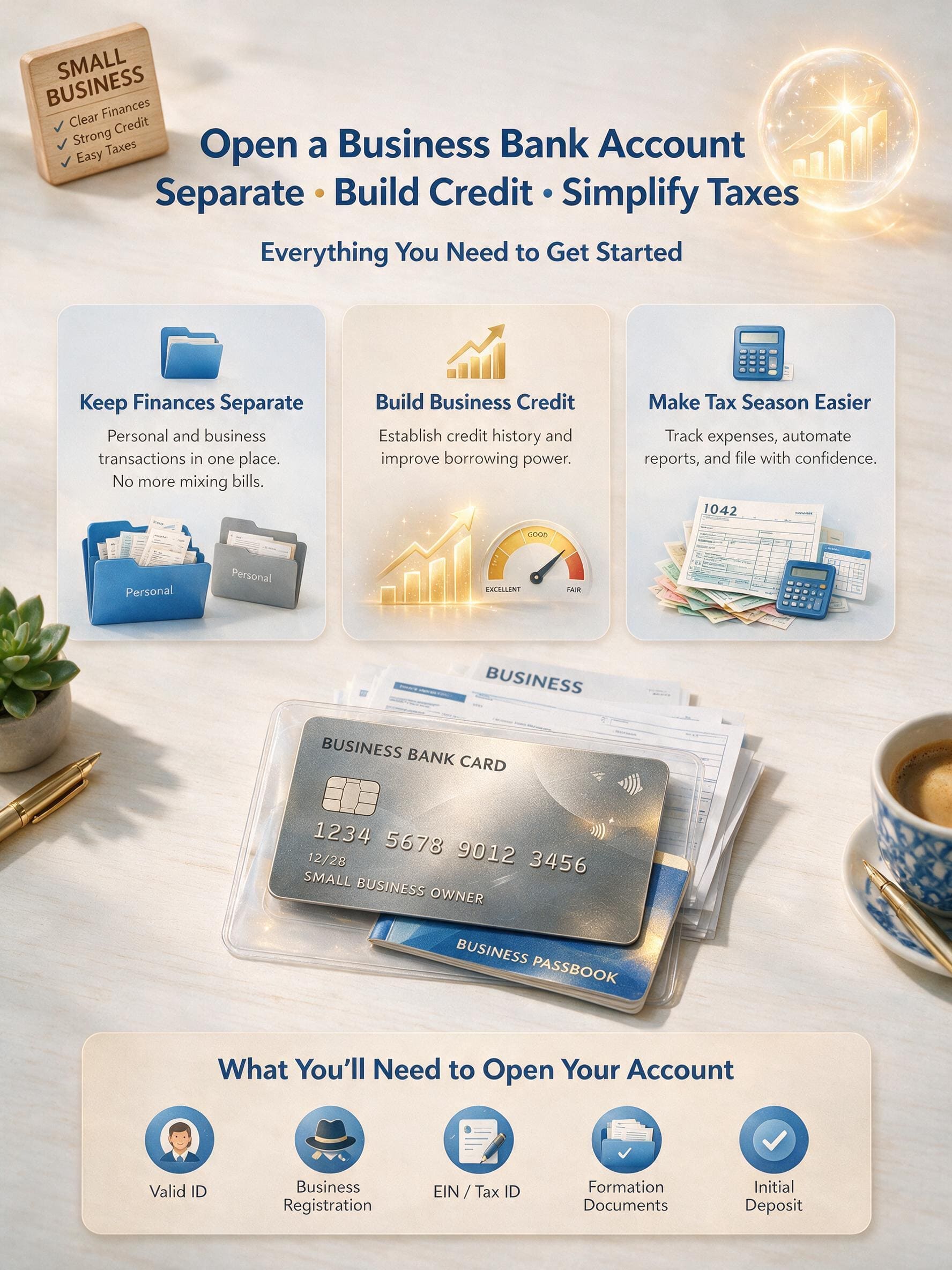
How to open a business bank account
Have these ready before you apply, and the process moves in minutes instead of days:
- Government-issued photo ID for every person who’ll have signing authority on the account.
- An Employer Identification Number (EIN) from the IRS — free, and takes about 15 minutes online if you’re a US resident applying with a US address. Sole proprietors without employees can sometimes use their Social Security Number instead, but an EIN keeps your SSN off business paperwork.
- Business formation documents — Articles of Organization for an LLC, Articles of Incorporation for a corporation, a partnership agreement, or a DBA/fictitious name certificate if you’re trading under a name that isn’t your own legal name.
- Proof of business address — a lease, utility bill, or in some cases a home address if that’s genuinely where you operate (more on this below).
- Ownership information for anyone who owns 25% or more of the business — legal name, address, date of birth, and ownership percentage. This is a federal anti-money-laundering requirement (Beneficial Ownership rules), not bank preference.
- An initial deposit, if the bank requires one — this ranges from $0 at most online-first banks to $100+ at some traditional branches.
Once you have this bundle assembled, the actual account-opening steps are short:
- Pick your business structure first (if you haven’t already) — sole proprietorship, LLC, or corporation, since this determines which documents you’ll need.
- Get your EIN from irs.gov directly — never pay a third party for this; it’s free.
- Choose the account type that fits how your business actually operates (covered in detail below).
- Apply online or in person, upload your documents, and fund the account.
- Set up the operational layer — online banking login, two-factor authentication, debit card, and a connection to your bookkeeping software (QuickBooks, Wave, or a simple spreadsheet if you’re just starting).
What Documents Do You Need to Open a Business Bank Account?
There isn’t one universal document list. Requirements depend on your business structure, bank, state, and application method. However, this is a useful starting checklist:
Almost everyone should expect to provide
- Government-issued photo ID
- Personal information
- Business legal name
- Business address
- Tax identification information
Depending on your business
You may also need:
- EIN confirmation
- Articles of Organization
- Articles of Incorporation
- Operating Agreement
- Partnership Agreement
- Business license
- DBA certificate
- Corporate resolution
- Ownership information
- Information about authorized signers
Wise’s current U.S. guide similarly identifies personal identification, business formation documents, EIN/tax identification, business address and ownership information among the information banks may request.
How to Open a Business Bank Account in 7 Steps
The process is easier if you think of it as seven decisions rather than one giant application.
Step 1: Determine Your Business Structure
Before applying, know what your business legally is.
Are you:
- A sole proprietor?
- An LLC?
- A partnership?
- A corporation?
- Operating under a DBA?
- A freelancer or independent contractor?
This matters because the bank needs to know who owns the business and who has authority to control the account.
For example, a sole proprietor generally has a simpler setup than a corporation with several shareholders and authorized signers. If you haven’t formally established your business yet, determine whether you need to register it before applying.
Step 2: Get Your Tax Identification Information
For many U.S. businesses, this means getting an Employer Identification Number (EIN) from the IRS.
An EIN identifies a business for federal tax purposes. Corporations and partnerships generally need EINs, while LLC requirements depend on how the LLC is taxed.
Some sole proprietors may use an SSN, although obtaining an EIN can provide a cleaner separation between personal and business information.
Don’t assume that having an EIN alone is enough to open an account.
Banks still need to verify the person applying for the account and other required ownership information.
Step 3: Gather Your Business Bank Account Documents
This is where many applications slow down. Have your documents ready before you start. Depending on your business, the bank may request:
Personal information
- Government-issued photo ID
- Legal name
- Date of birth
- Personal address
- Social Security number or other tax identification information
- Contact information
Business information
- Legal business name
- Business address
- Business phone number
- Date the business was established
- Description of business activities
- Expected transaction volume
- Expected sources of funds
Formation documents
Depending on your structure:
- Articles of Organization
- Articles of Incorporation
- Certificate of Formation
- Partnership Agreement
- Operating Agreement
- Business license
- DBA or fictitious-name certificate
- Corporate resolution or authorization documents
Ownership information
The bank may also ask for information about owners and authorized signers.
Current business-account guides from banks and financial providers commonly require some combination of identification, tax identification, formation documents, business address and ownership information.
Tip: Make sure the business name and address are consistent across your documents.
A mismatch between your application, formation paperwork and tax information can trigger additional verification.
Step 4: Choose the Right Business Bank
Don’t automatically choose the bank you already use personally. Your business has different needs.
A local contractor who deposits checks and cash regularly may need a very different banking setup from an online software company receiving international payments.
Consider these factors:
Monthly fees
Look beyond the advertised monthly fee.
Ask:
- Can the fee be waived?
- Is there a minimum balance?
- Are there transaction fees?
- Are cash deposits limited?
- Are incoming wires charged?
- Are outgoing wires charged?
Transaction limits
Some accounts limit the number of monthly transactions or charge fees after certain thresholds.
That might not matter when you’re making ten transactions a month.
It can matter a lot when you’re making several hundred.
Cash deposits
A brick-and-mortar business may need regular cash deposits.
An online business probably doesn’t.
If your business handles cash, check:
- Nearby branches
- ATM availability
- Cash deposit limits
- Deposit fees
- Cutoff times
Payment processing
If you sell products or services online, investigate how the account connects with your payment processor.
You may use platforms such as:
- Stripe
- PayPal
- Shopify
- Square
- Other payment providers
The important question isn’t simply whether a bank accepts electronic payments.
It’s whether the entire payment flow works smoothly with your business.
Accounting integrations
If you use accounting software, check whether the bank can connect with it.
Automatic transaction feeds can save considerable bookkeeping time.
Traditional Bank vs. Online Business Bank
You don’t necessarily need a branch. Many businesses can apply online, while others may still need a branch appointment depending on their structure, ownership, location or the bank’s verification requirements.
| Feature | Traditional Bank | Online Bank | Fintech / Neobank |
|---|---|---|---|
| Best for | Cash-heavy businesses, in-person service | Digital-first businesses, remote founders | Online sellers, freelancers, non-residents |
| Physical branches | Yes | No | No |
| Typical opening time | Same day to 1–2 weeks | 1–2 days | Minutes to 1 day |
| Monthly fees | Often $15–$95, waivable | Usually low or $0 | Usually $0 |
| Multi-currency support | Rare | Sometimes | Common |
| Cash deposits | Easy | Difficult or unavailable | Usually unavailable |
| FDIC insurance | Direct | Direct | Via partner bank |
There’s no universally “best” option — a home bakery that takes cash at the farmers market needs branch access, a fully remote SaaS founder never will.
Step 5: Complete the Application
Once you’ve chosen a provider and gathered your information, submit the application. You may be asked:
- What does your business do?
- Where is the business located?
- When did it start?
- Who owns it?
- Who controls the account?
- What is your expected monthly revenue?
- Where will incoming funds come from?
- What countries will you send or receive money from?
- How much money do you expect to move through the account?
Answer these questions accurately.
Don’t exaggerate your revenue because you think a larger number will make your company look more established. Likewise, don’t describe your business vaguely if you can explain exactly what you sell or what service you provide.
Banks conduct identity and compliance checks as part of the account-opening process.
Step 6: Complete Verification and Make the Initial Deposit
After submitting the application, the bank may approve it immediately or request additional information.
You may need to:
- Verify your identity
- Upload another document
- Confirm ownership
- Explain your business activity
- Verify your address
- Attend a branch appointment
Once approved, the bank may require an initial deposit. The amount varies significantly by account.
Some accounts have no minimum opening deposit, while others require money to be deposited before the account becomes fully operational.
Step 7: Set Up Your Banking System
Opening the account isn’t the end.
It’s the beginning of your business money-management system.
Once your account is active:
- Connect your payment processor.
- Update customer payment instructions.
- Move recurring business payments to the account.
- Connect your accounting software.
- Set up transaction alerts.
- Create appropriate user permissions.
- Order business debit cards if necessary.
- Establish a bookkeeping routine.
- Keep personal spending out of the account.
This last step is particularly important.
A business account only helps if you actually use it as a business account.
Now let’s get into the part most guides skip: what changes depending on what kind of business you’re actually running.
Opening a Bank Account for a Home-Based Business
Running your business from home creates one specific friction point that trips people up constantly: the address question. You don’t need a storefront to have a business bank account.
The problem: Banks ask for a “business address” and often assume it’s a commercial location. Your home address feels like it shouldn’t count — but in almost every case, it does.
A home-based business can include:
- Graphic design
- Consulting
- Photography
- Tutoring
- Virtual assistance
- Bookkeeping
- Web development
- Marketing
- Handmade products
- Online coaching
- Cleaning services
The important distinction is between where you operate and how your business is legally structured.
What actually works:
- Use your home address as your business address. This is completely standard and legal for the overwhelming majority of home-based businesses — consultants, Etsy sellers, tutors, bakers, freelance designers. Banks accept it constantly; you’re not the first person to apply this way.
- Check your local zoning and HOA rules before you apply, not after. Some cities and homeowners’ associations restrict certain business activities from residential addresses (this matters more for businesses with foot traffic, deliveries, or signage — less for a laptop-based service business).
- Consider a virtual mailbox or registered agent address if you want privacy — many home-based owners don’t want their home address listed on public business registries or client-facing invoices. Services like a virtual mailbox give you a real street address for mail and formation documents while your bank still knows your actual operating location.
- Skip the branch visit stress. Home-based businesses are exactly the customer profile online and community banks are built for — you rarely need cash deposits or in-person service, so a fully digital bank often fits better than the branch down the street.
Opening a Bank Account for an Online Business
E-commerce sellers, dropshippers, digital product creators, SaaS founders, and marketplace sellers (Etsy, Amazon, eBay) face a different problem: your “location” might genuinely be nowhere, your revenue might come from a dozen countries, and your transaction volume might spike unpredictably around a product launch or sale.
Online businesses have become much easier to operate financially, but banking requirements haven’t disappeared.
An online business may include:
- E-commerce stores
- Digital products
- SaaS businesses
- Affiliate websites
- Online courses
- Freelance businesses
- Content businesses
- Subscription businesses
- Remote agencies
When choosing an account, pay special attention to electronic payments and integrations.
What to prioritize when choosing a bank:
- Payment processor compatibility. Confirm the account connects cleanly to Stripe, PayPal, Shopify Payments, or your marketplace’s payout system before you commit — some smaller banks flag high-frequency small-dollar deposits from payment processors as suspicious activity, which can freeze your account at the worst possible time.
- Multi-currency support, if you sell internationally. If a meaningful share of your revenue arrives in GBP, EUR, or another currency, a multi-currency business account (offered by fintechs like Wise Business, Airwallex, or Mercury) can save you significant money over letting your bank apply its own conversion rate on every transfer.
- No physical footprint required. Fully digital banks and fintech platforms (Mercury, Novo, Bluevine, Relay) were essentially built for online businesses — no branch visits, fast online applications, and dashboards designed around API integrations rather than teller windows.
- Volume tolerance. If you expect irregular, high-volume transaction days (a viral product, a big sale), ask directly what triggers a hold or review on deposits. This is a question traditional bank reps often can’t answer clearly — fintechs built for online sellers usually can.
- Non-resident options, if you’re a founder outside the US selling to US customers. Traditional US banks often require in-person verification and a US-registered entity. Platforms designed for this — Payoneer, Wise Business, Mercury (which accepts many non-resident founders) — let you get US-style account details without flying anywhere, though be clear on whether you’re getting a full bank account or a “receiving account” that routes to your local bank, since these aren’t the same thing legally.
Opening a Bank Account for a Service Business
Consultants, agencies, coaches, freelancers, contractors, and professional service providers (legal, accounting, creative) have a different set of priorities: fewer physical transactions, but a strong need for clean invoicing, predictable recurring payments, and sometimes escrow or client trust account requirements.
Examples include:
- Plumbers
- Electricians
- Landscapers
- Cleaning companies
- Consultants
- Accountants
- Lawyers
- Marketing agencies
- Contractors
- Repair businesses
What matters most here:
- Invoicing and payment links built in, or easy to bolt on. If most of your income arrives as client payments rather than card swipes, look for a bank or platform with native invoicing, ACH transfers, and integration with tools like QuickBooks or FreshBooks — this alone can save hours a month.
- Separate client trust or escrow accounts, if your profession requires them. Lawyers, real estate agents, and some financial service providers are often legally required to keep client funds in a separate account (IOLTA-style) from operating funds. Confirm this with your state licensing board before you open anything — this is a compliance issue, not just a convenience one.
- Low or no transaction fees on incoming wires and ACH, since service businesses often receive fewer, larger payments rather than many small ones — a bank charging per-transaction fees designed for retail volume works against you here.
- A business savings account alongside checking, to set aside estimated quarterly taxes as they come in. Service businesses (especially solo freelancers and consultants) are the group most likely to get blindsided by a tax bill because income arrived in a handful of large deposits with no employer withholding anything automatically.
- Credit-building tools. As a service business scales into hiring subcontractors or renting office/studio space, a business credit card or line of credit tied to your account becomes useful — start with a bank that offers a path to that rather than switching banks later.
How to Open a Business Bank Account as a Freelancer
Freelancers frequently assume they don’t have a “real business.” That’s not necessarily true. If you’re earning money independently from:
- Writing
- Design
- Programming
- Photography
- Consulting
- Marketing
- Video production
- Virtual assistance
you are operating a business activity even if you don’t have employees. Depending on your structure, you may be able to open an account as a sole proprietor.
The bank may ask for your:
- Government ID
- SSN or EIN
- DBA, if applicable
- Business license, if applicable
- Business address
- Description of your work
A separate account can also make it much easier to determine how much your freelance business actually earned after expenses.
Mistakes That Slow Down or Sink Your Application
- Mismatched business names. If your EIN says “Smith Consulting LLC” and your application says “Smith Consulting,” expect a manual review delay. Match every document exactly.
- Applying before your EIN is confirmed. The confirmation letter (CP 575) can take a couple of weeks by mail even though the EIN itself is issued instantly online — don’t apply for a bank account with just the number and no documentation if the bank asks to see it.
- Ignoring ChexSystems. Many traditional banks check this database for past overdrafts or account closures — if you have a rocky banking history, an online bank or credit union is often more forgiving than a major national bank.
- Choosing a bank based on the branch nearest you rather than how your business actually moves money. Proximity matters a lot less than it used to.
- Never actually using the “business” side of the account — some owners open the account, then keep paying business expenses from a personal card out of habit. The separation only protects you if you maintain it consistently.
What Type of Business Bank Account Should You Open?
Most small businesses should start with a business checking account. It becomes the central account for everyday activity.
You may also eventually need:
Business savings account
Useful for:
- Tax reserves
- Emergency funds
- Future purchases
- Short-term cash reserves
Merchant services
Useful when customers pay by credit or debit card.
Business credit card
Useful for separating business purchases and potentially earning rewards, subject to the card’s terms.
Money market or other savings products
These may be useful for businesses holding larger cash reserves, depending on the provider and account terms.
You don’t need to open everything on day one.
Start with the account that solves your immediate problem, then add financial tools as the business grows.
What Fees Should You Watch For?
A bank account can look inexpensive until you understand its complete fee structure.
Check for:
- Monthly maintenance fees
- Minimum-balance requirements
- Excess transaction fees
- Cash deposit fees
- ATM fees
- Wire transfer fees
- International transfer fees
- Incoming payment fees
- Check fees
- Overdraft fees
- Stop-payment fees
- Additional user fees
Don’t compare banks based only on the monthly fee.
A $15 account can be more expensive than a $25 account if you frequently pay wire fees or cash-deposit charges.
Don’t Ignore International Banking Costs
This matters particularly for online businesses.
Suppose your U.S. business receives $10,000 from overseas customers each month.
The advertised account fee might be tiny.
But if your payment provider, bank, and currency conversion process collectively take a meaningful percentage of those transactions, the actual cost can be much higher.
Wise highlights international transfer fees and exchange-rate differences as costs businesses should examine when evaluating U.S. business banking.
If you work internationally, compare the total cost of moving money, not just the account’s monthly fee.
Quick FAQs About Business Bank Accounts!
Can I open a business bank account without an LLC?
Yes. Sole proprietors can generally open business accounts, subject to the bank’s requirements. An LLC is not automatically required simply because you want a separate business bank account.
Can I open a business bank account for a home-based business?
Yes. A home-based business can have a business bank account. The bank may require a verifiable business address and other documents depending on your business structure.
Can an online business have a business bank account?
Absolutely. Online businesses can use traditional banks, online banks and other eligible financial providers. Your decision should depend on payment methods, transaction volume, international activity, fees and other business needs.
Can freelancers open business bank accounts?
Yes. Freelancers commonly operate as sole proprietors or through another legal structure and may open an account based on that structure’s requirements.
Can I open a business bank account online?
Many providers allow online applications. However, some businesses may still need additional verification or an in-person appointment.
Can I open a business bank account with only an EIN?
Usually, no. An EIN identifies the business, but the financial institution generally still needs to verify the identity of the person or people opening and controlling the account.
Do I need a business license?
Not every business requires one. Whether you need a license depends on your business activity, location and applicable regulations. If your business requires one and the bank asks for it, you should have it ready.
How much money do I need to open a business bank account?
There is no universal amount. Some accounts have no minimum opening deposit, while others require an initial deposit. Check the specific account’s terms before applying.
Can I use my home address for my business?
Potentially, yes, particularly for a home-based business, but the bank’s rules determine what it accepts as a business address. The address may need to be verifiable.
Is an online business bank account safe?
It depends on the provider and account structure. If you’re considering a fintech platform, determine whether your funds are held at an FDIC-insured bank and understand how deposit insurance applies.
The Bottom Line
Opening a business bank account isn’t about finding the bank with the flashiest app or the lowest advertised monthly fee.
It’s about matching the account to the way your business actually operates.
- A home-based consultant may need little more than a straightforward checking account.
- An online store may prioritize payment integrations.
- A contractor may care about cash deposits and branch access.
- A freelancer may want a simple account that keeps client income separate from personal spending.
- An international online business may care most about currency conversion and cross-border payments.
- And a growing company may eventually need payroll, employee cards, merchant services, credit and more sophisticated cash management.
Start by understanding your business model, your money flow, and your documentation. Then compare accounts based on the things that will actually cost you time and money.
The best business bank account isn’t necessarily the one everyone recommends.
It’s the one that fits the business you’re building.