

Rich Dad Poor Dad by Robert T. Kiyosaki is one of the most influential personal finance books ever written. First published in the late 1990s, the book has sold tens of millions of copies worldwide and continues to influence how people approach saving, investing, and building wealth. Rather than offering a step-by-step investment manual, the book works more like a mindset shift — challenging readers to rethink what they were taught about money, careers, and financial security.
Through the comparison of two father figures—his biological father (the “Poor Dad”) and his best friend’s father (the “Rich Dad”)—Kiyosaki presents different philosophies about earning, saving, investing, and achieving financial independence.
The book does not simply teach readers how to make more money.
Instead, it encourages developing a new financial mindset.
It emphasizes that financial success depends more on education, habits, and smart decision-making than on earning a high salary.
The Ultimate Takeaway: True financial independence requires shifting your mindset from that of an employee to that of an investor and creator, ensuring that your capital works tirelessly to generate more capital.
Below is a detailed, original breakdown of the book’s core ideas, structure, and lessons — useful for anyone who wants to understand the book’s philosophy without necessarily reading it cover to cover, or for readers who want a refresher on its key takeaways.
Table of Contents
The Importance of Financial Education
One of the strongest messages in the book is that schools rarely teach financial literacy.
Students learn mathematics, science, history, and literature, but they often graduate without understanding budgeting, investing, taxes, debt management, or asset building.
Kiyosaki argues that this lack of financial education causes many people to spend their entire lives working for money without ever achieving true financial freedom.
Learning how money flows, understanding financial statements, recognizing investment opportunities, and managing risks are skills that everyone should develop regardless of their profession.
The Premise: Two Fathers, Two Philosophies
The book is built around a simple narrative device. Kiyosaki grew up with access to two father figures with dramatically different attitudes toward money. 
His biological father — the “poor dad” — was a well-educated, salaried professional who believed in the traditional path: get good grades, graduate from a respected school, land a stable job, and climb the corporate ladder.
He was cautious with money, viewed debt as inherently dangerous, and equated financial safety with job security.
His best friend’s father — the “rich dad” — was a self-made entrepreneur without formal higher education, who built his wealth through business ownership and investing.
He saw money differently: as a tool that could work for you rather than something you simply worked for.
Kiyosaki uses the contrast between these two men to illustrate two opposing mindsets about money — one rooted in fear and conventional wisdom, the other rooted in financial education and calculated risk-taking.
The entire book essentially argues that the second mindset, not academic intelligence or income level, is what actually produces long-term wealth.
Lesson 1: The Rich Don’t Work for Money
One of the book’s most repeated ideas is that financial struggle often has little to do with how much a person earns.
Many people spend their entire lives following a predictable financial routine. They study, find employment, receive a salary, and gradually increase their spending as their income grows.
While this path may provide temporary comfort, it often creates a situation where individuals depend entirely on their next paycheck to cover bills, loans, and everyday expenses.
As a result, they continue working primarily to maintain their lifestyle instead of building lasting financial security.
This pattern is largely influenced by emotional decisions.
The fear of financial uncertainty encourages people to accept stable income without exploring additional opportunities, while the desire for a better lifestyle motivates them to spend more on expensive possessions and luxuries.
As earnings increase, expenses usually rise as well, making it difficult to accumulate meaningful wealth.
Financially successful individuals tend to adopt a different approach.
Rather than relying solely on earned income, they focus on creating multiple income sources through investments, business ventures, and other assets that can generate money over time.
Their goal is to have their money produce additional income instead of depending only on personal effort.
The key lesson is that lasting financial freedom comes from developing financial knowledge, controlling unnecessary spending, making informed investment decisions, and building income-producing assets.
By changing financial habits and thinking beyond a monthly salary, individuals can gradually reduce financial stress, strengthen long-term stability, and create opportunities for sustainable wealth and greater independence.
This is where the book introduces its central distinction between an asset and a liability — a framework that has become one of its most widely cited contributions to personal finance thinking.
Lesson 2: Know the Difference Between Assets and Liabilities
One of the most valuable financial lessons is understanding the difference between assets and liabilities. Kiyosaki defines these terms in a deliberately simple, cash-flow-based way.
- An asset is anything that puts money into your pocket or has the potential to generate income over time – examples include rental properties, dividend-paying investments, profitable businesses, or intellectual property that earns royalties.
- A liability, on the other hand, is something that takes money out of your pocket through ongoing expenses such as loan payments, maintenance, insurance, or depreciation.
A luxury car purchased with a large loan, for instance, may appear valuable but often becomes a financial burden due to its continuing costs.
The key idea is to focus on acquiring income-producing assets before spending heavily on liabilities.
By consistently increasing assets and limiting unnecessary liabilities, individuals can build stronger cash flow, improve financial stability, and move closer to long-term financial independence.
This reframing is significant because it goes against a common assumption — that a personal home, a nice car, or other visible signs of success are automatically assets.
According to the book’s framework, if these possessions come with ongoing costs (mortgage interest, maintenance, insurance, depreciation) and don’t generate income, they function as liabilities rather than assets, even though they may look like markers of wealth.
The book encourages readers to build a growing column of income-generating assets — such as rental properties, dividend-paying investments, royalties, or business interests — rather than accumulating expensive possessions that quietly drain resources over time.
Lesson 3: Mind Your Own Business
Kiyosaki draws a distinction between a person’s job title and their actual financial focus.
Someone might work as an accountant, a teacher, or a manager for a living, but their real path to wealth comes from what he calls “minding their own business” — meaning building a personal portfolio of income-producing assets on the side, separate from their day job.
The idea is that a career pays the bills, but it’s the assets acquired and grown over time — a small rental property, shares in a business, a side venture — that eventually create independent wealth and, ideally, passive income that no longer depends on trading hours for dollars.
Lesson 4: Taxes and the Power of Corporations
The book spends time explaining how businesses and investors can use legal structures to their advantage in ways that traditional employees typically cannot.
Kiyosaki argues that employees are taxed on income before they get to spend anything, while business owners and investors often have more flexibility to earn, spend on legitimate business expenses, and then pay taxes on what remains.
While tax laws vary significantly by country and change over time, the underlying lesson Kiyosaki emphasizes is broader: financial literacy includes understanding how different income structures — employee wages, business profits, and investment returns — are treated differently, and using that knowledge legally and strategically rather than remaining passive about it.
Lesson 5: The Rich Invent Money
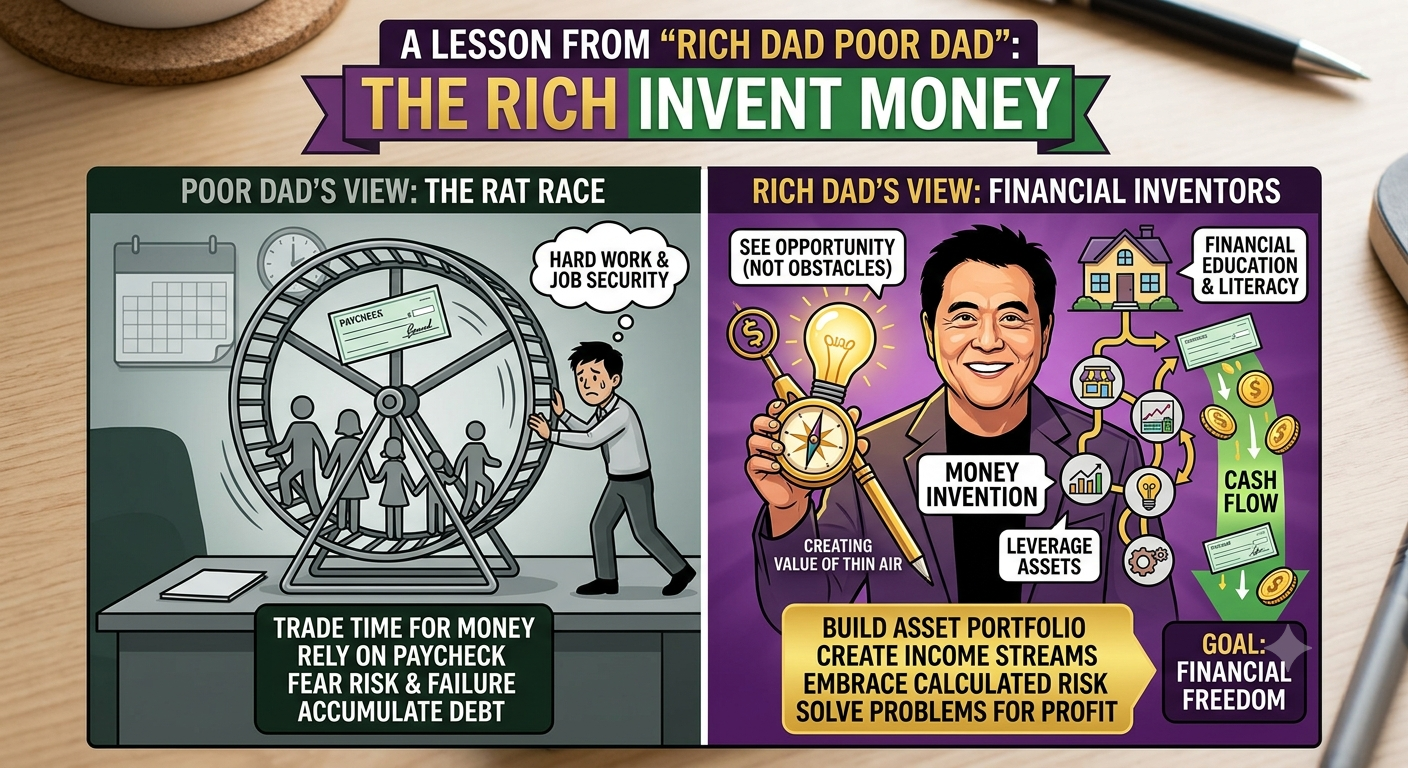
One of the most valuable lessons from Rich Dad Poor Dad is that financially successful people don’t depend solely on earning a salary. Instead, they develop the ability to recognize opportunities, solve problems, and build income-generating assets. Rather than working only for money, they use knowledge, creativity, and strategic thinking to create wealth over time.
Why Wealthy People Think Differently About Money
Many individuals believe the only way to increase income is by working longer hours, getting promoted, or finding a higher-paying job. While these methods can boost earnings, they often have limitations.
Wealthy people adopt a different mindset. They actively search for business ideas, investment opportunities, and market gaps that others overlook. Their goal is not simply to earn more money but to create long-term value that continues generating income.
Financial Education Is the Foundation of Wealth
One of the biggest advantages successful people have is their commitment to continuous learning. Financial education helps individuals understand how money works and teaches them to make smarter financial decisions.
Learning about topics such as investing, entrepreneurship, personal finance, taxes, cash flow, budgeting, and asset management allows people to identify opportunities with greater confidence. The more knowledge you gain, the better prepared you are to make informed financial choices.
Learn Before You Invest
Successful investors rarely make decisions based on emotions or luck. Instead, they research opportunities, evaluate potential risks, and calculate expected returns before investing their money. This disciplined approach helps reduce unnecessary financial mistakes.
How to Recognize Profitable Opportunities
Creating wealth often begins with identifying opportunities that others fail to notice. Instead of focusing on obstacles, financially successful people ask questions such as:
- Can this problem be solved?
- Is there an unmet market demand?
- Can this asset increase in value?
- Is there a smarter way to generate income?
By thinking creatively and staying informed, they discover profitable opportunities in business, real estate, technology, digital products, and many other industries.
Example of Opportunity-Based Thinking
Imagine finding a property priced below its market value because it requires only minor renovations. Rather than ignoring it, an informed investor carefully estimates the repair costs, analyzes the property’s future value, and determines whether the investment is financially worthwhile.
After improving the property, they may sell it for a profit or rent it out to generate passive income. Their success comes from careful planning, financial knowledge, and taking calculated action—not from simply earning a larger paycheck.
Replace Fear With Knowledge and Action
Every investment or business venture involves some level of uncertainty. However, risk can often be reduced through education, research, and proper planning.
Instead of allowing fear to stop progress, successful people continue learning, seek advice from experienced professionals, and make well-informed decisions. Confidence grows through preparation, not guesswork.
Smart Risk Management Matters
Successful wealth builders understand that avoiding all risk is impossible. Instead, they focus on managing risk by diversifying investments, researching opportunities thoroughly, and making decisions based on facts rather than emotions.
Develop a Wealth-Building Mindset
Building long-term wealth requires more than earning a high income. It requires developing habits that encourage financial growth.
Some of these habits include:
- Continuously improving financial knowledge.
- Looking for opportunities instead of problems.
- Thinking creatively to solve real-world challenges.
- Investing in assets that generate income.
- Learning from mistakes and adapting to changing markets.
Over time, these habits can lead to greater financial independence and long-term success.
The Bottom Line:
The principle of “The Rich Invent Money” teaches that wealth is not created by working harder alone. It is built through financial education, innovation, strategic thinking, and the ability to recognize opportunities where others see challenges.
By investing in your knowledge, improving your problem-solving skills, and maintaining an opportunity-focused mindset, you can create multiple paths to financial success and build lasting wealth for the future.
SEO Keywords naturally included: Rich Dad Poor Dad lessons, financial education, wealth-building mindset, create wealth, investment opportunities, financial success, passive income, financial independence, personal finance, wealth creation, smart investing, financial literacy.
Lesson 6: Work to Learn, Not Just to Earn
Kiyosaki challenges the idea of choosing a career path based purely on salary.
Instead, he suggests evaluating opportunities based on what skills, knowledge, and networks they help you build — particularly around sales, communication, leadership, and financial management, since these skills transfer across almost any future business or investment endeavor.
This is part of a broader argument the book makes: formal education teaches technical and professional skills, but rarely teaches financial literacy.
As a result, many highly educated people never learn how to manage or grow money effectively, no matter how much they earn.
Overcoming the Five Obstacles
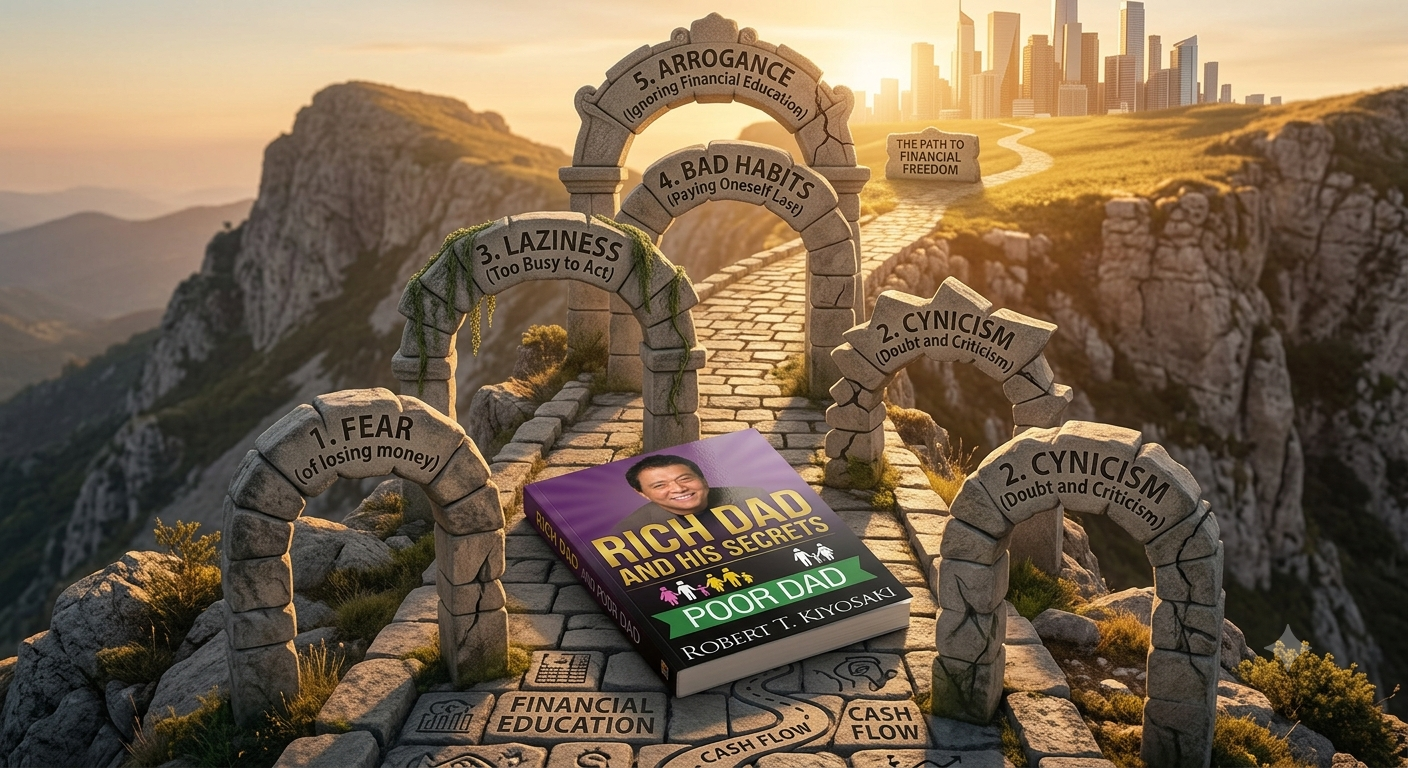
Robert Kiyosaki outlines five mental barriers that stop people from building wealth, along with ways to move past each one.
- Fear – Fear of losing money keeps many people from ever investing. Overcome it by starting small, learning continuously, and treating early losses as tuition rather than failure.
- Cynicism – Doubt and “what if it goes wrong” thinking paralyze action. Counter it by focusing on facts and opportunities instead of worst-case scenarios.
- Laziness – Staying busy with work or distractions often masks avoidance of financial planning. The fix is cultivating a small amount of productive “greed” — a genuine desire for a better financial future that pushes you to act.
- Bad habits – Poor money habits, like spending before saving, quietly sabotage wealth-building. Kiyosaki suggests paying yourself first, before other expenses.
- Arrogance – Assuming you already know enough leads to costly mistakes. Overcoming it means staying humble and continuously educating yourself on finance and investing.
Together, these lessons emphasize that mindset — not intelligence or income — is usually the biggest obstacle to financial success.
Kiyosaki outlines common psychological and practical barriers that keep people from building wealth, including fear, cynicism, laziness, bad habits, and overconfidence.
He frames these less as personality flaws and more as mental patterns that can be recognized and consciously worked through.
For each obstacle, the book suggests that self-awareness and consistent financial habits — rather than motivation alone — are what actually help people push past these barriers over time.
Practical Steps Rich Dad Poor Dad Suggests for Building Wealth
Beyond its core philosophy, Rich Dad Poor Dad offers readers a set of practical, mindset-driven steps meant to turn financial theory into everyday action. These aren’t rigid formulas but starting points for building better financial habits over time.
- Find a strong personal motivation. Kiyosaki suggests that lasting financial change requires a reason powerful enough to push through setbacks — something more compelling than simply wanting more money in the abstract.
- Treat financial education as ongoing, not optional. Since schools rarely teach money management in depth, the book encourages readers to actively seek out financial knowledge throughout life, rather than assuming a diploma alone prepares them for real-world money decisions.
- Stay alert to opportunities others overlook. Wealth-building opportunities often go unnoticed by people who aren’t actively looking. The book encourages developing the habit of evaluating deals, trends, and openings that others dismiss too quickly.
- Choose your circle carefully. Surrounding yourself with people who have relevant financial experience — even if they’re not wealthy themselves — can offer insight and accountability that’s hard to get alone.
- Master one approach before expanding. Rather than chasing every opportunity, the book recommends learning a single method or formula for building assets, refining it through practice, and only then diversifying into new strategies.
- Take action instead of waiting for certainty. Perhaps the most repeated step in the book: progress comes from doing something imperfectly now, rather than waiting indefinitely for the “right” moment or complete confidence.
Together, these steps reflect the book’s broader message — that consistent habits and a willingness to learn matter more than natural talent or a high starting income when it comes to building long-term financial security.
Criticisms and Balanced Perspective
Despite its popularity, Rich Dad Poor Dad isn’t without valid criticism, and presenting both sides gives readers a more complete picture. While the book has inspired millions of readers, it’s worth noting some balanced context often raised by financial commentators:
- Kiyosaki’s “rich dad” is presented as a real person but has never been independently verified, leading some critics to view the narrative as more of a storytelling device than a documented biography.
- The book is intentionally light on specific, actionable investment instructions and heavier on mindset and philosophy.
- Some financial advisors caution that concepts like leveraging debt for investment carry real risk and aren’t universally appropriate for every reader’s situation.
Additionally, some advisors caution against the book’s favorable framing of debt and leverage as wealth-building tools, since these strategies carry real risk and aren’t equally suitable for everyone’s financial situation or risk tolerance.
Even so, most critics agree the book’s greatest value lies not in its technical accuracy, but in shifting how readers think about money, assets, and long-term financial habits — a mindset foundation that still resonates with audiences today.
FAQ’s About Rich Dad Poor Dad
1. What is the main lesson of Rich Dad Poor Dad?
The main lesson of Rich Dad Poor Dad is that lasting wealth comes from financial education, not just income.
Kiyosaki argues that understanding the difference between assets and liabilities, and consistently acquiring things that generate income, matters more than salary size.
Real financial freedom means building resources that work for you, rather than trading time for money indefinitely.
Mindset, continuous learning, and calculated risk-taking, the book suggests, matter far more than formal schooling in achieving true financial independence.
2. What is the difference between an asset and a liability according to the book?
In Rich Dad Poor Dad, Kiyosaki explains assets and liabilities through cash flow, not appearance.
An asset is anything that puts money into your pocket over time — like a rental property, dividend-paying investments, or a profitable side business.
A liability, by contrast, takes money out of your pocket, even if it looks impressive on the surface.
This is why the book challenges the common belief that a personal home or car counts as an asset.
If it comes with ongoing costs — mortgage interest, maintenance, insurance, depreciation — without generating income, it functions as a liability.
The lesson: build a growing column of income-producing assets, since that’s what actually creates long-term financial security, not visible signs of wealth.
3. Is “rich dad” a real person?
Robert Kiyosaki has always described “rich dad” as a real mentor from his youth, though no independent records confirm his identity.
Critics argue the figure may be a composite or narrative device rather than a documented individual.
Kiyosaki has never revealed his identity, citing privacy reasons, leaving the claim unverifiable but central to the book’s storytelling approach.
4. Does Rich Dad Poor Dad recommend buying a house?
Not directly. Rich Dad Poor Dad challenges the popular belief that a primary home is a strong financial asset.
Kiyosaki argues that a house you live in usually creates ongoing costs — mortgage interest, taxes, maintenance — without generating income, making it a liability by his cash-flow definition, not an asset.
Rather than discouraging homeownership outright, the book urges readers to first build income-producing assets, such as rental property or investments, before treating a personal residence as a symbol of wealth.
The message is about prioritizing cash flow over appearances, not avoiding home purchases entirely.
5. What does “mind your own business” mean in the book?
It refers to building a personal portfolio of income-producing assets — such as investments, property, or a side business — separate from your regular job, rather than relying solely on a paycheck for long-term financial security.
6. Is Rich Dad Poor Dad suitable for beginners in personal finance?
Yes, Rich Dad Poor Dad is one of the most beginner-friendly personal finance books available.
Robert Kiyosaki avoids technical jargon and complex financial formulas, instead using simple storytelling to explain core concepts like assets, liabilities, and cash flow.
Because it focuses on mindset rather than advanced investment strategy, readers don’t need any prior financial knowledge to understand it. This makes it an excellent entry point for people who feel overwhelmed by traditional finance books.
That said, beginners should treat it as a foundation for changing how they think about money, then pair it with more detailed resources for specific investment guidance.
7. Does the book give specific investment advice, like which stocks to buy?
No, it doesn’t.
Rich Dad Poor Dad focuses on mindset and financial philosophy rather than concrete investment picks.
Kiyosaki avoids naming specific stocks, funds, or properties to buy, instead emphasizing financial education, asset-building principles, and mental frameworks.
Readers seeking exact strategies usually pair the book with more technical, niche-specific investment resources for actionable guidance.
8. What are the “five obstacles” mentioned in the book?
In Rich Dad Poor Dad, Kiyosaki identifies five mental barriers that stop people from building wealth:
- Fear of losing money
- Cynicism that breeds doubt
- Laziness disguised as busyness
- Deep-rooted bad financial habits
- Overconfidence that leads to careless decisions.
Rather than personality flaws, he frames these as learned patterns anyone can recognize and overcome through self-awareness, financial education, and consistent, intentional money habits over time.
9. Why does the book say employees pay more in taxes than business owners?
The book explains that employees are generally taxed on income before they can spend it, while business owners and investors often have more flexibility to use legitimate expenses and structures before taxes apply. Tax rules vary by country, so this point is best treated as a general principle rather than universal advice.
10. Is Rich Dad Poor Dad still relevant today?
Yes, largely. Its core message — that financial literacy matters more than income, and that building assets beats accumulating liabilities — hasn’t aged much, even if some examples feel dated. Modern readers still find value in its emphasis on mindset, calculated risk-taking, and continuous financial self-education, especially since these topics are rarely taught in schools.
That said, today’s economic landscape looks different: interest rates, housing markets, and investment options have shifted significantly since the book’s release. So while its philosophy remains a useful starting point, most financial experts suggest pairing it with more current, specific resources for practical decision-making.
11. What is meant by “the rich don’t work for money”?
“The rich don’t work for money” means that instead of trading time and effort solely for a paycheck, wealthy individuals focus on building systems, businesses, and investments that generate income on their own.
Rather than depending entirely on a job, they put money to work through assets like real estate, stocks, or business ventures.
The goal is financial independence, where income keeps flowing even without direct daily labor, allowing wealth to grow steadily over time.
12. What are common criticisms of Rich Dad Poor Dad?
Common criticisms include the unverified background of the “rich dad” character, a lack of specific actionable investment steps, and concerns from some financial professionals that certain ideas — like leveraging debt — carry risks that aren’t clearly addressed for every reader’s situation.
The Bottom Line:
Rich Dad Poor Dad isn’t really a finance manual — it’s a mindset shift. Robert Kiyosaki’s core argument is simple: the size of your paycheck matters less than what you understand about money.
Through the contrast between his own father’s cautious, employee-minded approach and his mentor’s entrepreneurial thinking, Kiyosaki makes the case that financial freedom comes from acquiring assets that generate income, not from chasing a bigger salary or accumulating expensive possessions that quietly drain your wallet.
The book’s lasting value lies in a few reframes: distinguishing true assets from liabilities, treating financial education as a lifelong skill rather than a school subject, and viewing calculated risk as a tool for growth rather than something to fear entirely.
It won’t hand you a specific investment plan or guarantee results, and some of its claims — including the existence of “rich dad” himself — remain unverified.
But as an entry point into thinking differently about money, careers, and long-term wealth-building, it remains one of the most widely read and discussed personal finance books ever published.