

Learn how to get rich with practical strategies that actually work. A deep-dive into the mindset, mechanics, and habits that separate those who build lasting wealth from those who only dream about it.
Everyone dreams of becoming rich. Some imagine owning a luxurious home, driving their dream car, traveling around the world, or simply living without worrying about bills. While these dreams are common, many people believe that getting rich is only possible through luck, inheritance, or winning the lottery.
The truth is very different.
Most wealthy people didn’t become rich overnight. Instead, they built their wealth through consistent effort, smart financial decisions, continuous learning, and patience. Wealth is rarely the result of one lucky event. It is usually the outcome of thousands of good decisions made over many years.
If you’re wondering “How can I get rich?”, you’ve come to the right place.
Table of Contents
Introduction: The Question Everyone Asks but Few Understand
Ask a room full of people whether they want to be rich, and nearly every hand goes up. Ask those same people how they plan to get there, and the room goes quiet.
“Getting rich” is one of the most searched phrases on the internet — and one of the most misunderstood ideas in modern life. It conjures images of lottery wins, viral social media fame, or some secret that wealthy people are keeping locked away in a vault. The reality is simultaneously less glamorous and far more empowering than that.
Getting rich is not a single event. It’s a process — a long, sometimes boring, often uncomfortable process that rewards people who understand a few core truths about money, time, and human behavior.
This article is not going to sell you a dream. It is going to give you a map. And like any honest map, it will show you the mountains alongside the roads.
Whether you’re starting from zero, recovering from financial setbacks, or simply tired of living paycheck to paycheck, this guide is written for you. Let’s begin at the beginning.
Chapter 1: Redefining “Rich” — What Are You Actually After?
Before learning how to get rich, it’s important to understand what “rich” actually means.
Most people say they want to be “rich” without ever stopping to ask: rich compared to what? Rich for what purpose? Rich by whose standard?
💡 Key Insight: Wealth without a destination is just a number. Your definition of rich is the compass that gives your financial journey direction.
Imagine two people:
- Person A earns $15,000 every month but spends nearly all of it.
- Person B earns $6,000 every month but saves, invests, and grows their money consistently.
After several years, Person B could easily become wealthier than Person A.
Being rich isn’t about how much you earn—it’s about how much you keep, invest, and grow.
There are three distinct layers to financial success that most people confuse with each other:
1. Income — The River Income is the flow of money coming in. A high salary makes you feel rich on paper, but income alone does not create wealth. A surgeon earning $400,000 a year who spends $420,000 a year is technically living in debt. Income is a river — it only fills you up if you have a vessel to hold it.
2. Wealth — The Reservoir Wealth is accumulated assets: savings, investments, property, and business equity. This is where actual financial security lives. Wealth is what remains when your income stops. It’s the difference between a person who works for money and one whose money works for them.
3. Financial Freedom — The Dam Financial freedom is the point at which your passive income or accumulated assets generate enough to cover your lifestyle indefinitely — without you actively trading time for money. This is the ultimate destination for most people who say they want to be “rich.”
🎯 Action Step: Write down a number. Not a vague “I want to be a millionaire” number, but a specific figure: “I want $X in invested assets generating $Y per month, allowing me to afford Z lifestyle.” Specificity is the beginning of strategy.
Understanding which layer you’re aiming for changes everything about how you approach the journey. Someone chasing financial freedom has a fundamentally different strategy than someone chasing a higher salary — and both are different from someone building a legacy business for their children.
Chapter 2: The Brutal Truth About Why Most People Never Build Wealth
Here is something uncomfortable: the reason most people never build significant wealth has very little to do with opportunity and almost everything to do with patterns — patterns of thinking, spending, and prioritizing.
Let’s name them honestly.
The Lifestyle Inflation Trap
This is the wealth-destroyer hiding in plain sight. As people earn more, they spend more — new car, bigger apartment, better vacations, upgraded wardrobe. Economists call this “hedonic adaptation.” The human brain quickly normalizes new pleasures and starts craving the next level.
The antidote is a concept called “lifestyle lag” — intentionally keeping your spending flat (or growing it slowly) while your income rises. The gap between what you earn and what you spend is where wealth is born.
⚠️ Warning:If every raise you receive is immediately absorbed into a higher monthly lifestyle, you will always feel like you need more — because you will always need more.
The Debt Spiral
Consumer debt — particularly high-interest credit card debt — is one of the most effective wealth-suppression systems ever designed. When you carry a balance at 20-25% annual interest, you are essentially working a portion of every month to pay a financial institution for the privilege of spending money you didn’t have.
Rich people understand that debt has two faces: bad debt (financing consumption) and good debt (financing assets that appreciate or generate income). Mortgages on investment properties, small business loans with strong ROI, and student loans for high-earning fields can be tools. Credit card balances for dining and shopping are anchors.
The Knowledge Gap
Financial literacy is not taught in most schools.
The majority of people enter adulthood without understanding how compound interest works, how tax-advantaged accounts function, what the difference between a stock and a bond is, or why investing in a diversified index fund over decades outperforms most active fund managers.
This knowledge gap isn’t a character flaw — it’s a systemic gap. But in the information age, it is one that anyone with internet access and disciplined curiosity can close.
💡 Key Insight:You don’t need an MBA to build wealth. You need to understand about a dozen financial concepts deeply, and then act on them consistently.
The Waiting Game
Perhaps the most insidious wealth-killer is waiting for the “right time.” Right time to start investing, launch the business, to cut expenses and to negotiate a raise.
Time is the one resource that, once spent, cannot be recovered.
And in the world of investing, time is also the primary engine of compound growth. A person who invests $500 a month from age 22 to 32 and then stops will almost certainly end up wealthier than someone who invests $500 a month from age 32 to 62 — simply because those early years have decades more to compound.
Start imperfectly. Start now.
Chapter 3: The Foundation — A Wealth Mindset
Before we discuss any tactical money moves, we need to spend serious time on the foundation: how wealthy people actually think. One of the biggest differences between wealthy people and those who constantly struggle financially is their mindset.
Your beliefs about money influence every financial decision you make.
If you believe:
- “I’ll never be rich.”
- “Money is evil.”
- “Rich people are lucky.”
- “Investing is only for experts.”
Then you’re likely to avoid opportunities that could improve your finances.
Instead, develop a growth mindset.
Tell yourself:
- I can learn financial skills.
- I can improve my income.
- I can make smarter money decisions.
- Wealth is built over time.
Your thoughts influence your actions, and your actions determine your financial future.
This is not about positive thinking or manifestation. It’s about genuinely different cognitive frameworks that shape decision-making over years and decades.
Wealthy People Think in Assets, Not Expenses
When most people receive extra money — a bonus, a tax refund, a gift — their first instinct is to think about what they can buy. Wealthy people’s first instinct is to think about what they can own — something that will appreciate, produce income, or expand their future capacity.
This is not about being miserly. It’s about understanding that every dollar is a seed, and seeds can either be planted or eaten. Both choices are valid. But only one creates an orchard.
They Embrace Delayed Gratification as a Superpower
The famous Stanford “marshmallow test” showed that children who could resist eating one marshmallow now in order to receive two later had better life outcomes across numerous measures. While the science has been refined over the decades, the underlying principle holds: the ability to delay gratification is a foundational skill for building anything meaningful, including wealth.
💡 Key Insight: Every financial sacrifice today is an investment in a future version of yourself who has more options, more security, and more freedom.
Without goals, money tends to disappear.
Successful people know exactly what they’re working toward.
They Value Ownership Over Employment (Eventually)
There’s nothing wrong with a salary — it provides stability and cash flow. But wealthy people understand that employment makes you comfortable while ownership makes you rich.
This is why the goal of most serious wealth-builders is eventually to own things: businesses, stocks, real estate, intellectual property. These are assets that generate returns whether you show up or not.
They Treat Money as a Tool, Not a Trophy
Many people associate wealth with status, and this association is dangerous. It leads to spending money on visible symbols of success (luxury cars, flashy watches, expensive clothes) rather than on assets that generate more money.
Real wealth is mostly invisible. The genuinely wealthy person often drives a reasonable car, lives in a sensible house, and puts the bulk of their capital into boring, reliable assets.
The status-chaser spends money trying to look rich. The wealth-builder spends money becoming rich.
They Are Comfortable with Calculated Risk
Building wealth requires taking risks — investing money that could lose value, starting a business that might fail, negotiating for something you might not get. People who fear all risk either keep their money in low-yield savings accounts or never invest at all.
The result is that inflation quietly erodes the purchasing power of everything they’ve saved.
Wealthy people don’t take reckless risks. They study situations, diversify their exposure, and accept that calculated risk is the price of admission to meaningful reward.
A Wealth-Building Roadmap by Age
There is no “perfect” age to start building wealth. The best time to begin is now. However, your priorities may change depending on your stage of life.
In Your 20s
This is the ideal time to build a strong financial foundation.
Focus on:
- Learning valuable skills
- Avoiding unnecessary debt
- Building an emergency fund
- Investing consistently
- Developing healthy money habits
The biggest advantage you have is time.
To Your 30s
Your career and income often grow during this decade.
Priorities include:
- Increasing retirement contributions
- Investing regularly
- Buying assets responsibly
- Growing additional income streams
- Protecting your family with appropriate insurance
In Your 40s
At this stage, many people earn their highest incomes.
Consider:
- Paying off expensive debt
- Expanding investments
- Planning for retirement
- Reviewing estate planning
- Teaching financial literacy to your children
To Your 50s and Beyond
Your focus should shift toward preserving wealth while continuing to grow it carefully.
Review your:
- Retirement savings
- Investment allocation
- Healthcare planning
- Estate documents
- Long-term financial goals
It’s never too late to improve your financial future.
Chapter 4: Building Multiple Streams — The Architecture of Income
One of the most consistently repeated pieces of wealth advice across decades and cultures is this: never depend on a single source of income.
Relying on a single paycheck can be risky.
Wealthy individuals often have several income sources.
Examples include:
- Salary
- Rental income
- Dividend income
- Freelancing
- Business profits
- Royalties
- Investments
- Online stores
- Affiliate marketing
The more income streams you develop, the stronger your financial foundation becomes.
The average millionaire reportedly has multiple income streams. Why? Because diversification protects. If one stream dries up, others keep flowing.
Here is a framework for thinking about income architecture:
Stream 1: Active Income — Your Labor
This is what most people have: a job or self-employment where time is directly exchanged for money. The levers here are skill level, negotiation, specialization, and career advancement.
🎯 Action Step: Audit your current active income. Are you being paid at market rate? When did you last negotiate? What skills, if developed, would allow you to command 20-50% more? These questions are worth serious time.
Stream 2: Business Income — Your Systems
Many of the world’s wealthiest people own businesses.
A business earns money even when the owner isn’t actively working. This might start as a side hustle — freelancing, consulting, selling products online — but the goal is to build systems that reduce the owner’s direct labor over time. A well-run business is an income-generating asset.
Starting a business doesn’t require a revolutionary idea. Many highly successful businesses do ordinary things extraordinarily well: better customer service, cleaner pricing, more consistent delivery. Differentiation beats invention in most markets.
A business allows you to create value for customers while increasing your income beyond the limits of a traditional salary.
Today you can launch a business with relatively low startup costs, including:
- Freelance agency
- E-commerce store
- Consulting service
- Coaching business
- Content creation
- Software development
- Digital marketing agency
- Graphic design studio
- Print-on-demand store
- Online education platform
Before starting, identify a real problem people are willing to pay to solve.
Successful businesses focus on helping customers—not simply making money.
Stream 3: Investment Income — Your Capital
This is where wealth truly accelerates. Investment income takes many forms:
- Dividend stocks: Companies that share profits with shareholders on a regular basis
- Index funds and ETFs: Diversified market exposure with low fees and long-term compounding
- Real estate rental income: Monthly cash flow from tenants covering mortgage and then some
- Bonds and fixed income: Lower-risk income for stability and balance
- REITs: Real estate investment trusts that allow property ownership without direct landlord responsibilities
The beautiful secret about investment income is that it scales without requiring more of your time. Once the capital is deployed, it works around the clock, across weekends, during vacations.
Stream 4: Passive and Residual Income — Your Creations
Most people earn active income—they work, then they get paid.
Passive income is different.
It continues generating money even when you’re not actively working every hour.
Building passive income usually requires time, effort, or money upfront, but it can provide financial freedom in the long run.
Examples include:
- Dividend-paying investments
- Rental properties
- Royalties from books or music
- Online courses
- Affiliate marketing
- YouTube content
- Blogs
- Digital products
- Mobile apps
- Automated online businesses
Passive income rarely becomes successful overnight. It often takes months or years of consistent effort before producing meaningful results.
⚠️ Warning: True passivity is rarer than the internet suggests. Most “passive” income requires significant upfront work and ongoing maintenance. But the ratio of effort to return does improve dramatically over time compared to active work.
Stream 5: Strategic Appreciation — Your Assets Growing
Not all income is cash. Sometimes wealth grows through asset appreciation: your house increases in value, your stock portfolio rises, your business becomes worth more. This isn’t a cash flow you can spend today, but it builds your net worth and expands your capacity for future capital deployment.
How to Build Wealth on a Low Income
Many people believe they need a six-figure salary to become wealthy. While a higher income certainly helps, your financial habits matter just as much.
If you’re earning a modest income, focus on improving what you can control.
1. Track Every Expense
For one month, write down everything you spend. You may discover small purchases that add up over time.
2. Save a Percentage of Every Paycheck
Even if it’s only 5% or 10%, consistency matters more than the amount.
3. Learn a High-Income Skill
Skills such as digital marketing, coding, graphic design, writing, or sales can significantly increase your earning potential.
4. Avoid High-Interest Debt
Paying high interest makes it much harder to build savings.
5. Increase Your Income Gradually
Look for opportunities such as freelancing, part-time work, or starting a small online business.
Remember, many successful entrepreneurs and investors started with very little money. Their wealth grew because they developed good financial habits and remained committed to their goals.
Chapter 5: The Investment Ladder — Where to Put Your Money and When
Saving money is important, but investing allows your money to grow.
One of the most paralyzing questions for beginners is: where do I actually put my money?
The answer depends on your timeline, risk tolerance, and goals — but there is a logical sequence that most financial experts agree on.
Rung 1: The Emergency Fund
Before investing a single dollar in the market, build a cash buffer of three to six months of living expenses in a high-yield savings account. This fund exists for one reason: to prevent you from having to liquidate investments at the worst possible moment when life gets expensive (job loss, medical emergency, car repair).
Without this buffer, the first real emergency forces you to sell assets — often at a loss, often at tax cost — and the wealth-building cycle gets disrupted.
💡 Key Insight: An emergency fund isn’t an investment. It’s insurance for your investment strategy.
Rung 2: Employer-Matched Retirement Accounts
If your employer offers a 401(k) or similar plan with matching contributions, this is the single highest-return investment available to you.
If your employer matches 50% of contributions up to 6% of your salary, you are getting a guaranteed 50% return on that portion before the market moves a single basis point.
Contribute at least enough to capture the full employer match. Every dollar left on the table here is free money declined.
Rung 3: High-Interest Debt Elimination
Any debt carrying an interest rate above 6-7% should be treated as a financial emergency. Paying off a credit card at 22% interest is equivalent to earning a guaranteed 22% return — which no investment reliably offers.
Prioritize elimination of high-interest consumer debt aggressively before moving further up the investment ladder.
Rung 4: Tax-Advantaged Investment Accounts
Once high-interest debt is cleared, maximize contributions to tax-advantaged accounts: IRAs (traditional or Roth), HSAs, and maxing out 401(k) contributions beyond the employer match.
The compounding inside tax-sheltered accounts is materially more powerful than in taxable accounts because taxes don’t erode growth along the way.
Rung 5: Taxable Brokerage Accounts and Other Investments
Beyond tax-advantaged limits, a standard brokerage account invested in diversified index funds, dividend stocks, or ETFs continues the compounding process. Real estate, business investment, and alternative assets also enter the picture here for those with sufficient capital and risk appetite.
Invest Your Money Wisely
Many people think investing is only for millionaires or financial experts. In reality, investing is one of the most effective ways for ordinary people to build wealth over time.
When your money sits in a regular savings account, it usually grows very slowly. Inflation can even reduce its purchasing power over the years. Investing gives your money the opportunity to earn returns and grow faster than inflation.
The most successful investors understand one important principle:
Don’t let your money sit idle. Put it to work.
There are many ways to invest, including:
- Stocks
- Index funds
- Exchange-Traded Funds (ETFs)
- Bonds
- Mutual funds
- Real estate
- Businesses
- Retirement accounts (where available)
Chapter 6: The Power of Compounding — The Eighth Wonder of the World
Albert Einstein is often credited with calling compound interest the “eighth wonder of the world.” Whether or not he actually said it, the idea behind compound growth is incredibly powerful.
Compounding is the process by which returns generate their own returns. When your investments earn a return and that return is reinvested to earn further returns, the growth becomes exponential rather than linear.
Consider this example:
- Person A invests $10,000 at age 25 and earns an average annual return of 8%. By age 65, that single investment grows to approximately $217,000 — with no additional contributions.
- Person B waits until age 35 to make the same $10,000 investment at the same return rate. By age 65, it grows to approximately $100,000.
The ten-year delay cut the outcome in half. This is the compounding effect.
⚠️ Warning:Compounding works in both directions. Debt compounds against you just as powerfully as investments compound for you. High-interest debt is the mirror image of compounding investment growth — and it’s working against you right now if you carry balances.
The key variables in compounding are:
- Principal — how much you start with
- Rate of return — driven by asset selection and market performance
- Time — the most powerful variable and the one you control most directly
- Frequency of compounding — monthly compounds faster than annually
This is why starting early — even with small amounts — is so dramatically more impactful than starting large but late.
Key Lesson: Time is often more valuable than the amount you invest.
The Importance of Financial Discipline
Knowledge alone doesn’t create wealth. Action does.
You may read dozens of books about personal finance, but unless you apply what you’ve learned, your financial situation is unlikely to change.
Financial discipline means making decisions based on your long-term goals instead of short-term emotions.
Examples include:
- Saving money before buying luxury items
- Investing consistently during both good and bad markets
- Avoiding emotional spending
- Reviewing your budget every month
- Staying committed even when progress feels slow
Discipline often beats intelligence in the world of personal finance.
Chapter 7: Real Estate: Building Long-Term Wealth Through Property
Real Estate — Building Wealth Through Property.
The journey to financial success through real estate is not about becoming rich overnight. Instead, it is about making smart decisions, managing risks, and allowing your investments to grow steadily over the years.
It has created more millionaires than perhaps any other asset class. Understanding why helps clarify whether and how it fits your wealth-building strategy.

Why Real Estate Is a Powerful Wealth-Building Tool
Property investing offers multiple opportunities to grow your net worth. Instead of relying on a single source of profit, real estate allows investors to earn money in several different ways at the same time.
1. Property Value Can Increase Over Time
One of the biggest reasons people invest in real estate is appreciation.
As cities expand, infrastructure improves, and demand increases, property values often rise. Although prices may fluctuate in the short term, quality properties in desirable locations have historically gained value over long periods.
Example:
A home purchased today for $150,000 may be worth significantly more after 15 or 20 years if the surrounding area continues to develop.
Key Takeaway: Buying quality property and holding it for the long term can create substantial wealth.
2. Rental Income Creates Cash Flow
Real estate can generate regular monthly income through rent.
If rental income exceeds mortgage payments, taxes, insurance, and maintenance expenses, the remaining amount becomes positive cash flow.
This additional income can help:
- Pay household expenses
- Build savings
- Reinvest into more properties
- Increase financial independence
Key Takeaway: Rental properties can become an additional income stream that grows over time.
3. Mortgage Payments Build Equity
When purchasing property with financing, every mortgage payment gradually increases your ownership.
Instead of paying rent to a landlord, you’re building equity in an asset that belongs to you.
Over time:
- Loan balances decrease.
- Property ownership increases.
- Net worth grows.
Think of each mortgage payment as another step toward full ownership.
Key Takeaway: Real estate can help protect purchasing power during periods of inflation.
4. Inflation Can Work in Your Favor
Inflation causes many goods and services to become more expensive over time.
Interestingly, real estate often benefits from inflation because:
- Property prices frequently increase.
- Rental rates may rise.
- Mortgage payments on fixed-rate loans remain relatively stable.
This means your income may grow while one of your largest expenses stays predictable.
💡 Key Insight: The combination of appreciation, cash flow, equity build-up, leverage, and tax advantages makes real estate uniquely powerful — but only when purchased thoughtfully, managed carefully, and held patiently.
The Risks Are Real Too
Real estate is illiquid, management-intensive, requires significant capital for entry, and is geographically dependent. Bad tenants, structural problems, rising interest rates, and local market downturns are real risks that require honest assessment.
The solution is education before investment: study the market, analyze cash flow projections conservatively, build reserves for vacancies and repairs, and start with properties in areas you understand.
The Habits That Separate Wealth Builders from Everyone Else
People who consistently build wealth often share common behaviors.
- They Set Goals: They know exactly what they want to achieve.
- They Live Below Their Means: They avoid unnecessary lifestyle inflation.
- They Continue Learning: Financial markets, technology, and industries constantly evolve.
- They Invest Consistently: Instead of waiting for the “perfect” time, they invest regularly over many years.
- They Think Long Term: Rather than chasing quick profits, they focus on sustainable growth.
- They Take Responsibility: Instead of blaming circumstances, they look for ways to improve their situation.
Chapter 8: Career Acceleration — Earning More Is the Fastest Lever
Investment and saving matter enormously, but the most immediate lever most people have is their income. A 20% increase in salary with constant spending produces dramatically more wealth-building capacity than a 20% reduction in a modest budget.
Invest in Rare and Valuable Skills
The market pays premiums for skills that are both in-demand and scarce. Data science, software engineering, specialized medicine, legal expertise, financial analysis, sales, and marketing leadership are examples of high-value skill domains. Developing deep expertise in a valued area over years creates a career asset that compounds — the better you get, the more valuable your time becomes.
🎯 Action Step: Identify the top 3 skills in your field that command the highest compensation. Create a 12-month learning plan to materially improve in at least one of them.
Negotiate Relentlessly (and Respectfully)
Research consistently shows that most people leave significant salary on the table simply by not asking. Negotiation is a skill, and like all skills, it improves with practice and preparation.
Before any salary conversation:
- Research market rates using multiple sources
- Quantify your specific contributions in dollar terms
- Practice the conversation with a trusted friend
- Have a target number and a minimum number
- Be comfortable with silence after making your ask
The worst answer is no — and you’re no worse off than before you asked.
Build Your Network Before You Need It
Most high-value career opportunities never appear on job boards. They flow through relationships: a former colleague who thought of you for a new role, a mentor who recommended you to a hiring partner, a peer who introduced you to a critical client.
Wealthy and successful people invest consistently in genuine relationships — not transactional networking, but authentic connection with people whose work you respect and whose success you actively support.
Consider Entrepreneurship as a Career Strategy
Not everyone is cut out for full-time entrepreneurship, and that’s fine. But many people operate at the intersection: keeping their job security while building a side business that could eventually eclipse their salary.
The entrepreneurial path offers unlimited income upside that employment never does. The employee’s compensation is bounded by what the employer decides to pay. The entrepreneur’s income is bounded only by the value they create.
Chapter 9: Frugality vs. Deprivation — The Intelligent Art of Spending Less
There is a difference between being frugal and being cheap. Frugality is strategic allocation of resources toward what matters most. Cheapness is refusing to spend even when spending would clearly improve outcomes or relationships.
Wealthy people tend to be frugal in surprising ways and generous in others. They think carefully about every major expenditure, negotiate aggressively on large purchases, and often avoid status-driven spending entirely — while simultaneously spending generously on experiences, education, health, and people they love.
The Big Wins Beat the Small Sacrifices
The internet is full of advice about cutting your daily coffee habit. The math on this is real but limited: cutting a $5 daily coffee saves $1,825 a year. Negotiating your rent down by $200/month saves $2,400. Refinancing a mortgage to a lower rate might save $5,000 a year.
💡 Key Insight: Focus the majority of your optimization energy on the “Big Three” expenses that dominate most budgets: housing, transportation, and food. Winning on these three fronts creates far more financial capacity than any number of small lifestyle cuts.
Automate Saving and Investing
One of the most powerful financial habits is removing decision-making from the process. Set up automatic transfers from your checking account to your savings and investment accounts on every payday — before you have a chance to spend the money.
What you never see, you never miss. What you never miss, you don’t spend. Automation converts good intentions into consistent results.
The 24-Hour Rule for Non-Essential Purchases
For any non-essential purchase above a certain threshold (say, $100), implement a mandatory 24-hour waiting period. The majority of impulse purchase desires evaporate within a day. Those that survive are usually genuine wants rather than momentary desires.
Common Mistakes That Keep People Poor
Avoiding mistakes is just as important as making good decisions.
Here are some common financial habits that slow wealth creation:
- Spending More Than You Earn: Living beyond your means often leads to debt and financial stress.
- Not Saving Money: Without savings, unexpected expenses can quickly become financial emergencies.
- Ignoring Investments: Waiting too long to invest means losing valuable years of compound growth.
- Depending on One Income Source: A single paycheck may not provide enough security during difficult times.
- Buying Things to Impress Others: Expensive purchases made only for appearances rarely contribute to long-term happiness or wealth.
- Falling for Get-Rich-Quick Schemes: Promises of guaranteed returns or instant riches are often unrealistic or fraudulent.
Real wealth is built through discipline, not shortcuts.
Chapter 10: Protecting Wealth — What Most People Ignore Until It’s Too Late
Building wealth without protecting it is like filling a bathtub with the drain open. Protection isn’t glamorous, but it is essential.
Insurance as Risk Transfer
Adequate insurance coverage — health, life, disability, liability, property — transfers catastrophic risk to a third party in exchange for a predictable premium. An uninsured medical emergency, lawsuit, or disability event can eliminate decades of wealth-building in a single year.
The general principle: insure against things that would genuinely ruin you financially, and self-insure for things you could absorb. High-deductible plans with health savings accounts, umbrella liability policies, and term life insurance are the pillars most wealth-builders prioritize.
Tax Efficiency — The Silent Multiplier
Taxes are the largest expense for most high earners, yet they receive far less attention than investment selection. Understanding and legally minimizing your tax burden can produce returns that exceed most investment strategies.
Key tax efficiency strategies include:
- Maximizing tax-advantaged accounts (401k, IRA, HSA)
- Tax-loss harvesting in investment portfolios
- Strategic charitable giving through donor-advised funds
- Long-term capital gains management (holding investments more than 1 year)
- Business deductions for legitimate business expenses
- Real estate depreciation and expense deductions
⚠️ Warning:Tax avoidance (legal) and tax evasion (illegal) are completely different. Never cross the legal line, but always explore the legal optimization space fully — ideally with a qualified CPA or tax attorney.
Estate Planning — Protecting What You Build
Wills, trusts, and beneficiary designations are not just for the elderly or ultra-rich. Any person with assets, dependents, or specific wishes about what happens to their money and property needs basic estate planning.
Without a will, the state decides how your assets are distributed — and the process goes through probate court, which is slow, expensive, and public. A simple estate plan protects your family and ensures your intentions are honored.
Chapter 11: The Psychology of Wealth — Managing Your Mind as the Market Moves
The biggest threat to most investors isn’t market downturns. It’s their own emotional response to market downturns.
Study after study shows that the average investor significantly underperforms the average market return — not because of bad investments, but because of bad timing driven by emotion. People sell during panics (locking in losses) and buy during euphoria (paying peak prices).

The Market Will Scare You — Plan for It
Every significant market correction feels, in the moment, like it might be the end of the financial world. The 2008-2009 financial crisis. The March 2020 COVID crash. Every major bear market generates headlines predicting permanent decline.
Every single time, the market has recovered and gone on to new highs. This isn’t a guarantee of the future — but it is a strong historical pattern, and it is the basis on which long-term investing operates.
💡 Key Insight:The investor’s job during a market crash is not to act. It’s to stay the course, possibly buy more, and remind yourself that temporary paper losses only become real losses if you sell.
Avoid Comparison as a Wealth Strategy
Social media has made comparison compulsive. When a friend or influencer posts about their crypto gains, their real estate deal, or their startup exit, the psychological pressure to abandon your sensible strategy for something more exciting can be overwhelming.
Resist it.
The stories you hear about spectacular wins are survivorship bias — the majority of people who tried those same speculative strategies lost money, and you’re not hearing from them. Your boring index fund growing 8% annually is outperforming the majority of active investors and fund managers over 20-year periods.
Celebrate Progress, Not Perfection
Wealth-building is a marathon measured in decades. The quarterly or annual milestones along the way — first $10,000 invested, first $50,000, first $100,000 — deserve recognition. They represent real decisions, real discipline, and real sacrifice.
Acknowledge the progress. Stay motivated for the long road. And resist the trap of checking your portfolio daily.
Common Myths About Getting Rich
There are many misconceptions about wealth. Let’s clear up a few of the most common ones.
- Myth 1: You Need to Be Lucky – Luck can create opportunities, but consistent effort and smart decisions are what build lasting wealth.
- Myth 2: Only Business Owners Become Rich – Many employees, professionals, and freelancers build significant wealth through saving and investing.
- Myth 3: Investing Is Gambling – Investing without research is risky. Investing with knowledge, diversification, and patience is a proven way to grow wealth over time.
- Myth 4: It’s Too Late to Start – The best time to start was years ago. The second-best time is today.
- Myth 5: Rich People Never Fail – Most successful entrepreneurs and investors have experienced setbacks. They learn from mistakes and keep moving forward.
Chapter 12: The Timeline — A 10 Year Wealth-Building Plan
Here’s an honest timeline for someone starting from zero with a median income and disciplined habits. Building wealth doesn’t happen in a single year. Here’s an example of what a decade-long plan might look like.
1–2 Years
- Create a budget
- Build an emergency fund
- Eliminate high-interest debt
- Start investing
- Learn high-income skills
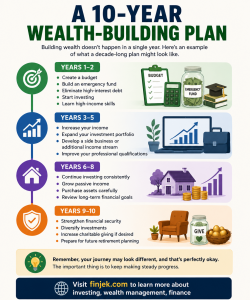
3–5 Years
- Increase your income
- Expand your investment portfolio
- Develop a side business or additional income stream
- Improve your professional qualifications
Years 6–8
- Continue investing consistently
- Grow passive income
- Purchase assets carefully
- Review long-term financial goals
Years 9–10
- Strengthen financial security
- Diversify investments
- Increase charitable giving if desired
- Prepare for future retirement planning
Remember, your journey may look different, and that’s perfectly okay. The important thing is to keep making steady progress.
⚠️ Warning:This timeline assumes consistent action, reasonable returns, and no catastrophic setbacks. Life intervenes — that’s why the emergency fund, insurance, and diversification matter. The timeline may shift, but the destination remains reachable.
Chapter 13: Giving, Legacy, and the Meaning of Wealth
No honest guide to wealth-building can end without addressing the question that every wealthy person eventually confronts: wealth for what?
The research on human happiness and money is nuanced. Up to a certain income threshold, more money genuinely does improve wellbeing — it removes stressors, expands options, and provides security. Beyond that threshold, the relationship between additional wealth and additional happiness becomes much weaker.
What consistently drives lasting satisfaction, according to decades of psychological research, is not the accumulation of wealth but the use of wealth: investing in experiences over things, spending money on others, contributing to causes that matter, and having the freedom to spend your time on work that feels meaningful.
The wealthy people who tend to be genuinely happy aren’t those who simply accumulated the most. They’re those who used their wealth as a vehicle for living according to their deepest values — whether that means creating jobs, funding research, supporting their families across generations, or simply having the freedom to spend their time exactly as they choose.
💡 Key Insight: The goal isn’t to die with the biggest number. The goal is to live with the most freedom, purpose, and generosity your resources allow.
Building wealth is a means, not an end. Define your end clearly. Build your means deliberately. And spend both your money and your time on the things that will matter most when you look back.
Frequently Asked Questions (FAQs)
Q. Can anyone become rich?
A. Many people can improve their financial situation significantly by increasing their income, controlling spending, investing wisely, and maintaining consistent financial habits. Results vary depending on personal circumstances, opportunities, and the time available to build wealth.
Q. What is the fastest way to get rich?
A. There is no guaranteed fast method. Most lasting wealth is built gradually through earning, saving, investing, and creating value for others. Be cautious of anyone promising quick riches or guaranteed returns.
Q. How much should I save every month?
A. A common guideline is to save at least 20% of your income if possible. However, even smaller, consistent contributions can make a meaningful difference over time.
Q. Should I invest before paying off debt?
A. It depends on the type of debt. High-interest debt is often a priority because the interest can outweigh potential investment returns. Lower-interest debt may allow for a balanced approach of paying down debt while investing. Consider your own financial situation carefully.
Q. Can I build wealth with a regular job?
A. Yes. Many financially successful people have built wealth through steady careers combined with disciplined saving and long-term investing.
Q. Is real estate the best investment?
A. Real estate can be a valuable investment, but it is not the only path to wealth. Stocks, index funds, businesses, and other diversified investments may also play an important role.
Q. How long does it take to become wealthy?
A. There is no fixed timeline. Factors such as income, savings rate, investment returns, and financial decisions all influence how quickly wealth grows. For many people, building substantial wealth is a long-term process measured in years or decades.
Q. What is the biggest mistake people make?
A. Many people spend more than they earn, avoid investing, carry expensive debt, or chase unrealistic “get rich quick” opportunities instead of following a long-term plan.
Summary: The Core Principles Condensed
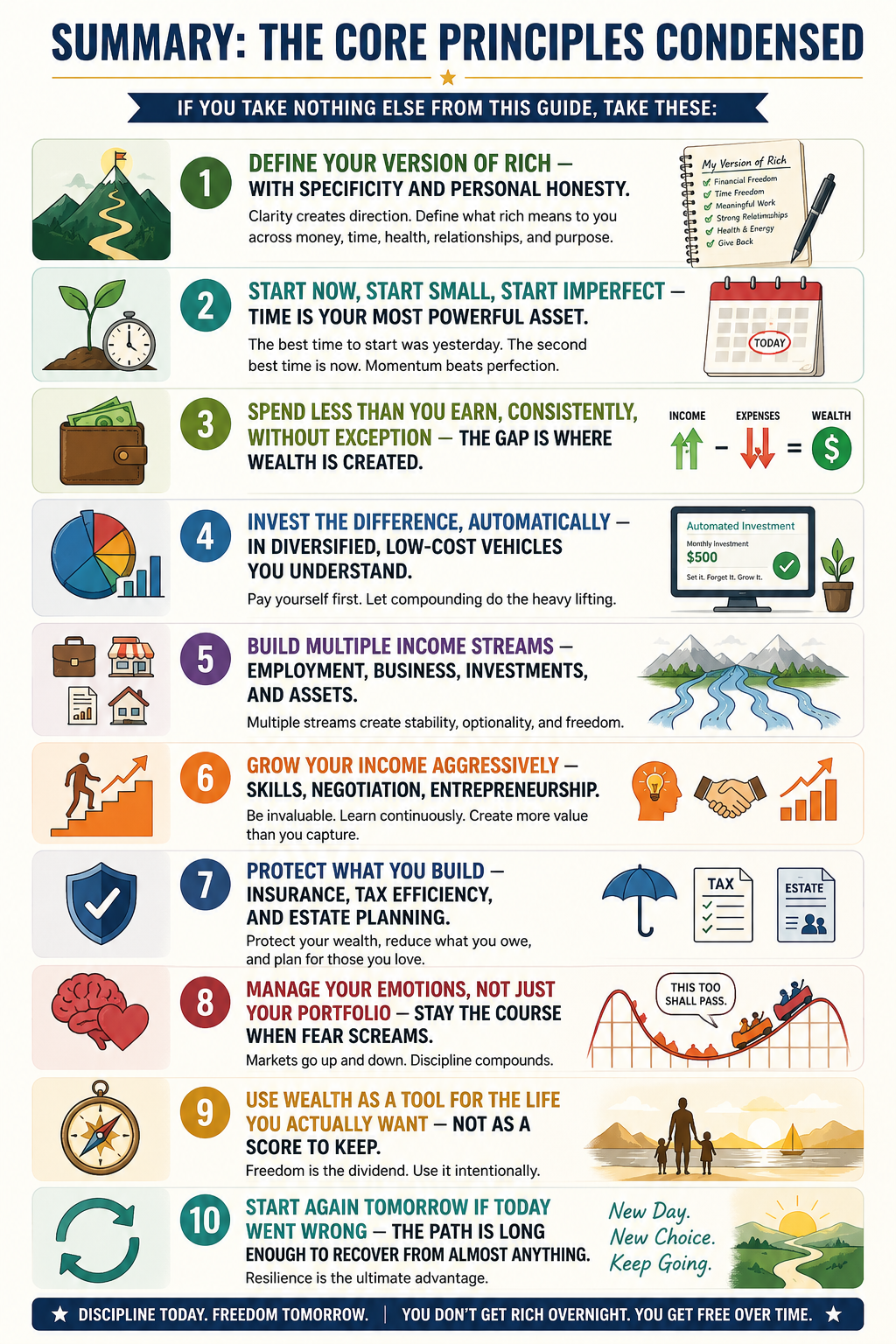
If you take nothing else from this guide, take these:
1. Define your version of rich — with specificity and personal honesty.
2. Start now, start small, start imperfect — time is your most powerful asset.
3. Spend less than you earn, consistently, without exception — the gap is where wealth is created.
4. Invest the difference, automatically — in diversified, low-cost vehicles you understand.
5. Build multiple income streams — employment, business, investments, and assets.
6. Grow your income aggressively — skills, negotiation, entrepreneurship.
7. Protect what you build — insurance, tax efficiency, and estate planning.
8. Manage your emotions, not just your portfolio — stay the course when fear screams.
9. Use wealth as a tool for the life you actually want — not as a score to keep.
10. Start again tomorrow if today went wrong — the path is long enough to recover from almost anything.
Final Thoughts: The Richest Thing You Can Do Today
The richest thing you can do today is not to make a large investment or land a new client — though both are wonderful. The richest thing you can do is make a decision.
A decision that this is the year you stop letting money happen to you and start making it work for you. A decision to read one more chapter, open one more account, save one more percent, negotiate one more raise.
Building wealth is a marathon, not a sprint. You don’t need to become rich overnight—you need to become a little stronger financially every day. Over time, those small improvements can lead to extraordinary results. Start today, stay consistent, and let your habits shape the financial future you want.
A Quick Recap & Final Inspiration
Every successful financial journey begins with a single step:
- Define what wealth means to you.
- Set clear financial goals.
- Increase your earning potential.
- Spend less than you earn.
- Save consistently.
- Invest for the long term.
- Build multiple income streams.
- Avoid unnecessary debt.
- Keep learning valuable skills.
- Stay disciplined and think long term.
There will be challenges along the way. Markets will rise and fall. Careers will change. Unexpected expenses will happen. What matters most is your ability to stay focused on your long-term goals.
The math works. It always has.
Your move.
NOTE: This article is written for educational and informational purposes. It does not constitute personalized financial advice. Please consult with a qualified financial professional before making significant investment or financial planning decisions.