

A generation ago, earning a steady paycheck from one employer was enough for many Americans to build a comfortable life. A full-time job could cover housing, groceries, healthcare, transportation, retirement savings, and even family vacations. Today, that reality has changed dramatically.
Across the United States, millions of households are feeling the pressure of rising costs. Grocery bills continue to climb, rent and home prices remain historically high in many areas, healthcare expenses consume larger portions of household budgets, and everyday necessities cost more than they did just a few years ago. While many workers have received raises, wage growth often struggles to keep pace with these increases.
Building multiple income streams is no longer reserved for entrepreneurs or wealthy investors. It has become one of the smartest financial strategies for anyone who wants greater stability, flexibility, and long-term financial confidence.
You’ll learn what’s driving this shift, the real risks of depending on a single paycheck, the most popular ways people are diversifying their earnings right now, and a practical step-by-step approach for starting your own second (or third) income stream — without burning out in the process.
Table of Contents
1. The Changing Reality of Income in America
For decades, a steady paycheck meant a stable life. That equation has changed. Over the past twenty years, earning a regular income has stopped guaranteeing financial comfort, and several forces explain why.
Why Do Americans Need Multiple Income Streams?
Millions of Americans now need multiple income streams because one paycheck often isn’t enough to keep up with inflation, rising living expenses, economic uncertainty, and changing employment trends. By earning money from several sources—such as freelancing, investing, side businesses, or passive income opportunities—individuals can reduce financial risk, increase stability, and work toward long-term wealth.
Living costs have climbed faster than paychecks. Housing, groceries, healthcare, and childcare now eat up a much bigger share of household budgets than they did a generation ago.
At the same time, wage growth hasn’t kept pace — many workers get modest annual raises that fail to match the actual rise in everyday expenses.
Here are some important points you need to know about why Americans need multiple income streams.
1. Inflation and Higher Expenses
Inflation has reshaped the financial lives of millions of Americans. While inflation rates fluctuate over time, higher prices often remain even after inflation begins to cool. That means households continue paying more for everyday necessities long after headlines suggest inflation is improving.
Consider just a few common expenses:
- Weekly grocery shopping costs significantly more than it did only a few years ago.
- Utility bills have increased in many regions.
- Housing costs remain one of the largest financial burdens for both homeowners and renters.
- Auto insurance premiums and maintenance expenses continue to rise.
- Healthcare deductibles and prescription costs consume a growing share of family budgets.
These higher expenses affect families across income levels. Even professionals earning six-figure salaries often report feeling greater financial pressure than they expected.
As a result, many Americans are looking beyond budgeting alone. They recognize that increasing income can be just as important as reducing expenses.
2. Wage Growth That Hasn’t Kept Pace
Many employers continue offering annual raises, but those increases don’t always reflect the true cost of living.
For example, receiving a 3% salary increase may seem encouraging. However, if essential expenses increase by 5% or more during the same period, purchasing power actually declines.
This gap between income growth and living expenses has encouraged workers to rethink how they earn money.
Instead of relying exclusively on traditional employment, many people now explore:
- Freelance work
- Weekend consulting
- Selling digital products
- Dividend investing
- Online tutoring
- E-commerce businesses
These additional income sources help offset the impact of rising costs while providing greater financial flexibility.
3. Job Insecurity Is the New Normal
One of the biggest financial lessons of the past decade is that no job is completely guaranteed.
Large corporations, startups, and even government agencies regularly face changes such as:
- Budget reductions
- Mergers
- Automation
- Department restructuring
- Artificial intelligence adoption
- Outsourcing
- Hiring freezes
- Economic downturns
Even highly skilled professionals with years of experience can unexpectedly lose their positions through no fault of their own.
If your entire financial life depends on one employer, a sudden layoff can quickly create stress.
Mortgage payments, student loans, childcare expenses, insurance premiums, and utility bills continue regardless of employment status.
That’s one reason why Americans need multiple income streams more than ever before. Additional sources of income create a financial safety net that continues working even if one paycheck disappears.
4. Employment Patterns Are Shifting
The traditional nine-to-five, one-employer career path is fading. More companies rely on contract workers, part-time staff, and gig labor to stay flexible. That flexibility benefits businesses, but it shifts financial risk onto workers, who now shoulder more responsibility for their own stability.
Put these four trends together, and it’s easy to see why economic challenges in the United States have pushed so many people to look beyond their main job for financial breathing room.
2. Why One Paycheck Is No Longer Enough
A steady paycheck still provides an important financial foundation. However, relying on only one income source exposes families to unnecessary risk.
Diversifying income creates greater resilience during both expected and unexpected life events.

Relying on one paycheck leaves households vulnerable during unexpected job loss.
- The Risk of a Single Point of Failure – If your entire financial life depends on one job, one employer, and one paycheck, then any disruption to that job disrupts everything: your rent, your groceries, your ability to pay down debt. There’s no cushion, no backup plan, and no room for error.
- Emergencies Don’t Wait for Convenient Timing – Cars break down. Roofs leak. Medical bills show up uninvited. According to multiple national surveys, a large portion of American adults would struggle to cover a surprise $1,000 expense without borrowing money or selling something. A second income stream — even a modest one — can be the difference between handling a crisis calmly and spiraling into debt.
- Diversification Isn’t Just for Investors: Financial advisors have preached diversification for decades when it comes to stocks and bonds. The same logic applies to your income. If one stream dries up — a layoff, a slow season, a client who disappears — the others keep you afloat while you regroup. This is the heart of financial security in uncertain times: not eliminating risk, but spreading it out so no single setback becomes a full-blown crisis.
3. The Rise of Multiple Income Streams
The idea of earning money from multiple sources isn’t new, but the tools available today make it far more accessible than it used to be.
- Side hustles — driving for a rideshare app, tutoring, pet-sitting, or selling handmade goods on weekends
- Freelancing — writing, graphic design, bookkeeping, virtual assistance, and web development, all doable from a laptop
- Online businesses — dropshipping stores, print-on-demand shops, and niche e-commerce brands
- Investments — stocks, index funds, real estate investment trusts (REITs), and bonds that generate returns over time
- Digital income opportunities — selling online courses, digital templates, stock photography, or affiliate marketing
- Entrepreneurship — launching a small local business, a consulting practice, or a service-based company
What’s changed is accessibility. A smartphone and an internet connection now open doors that once required significant capital or connections.
Anyone with a skill, a bit of time, and some patience can start building a second income stream this month, not “someday.”
Side Hustles Continue to Grow
One of the biggest financial trends in recent years is the rise of side hustles. These part-time income opportunities allow people to earn extra money without leaving their full-time jobs.
Unlike traditional second jobs with fixed schedules, many side hustles offer flexibility. You can work evenings, weekends, or whenever your schedule allows.
Popular side hustles in America include:
- Driving for ride-sharing platforms
- Food and grocery delivery
- Pet sitting and dog walking
- Lawn care and landscaping
- Photography
- Event planning
- House cleaning
- Furniture flipping
- Mobile car detailing
- Personal fitness coaching
Many of these opportunities require little upfront investment and can begin generating income within weeks.
Real-world example:
A teacher who tutors students online for 10 hours each week could earn several hundred dollars a month while helping students improve academically. That additional income might cover groceries, utility bills, or monthly retirement contributions.
4. Benefits of Building Multiple Income Sources
Creating additional income streams isn’t just about making more money. It provides meaningful financial and personal advantages that can improve your quality of life over time.
-
Greater Financial Stability
Financial stability starts with reducing dependence on a single source of income.
Imagine two households:
- Household A relies entirely on one salary.
- Household B earns income from a salary, freelance work, dividends, and an online business.
If both employees lose their jobs, Household B still has other income sources helping to cover expenses.
This diversified approach reduces financial stress and creates greater resilience during economic uncertainty.
-
More Freedom and Flexibility
Extra income provides choices.
Rather than living paycheck to paycheck, additional earnings allow people to:
- Travel more often
- Reduce working hours
- Change careers
- Spend more time with family
- Pursue education
- Start businesses
- Volunteer in their communities
Financial freedom isn’t only about becoming wealthy. It’s about having options.
-
Protection During Job Loss
Layoffs can happen without warning.
Workers who already earn money from several sources often recover more quickly because they aren’t starting from zero.
For example, someone earning an extra $2,000 each month through consulting or freelancing may experience far less financial disruption after losing a traditional job than someone who depends entirely on one paycheck.
-
Faster Progress Toward Financial Goals
Extra income accelerates nearly every financial objective.
Additional earnings can help you:
- Build an emergency fund
- Eliminate credit card debt
- Pay off student loans
- Save for a down payment
- Increase retirement contributions
- Invest consistently
- Fund children’s education
Even an extra $500 per month invested consistently can grow significantly over the long term through the power of compound returns.
-
Reduced Financial Stress
Money remains one of the leading causes of stress for many households.
Knowing you have multiple ways to earn income creates peace of mind.
Instead of worrying about every unexpected expense, you gain confidence that your finances can better withstand life’s challenges.
This emotional benefit often proves just as valuable as the financial rewards themselves.
5. Popular Ways Americans Are Creating Extra Income
Here’s a closer look at the specific paths people are actually using right now to grow their earnings:
- Freelance work — Platforms connect skilled workers with clients needing writing, design, marketing, or technical help
- Consulting — Professionals with specialized expertise offer paid advice to businesses in their field
- E-commerce — Selling physical or digital products through an online storefront, often run in the evenings or on weekends
- Content creation — Building an audience on YouTube, blogs, or social platforms and monetizing through ads, sponsorships, or products
- Real estate income — Renting out a spare room, an investment property, or even a parking spot for steady monthly cash flow
- Dividend investing — Building a portfolio of dividend-paying stocks or funds that pay out income on a regular schedule
- Online education — Creating and selling courses, coaching sessions, or tutoring services in a subject you know well
- Remote work opportunities — Taking on a second part-time remote job that fits around a primary career
Most people don’t start with all of these at once. They pick one that matches their skills and schedule, get comfortable with it, and expand from there.
6. Challenges of Managing Multiple Income Streams
Building multiple income streams can improve your financial future, but it also comes with responsibilities. Understanding these challenges ahead of time can help you create sustainable habits and avoid common mistakes.
1. Time Management
Time is your most valuable resource. If you’re working a full-time job while building a side business or freelancing, your schedule can become overwhelming.
Instead of trying to do everything at once, focus on one additional income stream until it becomes manageable. Use digital calendars, task management apps, or time-blocking techniques to stay organized.
Tips for better time management:
- Schedule dedicated work hours for your side income.
- Prioritize high-value tasks.
- Eliminate distractions while working.
- Batch similar tasks together.
- Review your weekly progress every Sunday.
Consistency matters far more than working long hours occasionally.
2. Avoiding Burnout
Many people become excited about earning more money and end up working every evening and weekend. While hard work is important, burnout can quickly reduce productivity and harm your physical and mental health.
Make time for:
- Family and friends
- Exercise
- Adequate sleep
- Hobbies
- Vacations
- Personal downtime
Remember that your goal isn’t simply to make more money—it’s to improve your quality of life.
3. Learning New Skills
Every income stream requires different skills.
You might need to learn:
- Digital marketing
- SEO
- Sales
- Accounting
- Website management
- Customer service
- Video editing
- Social media marketing
- Investing basics
The good news is that thousands of affordable online courses, books, podcasts, and tutorials make learning easier than ever.
Investing in your education often produces one of the highest returns you’ll ever earn.
4. Maintaining Consistency
Most successful income streams don’t generate significant profits overnight.
Many people quit too early because they expect immediate results.
Whether you’re building a blog, YouTube channel, freelance business, or online store, growth takes time.
Think of each income stream as planting a tree. It requires consistent care before it begins producing fruit.
Small daily improvements often lead to remarkable long-term success.
5. Managing Taxes and Finances
As your income grows, your financial responsibilities become more complex.
Keep detailed records of:
- Income
- Business expenses
- Receipts
- Mileage
- Equipment purchases
- Software subscriptions
Consider opening a separate bank account for your business activities and consult a qualified tax professional if your side income grows substantially.
Good financial organization saves time, reduces stress, and helps you maximize deductions.
7. How to Start Building Multiple Income Streams
Here’s a practical, step-by-step approach that works for most people, regardless of their starting point.
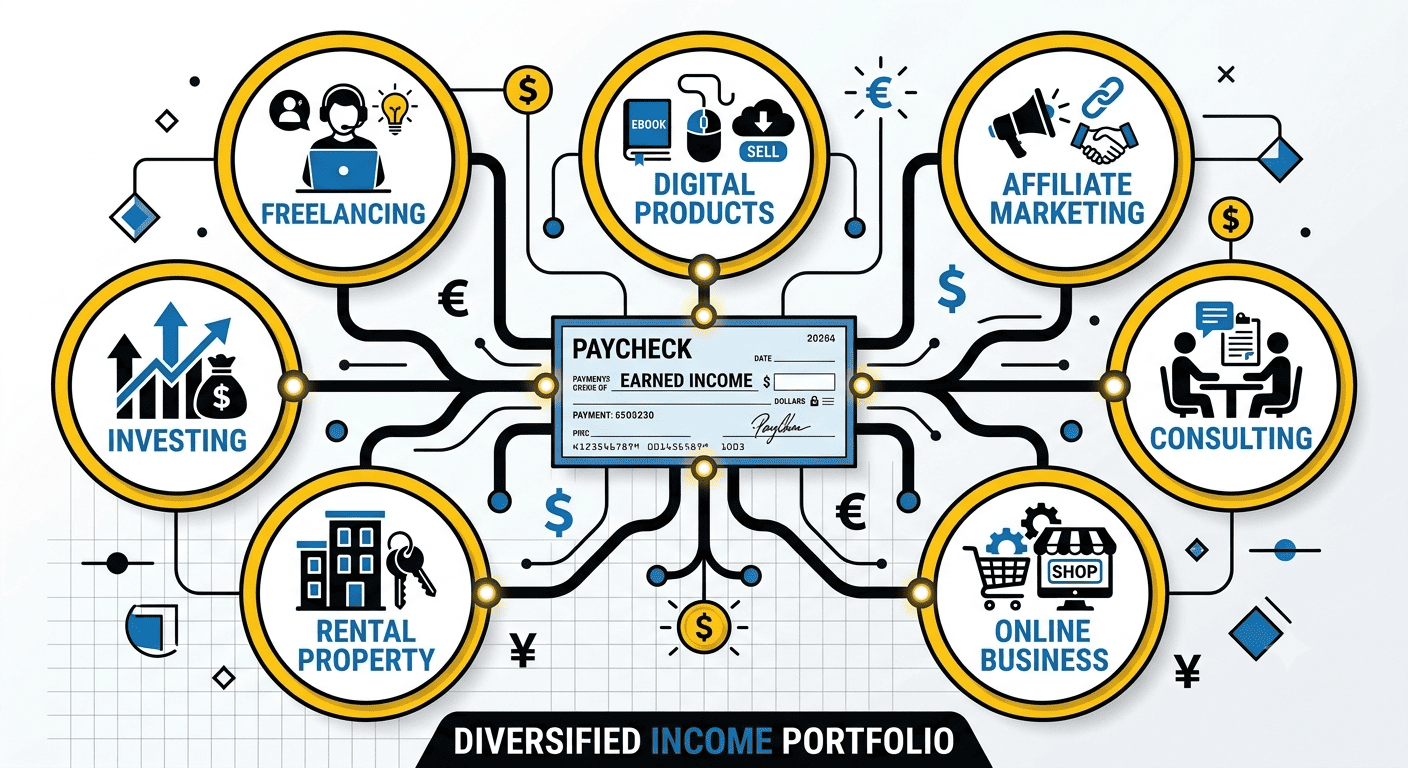
Diversifying income reduces financial risk and improves long-term stability.
1: Evaluate Your Existing Skills. Look at what you already know how to do — writing, organizing, teaching, fixing things, designing, negotiating. Your first income stream is usually hiding in a skill you already have, not something you need to learn from scratch.
2: Choose Realistic Opportunities. Match the opportunity to your actual schedule and energy level. A single parent working full-time probably shouldn’t launch a demanding e-commerce store overnight. Pick something that fits your current life, not your ideal one.
3: Start Small and Test the Waters. Don’t quit your job or invest your savings on day one. Take on one freelance project. List one item for sale. Buy a small amount of a dividend stock. Small starts reduce risk and build confidence.
4: Build Systems, Not Just Effort. As your side income grows, create simple systems — templates for client emails, a content calendar, automated savings transfers into investments. Systems save time and reduce the mental load of running multiple income sources.
5: Track Your Income Growth. Keep a simple spreadsheet or app that shows what each stream earns monthly. Tracking progress keeps you motivated and helps you spot which streams deserve more of your time and which ones aren’t worth continuing.
These steps reflect proven personal finance strategies used by people who’ve successfully diversified their income without upending their lives.
Key Takeaways
If you remember only a few things from this guide, let them be these:
- Relying on one paycheck has become increasingly risky.
- Inflation and rising living costs continue to pressure household budgets.
- Income diversification improves financial security.
- Building multiple income streams takes time, not perfection.
- Start with one opportunity and grow consistently.
- Investing in your skills often produces the highest long-term returns.
- Financial resilience comes from creating options—not depending on one employer.
Conclusion
America’s financial landscape has changed. Inflation, rising household expenses, evolving workplaces, and economic uncertainty have made it increasingly difficult for many families to depend on just one paycheck.
Building multiple income streams is no longer reserved for entrepreneurs or investors. It has become a practical strategy for improving financial security in uncertain times, reducing risk, and creating greater freedom.
Whether you choose freelancing, investing, launching an online business, consulting, real estate, or another opportunity, the key is to begin with one realistic step. Over time, consistent effort can transform a small side income into a meaningful source of financial stability.
The future belongs to people who adapt, diversify, and continue developing valuable skills. By taking action today, you can strengthen your financial foundation and build wealth beyond a single paycheck.
Building wealth beyond a paycheck starts with one small step. Pick one skill, one opportunity, one hour a week — and start there. Financial resilience isn’t built overnight, but it is built, one income stream at a time.
PRO TIP: Ready to take control of your financial future? Start by identifying one skill you already have, choose a realistic income opportunity, and commit to taking your first step this week. Building multiple income streams doesn’t happen overnight, but every small action moves you closer to greater financial security, resilience, and long-term wealth.
Frequently Asked Questions
1. Why do Americans need multiple income streams today?
Rising living costs, stagnant wages, and increasing job insecurity mean a single paycheck often isn’t enough to cover expenses or protect against financial emergencies. Multiple income streams spread out risk and provide a financial cushion.
2. What is the easiest way to start a second income stream?
Freelancing based on an existing skill — like writing, design, or virtual assistance — is usually the fastest and lowest-cost way to start earning extra income, since it requires no upfront investment.
3. Can passive income really replace a full-time job?
For most people, passive income supplements rather than replaces a primary job, at least initially. Over years of consistent investing or building assets like rental property or dividend portfolios, it can eventually cover a significant portion of expenses.
4. How many income streams should the average person have?
There’s no fixed number. Many financial experts suggest aiming for two to three income sources — a main job plus one or two side streams — to create meaningful financial security without overwhelming your schedule.
5. Is it risky to rely only on one job in today’s economy?
Yes. Layoffs, automation, and economic shifts can affect even stable-seeming jobs. Diversifying income reduces the impact of losing any single source and builds long-term financial resilience.
Ready to build your own financial safety net? Start with just one income stream this month — whether it’s freelancing a skill you already have, investing your first $50 into dividend stocks, or listing your first product online.
The best time to diversify your income was years ago. The second-best time is today.