

Investment banking remains one of the most competitive and financially rewarding career paths in the finance world. It attracts ambitious individuals who thrive under pressure, enjoy solving complex problems, and want to work at the center of major corporate deals. Investment bankers assist corporations, governments, and institutional entities to work on billion-dollar business transactions, raising capital, executing mergers and acquisitions (M&A), and navigating complex financial transactions.
This guide breaks down everything you need to know to break into the field.
For many students and young professionals, investment banking represents more than just a job.
It is a career that combines finance, strategy, problem-solving, and business leadership. The profession is known for its challenging work environment, excellent learning opportunities, and attractive compensation packages.
However, becoming an investment banker requires dedication, technical expertise, continuous learning, and strong interpersonal skills.
Whether you are a high school student exploring career options, a university graduate preparing for interviews, or a working professional planning a career transition, this guide will provide a clear roadmap to help you understand what it takes to succeed in investment banking.
By the end of this article, you will know:
- What investment banking is
- What investment bankers do
- The educational qualifications you need
- Essential technical and soft skills
- Certifications that improve your profile
- Salary expectations
- Career progression
- Common interview questions
- Practical tips to land your first job
- Future opportunities in investment banking
“A man always has two reasons for what he does—a good one, and the real one.” — J.P. Morgan
Table of Contents
Part 1: The Basics – Ultimate Guide to IB
Here’s the first part of your investment banking guide, covering the fundamentals.
- Definition
- History
- Why Investment Banking Matters
- Types of Investment Banks
- Commercial vs Investment Banking
- Why Consider a Career in Investment Banking?
1.1. History of Investment Banking
Investment banking has evolved over several centuries.
In the 18th and 19th centuries, merchant banks in Europe facilitated international trade by financing commercial ventures and government projects.
As global economies industrialized, investment banks became increasingly involved in raising capital for railways, manufacturing companies, and infrastructure projects.
During the 20th century, financial markets expanded rapidly. Investment banks began offering services such as underwriting securities, advising on mergers and acquisitions, managing public offerings, and conducting sophisticated financial research.
Today, investment banking has become a global industry supported by advanced technology, data analytics, artificial intelligence, and international financial markets.
Before start learning the different aspects of investment banking career, you’ll need to know:
1.2. What Is Investment Banking?
Investment banking is a specialized area of finance that helps businesses, governments, and institutions raise capital, manage complex financial transactions, and achieve strategic growth objectives.

Unlike commercial banks, which primarily provide services such as savings accounts, personal loans, and mortgages to individuals and small businesses, investment banks focus on large-scale financial activities for corporations, institutional investors, and governments.
Their work involves advising clients on how to raise money, buy or sell businesses, issue shares, issue bonds, restructure debt, and make significant investment decisions.
Simply put, investment banks act as financial advisors and intermediaries, helping organizations access capital and execute major financial transactions efficiently.
1.3. Why Is Investment Banking Important?
Every growing business eventually requires capital to expand, acquire competitors, launch new products, or enter new markets. Governments also need financing to build infrastructure, improve public services, and stimulate economic development.
Investment banks play a crucial role in connecting organizations with investors who are willing to provide capital.
Without investment banks, many large-scale projects and corporate expansions would be far more difficult to finance.
Their expertise also helps businesses reduce financial risk, identify growth opportunities, and maximize shareholder value.
1.4. What Does an Investment Banker Do?
The role of an investment banker extends far beyond buying and selling stocks. Investment bankers act as intermediaries between companies and investors.
Instead, investment bankers serve as trusted advisors who help organizations make informed financial decisions.
Their responsibilities often include:
- Raising Capital – Companies require funding to grow. Investment bankers help them secure capital through equity offerings, debt financing, private placements, and other financial instruments.
- Advising on Mergers and Acquisitions – When one company plans to acquire another or merge with a competitor, investment bankers evaluate the financial implications, negotiate terms, and guide both parties throughout the transaction.
- Business Valuation – Determining the value of a company is a critical part of many financial transactions. Investment bankers use various valuation techniques to estimate a company’s fair market value.
- Financial Modeling – Investment bankers build detailed financial models that forecast future revenues, expenses, profits, and cash flows. These models help clients make informed business decisions.
- Initial Public Offerings (IPOs) – When a private company decides to become publicly traded, investment bankers manage the IPO process by preparing documentation, pricing shares, and marketing the offering to investors.
- Debt and Equity Financing – Organizations often need financing for expansion, acquisitions, or operational improvements. Investment bankers recommend suitable financing strategies based on market conditions and the client’s financial objectives.
- Strategic Financial Advice – Investment bankers advise senior executives on capital allocation, restructuring, investment opportunities, and long-term business strategy.
These are some important responsibilities to know before becoming an IB.
1.5. Commercial Banking vs. Investment Banking
Though both fall under the broader banking industry, commercial banking and investment banking serve very different purposes, clients, and functions. Understanding the distinction helps clarify why career paths, skill sets, and work environments differ so much between the two.
1- Core Purpose
- Commercial banks primarily serve individuals and businesses by accepting deposits and providing loans. Their core function is to facilitate everyday financial activities like checking and savings accounts, mortgages, and business loans.
- Investment banks focus on helping corporations, governments, and institutions raise capital, execute mergers and acquisitions, and navigate complex financial transactions. They don’t typically deal with everyday consumer banking needs.
2- Primary Clients
- Commercial banks serve a broad range of clients, including individual consumers, small businesses, and large corporations seeking basic banking services like loans and deposit accounts.
- Investment banks work almost exclusively with institutional clients — large corporations, governments, private equity firms, and hedge funds — who need help with capital raising, deal advisory, or trading.
Key Services Offered!
| Aspect | Commercial Banking | Investment Banking |
|---|---|---|
| Core Activity | Accepting deposits, issuing loans | Underwriting, M&A advisory, trading |
| Revenue Source | Interest income, fees | Advisory fees, underwriting fees, trading profits |
| Risk Profile | Generally lower risk | Higher risk, tied to market performance |
| Regulation | Heavily regulated for consumer protection | Regulated but with more transaction-based oversight |
| Client Interaction | Ongoing, relationship-based | Deal-based, often project-specific |
1.6. Who Can Become an Investment Banker?
One common misconception is that only finance graduates can enter investment banking.
In reality, investment banks recruit talented individuals from a variety of academic backgrounds, provided they possess strong analytical abilities and a willingness to learn.
Common educational backgrounds include:
- Finance
- Accounting
- Economics
- Mathematics
- Statistics
- Engineering
- Computer Science
- Business Administration
- Physics
- Data Science
Professionals from non-finance disciplines often strengthen their profiles by learning accounting, valuation techniques, financial modeling, and corporate finance before applying for investment banking roles.
1.7. Why Consider a Career in Investment Banking?
Investment banking continues to attract ambitious professionals for several compelling reasons.
- High Earning Potential – Investment banking is known for offering competitive salaries, performance bonuses, and long-term financial growth opportunities.
- Continuous Learning – Few careers expose professionals to such a wide range of industries, business models, and financial transactions.
- Global Career Opportunities – Leading investment banks operate in major financial centers worldwide, creating opportunities for international careers.
- Professional Development – Investment banking develops analytical thinking, financial expertise, communication skills, leadership, and problem-solving abilities that remain valuable throughout your career.
- Strong Exit Opportunities – Many investment bankers later transition into private equity, venture capital, corporate finance, consulting, entrepreneurship, or executive leadership roles.
1.8. Is Investment Banking the Right Career for You?
Investment banking is best suited for individuals who enjoy solving complex problems, working with numbers, analyzing businesses, and performing well in fast-paced environments.
You may find this career rewarding if you:
- Enjoy finance and economics.
- Have strong analytical skills.
- Like learning continuously.
- Work well under pressure.
- Communicate effectively with others.
- Pay close attention to detail.
- Are comfortable working on challenging projects.
- Thrive in competitive environments.
On the other hand, if you prefer predictable working hours or a slower-paced career, you may wish to explore other areas of finance.
“Bankers are the architects of finance, building fragile edifices on uncertain foundations.” — Paul Volcker
Part 2: Education, Skills, Certifications & Career
In the previous section, you learned what investment banking is, what investment bankers do, and why this career is considered one of the most respected professions in finance.
Now it’s time to explore the practical steps that will help you build a successful career in investment banking.
While there is no single path to becoming an investment banker, most successful professionals follow a structured approach that combines education, technical skills, practical experience, and continuous learning.
2.1. Educational Foundation to Become an IB
A strong educational base is often the first real checkpoint on the path to investment banking. While it’s not the only factor recruiters weigh, it shapes how competitive your application looks and how prepared you are for the technical demands of the job.
2.1.1. Choose a Relevant Degree
Most investment banks favor candidates with a bachelor’s degree in finance, economics, accounting, business administration, or mathematics. These fields build the quantitative and analytical foundation needed for tasks like financial modeling, valuation, and interpreting financial statements. That said, banks do hire from other disciplines — engineering, physics, and computer science majors, for example — as long as the candidate can demonstrate strong analytical ability and a genuine interest in finance.
2.1.2. Target the Right Universities
Top-tier banks tend to concentrate their campus recruiting efforts at a select group of universities known for strong finance or business programs. Attending one of these schools can make it easier to access recruiting events, alumni networks, and referrals. However, this isn’t a hard requirement — candidates from other schools regularly break in by networking aggressively, pursuing internships independently, and reaching out directly to bankers for informational interviews.
2.1.3 Prioritize Quantitative Coursework
Regardless of major, coursework in accounting, corporate finance, statistics, and financial modeling adds real credibility to a resume. These classes also build the technical vocabulary needed to perform well in interviews, where questions on valuation methods and accounting concepts are standard.
2.1.4. Consider an MBA for a Later Entry Point
For those who don’t break into banking directly out of undergrad — or who started their careers in a different field — a Master of Business Administration from a well-regarded program is a common route into associate-level roles. MBA programs often have dedicated finance career tracks, on-campus recruiting pipelines, and summer internships that convert into full-time offers.
2.1.5. Supplement Formal Education with Self-Study
Because university coursework doesn’t always cover the specific technical skills banks expect, many aspiring bankers supplement their education with independent study or specialized courses in financial modeling, valuation techniques, and industry-specific knowledge. This extra effort often makes the difference in interviews, where practical technical fluency is tested directly.
Together, these educational building blocks don’t guarantee a role, but they create the foundation recruiters look for — and they make the rest of the preparation (skills, internships, networking) far more effective.
2.2. Building Core Skills for Investment Banking
Getting hired is only the first hurdle — succeeding in investment banking requires a specific set of technical and interpersonal skills. Building these early gives candidates a real edge in interviews and a smoother transition once on the job.
Financial Modeling
At the heart of investment banking work is the ability to build accurate, flexible financial models. This includes:
- Discounted Cash Flow (DCF) Analysis: Estimating a company’s value based on projected future cash flows.
- Comparable Company Analysis (Comps): Valuing a business by comparing it to similar publicly traded companies.
- Precedent Transaction Analysis: Valuing a company based on past M&A deals in the same industry.
- Leveraged Buyout (LBO) Modeling: Assessing the feasibility and returns of acquiring a company primarily through debt financing.
These models form the backbone of pitch books, deal recommendations, and client presentations, so accuracy and speed matter enormously.
2.3. Types of Investment Banking Services
Investment banks don’t do just one thing — they operate through several distinct service lines, each serving different client needs. Understanding these divisions helps clarify what different teams within a bank actually do day to day.
1. Mergers and Acquisitions (M&A) Advisory
This is one of the most well-known functions of investment banking. Bankers in M&A advise companies on buying, selling, or merging with other businesses. Their work includes valuing target companies, structuring deals, negotiating terms, and guiding clients through due diligence and regulatory approval.
2. Capital Raising (Underwriting)
Investment banks help companies and governments raise money by issuing securities. This falls into two main categories:
- Equity Capital Markets (ECM): Assisting companies in raising funds through stock issuances, including Initial Public Offerings (IPOs) and follow-on offerings.
- Debt Capital Markets (DCM): Helping clients raise funds through bond issuances or other debt instruments, often used for expansion, refinancing, or large projects.
3. Sales and Trading
This division facilitates the buying and selling of securities on behalf of clients, as well as for the bank’s own accounts in some cases. Sales teams build relationships with institutional investors, while traders execute transactions and manage risk tied to market movements.
4. Equity Research
Research analysts study public companies and industries, producing reports with earnings forecasts, valuation estimates, and buy/sell/hold recommendations. This research supports both the bank’s trading desks and its institutional clients making investment decisions.
5. Asset Management
Some investment banks also manage money on behalf of individuals, corporations, and institutions, aiming to grow their clients’ wealth through diversified investment strategies across asset classes like equities, bonds, and alternative investments.
6. Wealth Management
Closely related to asset management, this service focuses on high-net-worth individuals, offering personalized financial planning, investment advice, and portfolio management tailored to each client’s goals.
7. Restructuring Advisory
When companies face financial distress, restructuring teams advise on reorganizing debt, negotiating with creditors, or navigating bankruptcy proceedings to help the business stabilize or emerge stronger.
8. Leveraged Finance
This specialized area focuses on helping companies raise debt for high-risk transactions, such as leveraged buyouts (LBOs), where a company is acquired primarily using borrowed money.
9. Syndicated Lending
Banks often arrange large loans that are too big for a single lender to provide alone. In syndicated lending, multiple banks pool resources to fund a single borrower, spreading out the risk.
Each of these service lines requires a slightly different skill set, but they all share a common foundation in financial analysis, client relationship management, and deal execution — which is why building strong core skills early on pays off no matter which path a banker eventually specializes in.
2.4. Gaining Relevant Experience for Investment Banking
Landing a role in investment banking rarely comes down to grades alone — real-world exposure to finance, deal work, or related fields is often what separates a strong candidate from the rest. Here’s how to build that experience strategically.
Start with Internships
Internships are the single most important stepping stone into investment banking.
Most banks fill the majority of their full-time analyst classes from their summer internship programs, typically recruiting rising seniors or, increasingly, sophomores and juniors through earlier “spring week” or freshman programs.
Performing well during an internship — and converting it into a full-time offer — is the most direct path into the industry.
Apply Early and Broadly
Recruiting timelines in investment banking have moved earlier and earlier, with some banks locking in interns more than a year before the internship actually starts.
Applying broadly across bulge bracket banks, boutique firms, and middle-market banks increases the odds of landing at least one offer, since competition for any single seat is intense.
Seek Out Related Roles as Stepping Stones
If a direct internship offer isn’t available right away, related experience can still build a strong resume. Useful stepping-stone roles include:
- Equity research – builds strong valuation and industry analysis skills
- Corporate finance or FP&A roles – develops financial modeling and forecasting experience
- Private equity or venture capital internships – exposes candidates to deal structuring and due diligence
- Big Four accounting firms – particularly transaction advisory or valuation services groups
- Boutique investment banks – often more open to non-traditional candidates and can serve as a launchpad to larger firms later
Participate in Finance Clubs and Case Competitions
Joining a university investment banking or finance club provides hands-on practice building pitch books, running stock pitches, and networking with alumni already working in the industry.
Case competitions, in particular, simulate real deal scenarios and give candidates tangible examples to discuss in interviews.
Build a Portfolio of Independent Projects
Candidates without direct finance internships can still demonstrate initiative by independently building financial models, writing equity research reports on public companies, or analyzing hypothetical M&A deals.
These self-directed projects show genuine interest and technical capability, and they give interviewers concrete work to discuss.
Network Relentlessly
Informational interviews and networking calls with current bankers — especially alumni from the same school — often lead directly to referrals, which significantly increase the chances of getting an interview.
Many candidates land offers not purely through cold applications, but through relationships built over months of coffee chats and follow-up conversations.
Leverage Referral Programs
Many banks offer formal or informal referral systems where current employees can recommend candidates directly to recruiters. A strong referral, built through genuine networking rather than a one-off email, can help a resume stand out in a pile of thousands of applications.
Consider a Lateral Move
For those already working in adjacent fields like accounting, corporate development, or consulting, moving laterally into investment banking is a well-established path. Building relevant technical skills, networking with bankers, and applying for associate-level lateral openings can open doors even after a candidate has already started a career elsewhere.
2.5. Don’t Underestimate Soft Experience
Leadership roles in student organizations, part-time jobs that demonstrate work ethic, and even unrelated internships that show strong analytical or communication skills all contribute to a well-rounded application.
Essential Soft Skills
Technical expertise alone will not guarantee success.
Investment bankers also need excellent interpersonal skills.
- Communication – Professionals must explain complex financial concepts to executives, investors, and clients in a clear and confident manner.
- Teamwork – Large financial transactions involve lawyers, accountants, consultants, and senior bankers working together. Collaboration is essential.
- Time Management – Investment bankers often manage multiple projects simultaneously while meeting strict deadlines. Effective prioritization is critical.
- Problem-Solving – Every transaction presents unique challenges. Creative thinking and logical analysis help professionals develop practical solutions.
- Attention to Detail – Even a small error in a valuation model or presentation can affect important business decisions. Accuracy is one of the most respected qualities in investment banking.
- Adaptability – Financial markets evolve constantly. Successful investment bankers embrace change and continue learning throughout their careers.
Recruiters look for evidence of drive, resilience, and the ability to handle pressure — qualities that don’t always come from finance-specific experience alone.
Building relevant experience is rarely a straight line. Most successful candidates combine several of these strategies — internships, networking, independent projects, and stepping-stone roles — to steadily strengthen their candidacy over one or two years before finally breaking in.
2.6. Certifications That Add Value in Investment Banking
While no certification is strictly required to break into investment banking, certain credentials can strengthen a resume, demonstrate technical commitment, and help candidates — especially those from non-traditional backgrounds — stand out in a competitive applicant pool.
1- Chartered Financial Analyst (CFA)
The CFA is one of the most respected credentials in the finance industry. It covers investment analysis, portfolio management, ethics, and valuation in depth across three rigorous exam levels. While it’s more commonly associated with asset management and equity research, having a CFA charter (or even progress through the exams) signals strong technical knowledge and dedication, which can help candidates transitioning from other fields or looking to move up within the industry.
2- Financial Modeling Certifications
Various financial modeling and valuation certificate programs teach the practical skills used daily in investment banking, such as building DCF models, LBO models, and comparable company analyses. These programs are especially useful for candidates without formal finance coursework, helping close the technical gap before interviews.
3- Series Licenses (Region-Specific)
In many countries, entry-level investment bankers are required to hold specific securities licenses to legally perform certain functions, such as executing trades or advising on securities transactions. These licenses are usually sponsored by the employer and completed after hiring, so they aren’t typically pursued beforehand, but candidates should be aware they’ll need to obtain them once employed.
4- Chartered Alternative Investment Analyst (CAIA)
For those interested in specializing in alternative investments — private equity, hedge funds, real estate, or infrastructure — the CAIA designation provides focused expertise. It’s less common than the CFA but can be valuable for bankers working closely with alternative asset clients.
5- Financial Risk Manager (FRM)
The FRM certification focuses on risk management, which is particularly relevant for bankers working in areas like structured finance, leveraged finance, or capital markets, where understanding and quantifying risk is central to the role.
6- Bloomberg Market Concepts (BMC)
This shorter, more accessible certification introduces candidates to financial markets, economic indicators, and the Bloomberg Terminal — a tool used extensively in trading and research roles. It’s a relatively quick way for students to demonstrate market familiarity on a resume.
7- Excel and Financial Analysis Courses
While not formal certifications in the traditional sense, completing recognized courses in advanced Excel, financial statement analysis, or valuation techniques can be listed on a resume to show proactive skill-building, particularly for candidates applying without a finance-heavy academic background.
Do Certifications Guarantee a Job?
It’s worth being clear-eyed here: certifications alone won’t secure an investment banking offer. Recruiters weight internships, networking, and interview performance far more heavily. However, certifications can serve as a differentiator — especially for career changers, candidates from non-target schools, or those trying to demonstrate technical seriousness before landing their first internship or full-time role.
Choosing the Right Certification for Your Stage
- Undergraduates early in their studies often benefit most from financial modeling courses and BMC, since these are quick to complete and directly relevant to interview prep.
- Career changers or those without a finance background may find the CFA or a structured modeling certificate more valuable for building credibility.
- Those targeting specialized divisions (like risk or alternatives) should consider certifications aligned with that specific path, such as the FRM or CAIA.
Ultimately, certifications work best as a complement to hands-on experience and networking — not a replacement for them.
2.7. Online Learning Can Accelerate Your Career
Traditional education provides theoretical knowledge, but online learning allows you to develop practical skills that employers value.
Some useful topics include:
- Financial Modeling
- Corporate Finance
- Valuation
- Financial Statement Analysis
- Excel for Finance
- PowerPoint Presentations
- Business Communication
- Data Visualization
- Accounting Fundamentals
- Capital Markets
Continuous learning demonstrates curiosity and commitment—qualities that employers appreciate.
In the previous sections, you learned about investment banking, educational requirements, technical skills, certifications, and the roadmap to entering the industry. However, having the right qualifications is only half the journey. The next challenge is securing your first investment banking job.
Investment banks receive thousands of applications every year, but only a small percentage of candidates make it to the interview stage. The difference between a successful applicant and one who gets rejected often comes down to practical experience, networking, preparation, and attention to detail.
“The premise of accepting a job at an investment bank is the understanding that you are ‘rewarded’ for the risk of taking on a job that is not a career but rather a ‘financial relationship’ where you must be worth more than what you are being paid today.” — Karen Ho
Part 3: Internships, Resume, Interviews, Salary, and Career Growth
In the previous sections, you learned about investment banking, educational requirements, technical skills, certifications, and the roadmap to entering the industry.The next challenge is securing your first investment banking job.
Investment banks receive thousands of applications every year, but only a small percentage of candidates make it to the interview stage. The difference between a successful applicant and one who gets rejected often comes down to practical experience, networking, preparation, and attention to detail.
This section explains how to stand out from other applicants and build a career that continues to grow over the long term.
3.1. Why Internships Matter?
If there is one factor that significantly increases your chances of receiving a full-time investment banking offer, it is completing a relevant internship.
Investment banks use internships to identify talented students before graduation. Many firms extend full-time offers to interns who perform well during their internship programs.
An internship allows you to:
- Apply classroom knowledge to real business situations.
- Learn how investment banking teams operate.
- Build relationships with experienced professionals.
- Develop technical skills under supervision.
- Strengthen your resume with practical experience.
- Understand whether investment banking matches your career goals.
Even if your internship is with a smaller financial firm, corporate finance department, or boutique investment bank, the experience can still make your profile much stronger.
3.2. How to Find Investment Banking Internships?
Finding the right internship requires planning and persistence. Instead of applying randomly, create a structured approach.
- University Career Centers – Many universities partner with financial institutions and organize recruitment events, career fairs, and internship programs.
- Company Career Pages – Large investment banks regularly post internship opportunities on their official websites. Check these pages frequently because applications often open months before the internship begins.
- Professional Networking Platforms – A well-maintained professional profile can help you discover internship openings and connect with recruiters.
- Alumni Networks – Graduates working in finance often provide valuable career advice and may refer qualified students for internship opportunities.
- Finance Competitions – Participating in case competitions, valuation challenges, and stock market contests demonstrates initiative and analytical ability.
3.3. Crafting a Standout Investment Banking Resume
Your resume is your first impression—and in investment banking, it plays by its own rules. Recruiters often skim for mere seconds, so every bullet point needs to justify its place. Here’s how to build a resume that stands out from the stack.
Keep It to One Page – No matter your experience level, an investment banking resume should fit on a single page. Concise formatting shows you can prioritize what matters.
Lead with Education – Most candidates are students or recent grads, so education belongs near the top. List your school, major, graduation date, and GPA if it’s competitive (typically 3.5+). Add relevant coursework in finance or quantitative fields if your major isn’t finance-focused.
Write a Sharp Professional Summary – Open with a brief snapshot of your academic background, career goals, and top qualifications.
Emphasize Impact, Not Duties – For internships and jobs, skip generic task lists. Use an action-result format that shows measurable outcomes.
Use Powerful Action Verbs – Start bullets with verbs like “built,” “analyzed,” “negotiated,” or “structured” instead of passive phrases like “responsible for.”
Highlight Technical Skills – Dedicate a section to financial modeling, Excel, valuation methods (DCF, comps, LBOs), Bloomberg Terminal, Capital IQ, SQL, and Python.
Showcase Extracurriculars and Certifications – Investment clubs, case competitions, and leadership roles demonstrate initiative. List certifications like CFA progress or financial modeling courses in a clear, separate section.
3.3.1. Resume Mistakes to Avoid
Many strong candidates are rejected because of avoidable errors.
Avoid Common Mistakes
- Overly long bullet points: Keep each bullet to one or two lines for readability.
- Generic language: Avoid vague phrases like “team player” or “hard worker” without evidence to back them up.
- Inconsistent formatting: Fonts, spacing, and bullet styles should be uniform throughout.
- Typos or errors: Given the emphasis on attention to detail in the industry, even a single typo can hurt credibility significantly.
- Irrelevant experience without framing: If including a non-finance job, connect it to transferable skills like analytical thinking, client interaction, or leadership.
3.4. The Importance of Networking
Networking is one of the most valuable career-building activities in investment banking. In an industry where thousands of qualified candidates compete for a limited number of seats, networking often matters just as much as grades or technical skills — sometimes more. Networking does not mean asking strangers for jobs. Instead, it involves building genuine professional relationships over time.
Here’s why it plays such an outsized role in breaking into and succeeding in investment banking.
3.4.1. Effective Networking Strategies
- Connect With Alumni – Graduates from your university often understand your career path and may be willing to provide guidance.
- Attend Industry Events – Finance conferences, seminars, webinars, and business networking events provide opportunities to meet professionals working in investment banking.
- Build Meaningful Conversations – Instead of immediately requesting a job, ask thoughtful questions about:
- Career experiences
- Industry trends
- Skills employers value
- Recommended learning resources
People are generally more willing to help when conversations are respectful and authentic.
3.5. Investment Banking Interview Preparation
Investment banking interviews are designed to evaluate both technical expertise and personal qualities. These interviews are notoriously rigorous, blending technical questions with behavioral assessments and tests of composure under pressure. Thorough preparation across all these dimensions is essential to standing out.
Most investment banking interview processes involve multiple rounds, often starting with a phone or video screen, followed by in-person or virtual interviews, and culminating in a “Superday” — a series of back-to-back interviews with multiple bankers in a single day. Each round typically blends technical and behavioral questions, though the ratio shifts depending on the interviewer’s seniority.
3.5.1. Types of Interview Questions
Most interviews include three categories.
1- Technical Questions
Interviewers assess your understanding of finance, accounting, and valuation.
Examples include:
- Walk me through the three financial statements.
- What is discounted cash flow analysis?
- How do interest rates affect company valuation?
- Explain enterprise value and equity value.
- What happens to depreciation across the financial statements?
- How would you value a private company?
These questions test conceptual understanding rather than memorization.
2- Behavioral Questions
Behavioral questions evaluate communication, leadership, and teamwork.
Examples include:
- Tell me about yourself.
- Why investment banking?
- Describe a difficult challenge you overcame.
- Explain a time you worked in a team.
- What is your greatest achievement?
- How do you handle stressful situations?
Use real-life examples and focus on your actions and results.
3- Market Awareness Questions
Investment bankers are expected to follow financial markets.
Interviewers may ask:
- What major financial news has recently attracted your attention?
- Which industries are growing?
- How do inflation and interest rates affect businesses?
- Which company would you invest in today and why?
Reading financial news regularly helps you answer these questions confidently.
3.5.2. Technical Skills Frequently Tested
Investment banking interviews often include practical exercises.
These may involve:
- Excel tests.
- Financial modeling exercises.
- Accounting questions.
- Company valuation.
- Market analysis.
- Business case studies.
Consistent practice improves both speed and accuracy.
3.6. Investment Banker Salary
Investment banking is known for paying some of the highest entry-level salaries in the world, with compensation structured around a base salary plus a significant year-end bonus. Numbers vary by bank, region, and seniority level, but here’s a breakdown based on the most current 2026 data.
Compensation generally consists of:
- Base salary.
- Annual performance bonus.
- Signing bonus (in some firms).
- Stock awards.
- Profit-sharing opportunities.
Total earnings often increase significantly as professionals move into senior positions.
3.7. How IB Compensation Is Structured?
Pay in investment banking typically comes in two parts. Base salary is fixed and paid on a regular schedule regardless of deal flow, while the year-end bonus is variable and tied to individual performance, group revenue, and overall firm profitability. For most banks, the bonus amounts to 50% to 100% of an analyst’s base salary, and firms often pay the entire bonus in cash.
In 2026, first-year analysts at bulge bracket banks earn a base salary in the range of $100,000 to $125,000, with year-end bonuses bringing total all-in compensation to roughly $170,000 to $190,000. At elite boutiques such as Evercore, Centerview, and Moelis, top-ranked analysts can push total pay beyond $250,000.
Location matters too. A first-year analyst based in New York may see a base salary around $119,000, while the same role in a smaller market can run 10–20% lower.
Regional Differences
Pay varies considerably by market:
- United States (New York): Sets the global benchmark for IB compensation.
- United Kingdom: Analyst total compensation runs roughly £100,000 to £150,000, or about $135,000 to $200,000 USD.
- India: Analysts at global banks typically earn between Rs 20 lakh and Rs 30 lakh, while Managing Directors can earn Rs 1 crore or more.
3.8. Common Mistakes New Investment Bankers Make
Learning from the experiences of others can help you avoid unnecessary setbacks.
Some common mistakes include:
- Ignoring Networking – Technical skills matter, but professional relationships often create valuable career opportunities.
- Weak Excel Skills – Advanced spreadsheet skills are essential in investment banking.
- Poor Communication – Being technically correct is not enough. You must also explain ideas clearly.
- Neglecting Financial News – Markets change every day. Staying informed helps you make better decisions.
- Avoiding Feedback – Constructive feedback helps professionals improve more quickly.
- Focusing Only on Salary – Early in your career, prioritize learning opportunities, mentorship, and professional growth over short-term financial rewards.
“The financial system… reflects and magnifies what we human beings are like. Money amplifies our tendency to overreact, to swing from exuberance when things are going well to deep depression when they go wrong.” — Niall Ferguson
Part 4 – Artificial Intelligence (AI Role in IB)
AI in investment banking has moved well past the experimentation phase. Major players including JPMorgan, Goldman Sachs, HSBC, and Barclays are running AI across advisory, trading, and client-facing work, not just back-office functions as the biggest investment banks have moved past pilot projects and are now running AI across core banking operations.
The scale of investment is enormous: JPMorgan alone allocated $20 billion of its $105 billion 2026 technology budget largely toward AI infrastructure and deployment, and hyperscale AI capex across the sector is approaching $700 billion in 2026, a fivefold increase over five years.
4.1. The Future of Investment Banking in the AI Era
Artificial intelligence has moved from experimental pilot projects to a core part of how banks operate. This shift is reshaping what junior bankers actually spend their time doing.
4.1.1. AI Is Already Boosting Productivity, Not Replacing Bankers
Generative AI is projected to boost front-office productivity at the world’s largest investment banks by roughly 27–35% by 2026, translating into millions of dollars in additional revenue per front-office employee. Rather than replacing analysts outright, banks are using AI to automate the most repetitive parts of the job — first drafts of pitch books, industry research summaries, and preliminary due diligence documents — while humans focus on judgment calls, client relationships, and deal strategy.
4.1.2. From Pilots to Production
Many banks spent 2023–2025 running small AI pilot programs. The defining shift in 2026 is the move from scattered proof-of-concept projects into governed, production-scale AI systems that plug directly into daily workflows, rather than isolated tools used by a handful of teams.
4.1.3. Agentic AI Is the Next Frontier
A growing trend is “agentic AI” — systems that can handle multi-step tasks with minimal human input, such as compiling a full research packet or managing document collection for a deal, only escalating exceptions to a human. Agentic AI won’t replace bankers so much as redefine their roles, shifting analysts and associates from manual task execution toward oversight, quality control, and strategic judgment.
4.1.4. Why Human Judgment Still Matters
Even as AI tools mature, human bankers remain essential for aligning decisions with legal requirements, client relationships, and long-term strategic context — areas where AI can flag patterns but cannot provide ethical judgment or bespoke deal-structuring creativity. In a field built on trust and relationships, the banks that combine AI-driven efficiency with strong human judgment are expected to pull ahead of those relying on either alone.
4.1.5. What This Means If You’re Starting a Career Now
Rather than making the entry-level path obsolete, AI is raising the bar for what “value-add” work looks like at the junior level. The most competitive future candidates will need to be comfortable working alongside AI tools, spend less time on manual data-pulling, and focus earlier on judgment-driven, client-facing skills — meaning the technical fundamentals (modeling, valuation, accounting) still matter, but so does fluency with AI-assisted workflows.
4.2. Emerging Trends and Technologies in Investment Banking
Beyond generative AI, several other shifts are reshaping how deals get done and how banks are structured.
4.2.1. Machine Learning in Deal and Market Analysis
Machine learning models can now process vast historical performance data to identify market patterns that traditional analysis might miss, helping bankers move from reacting to market shifts toward anticipating them. Institutional platforms like BlackRock’s Aladdin use machine learning and big-data analytics to simulate market scenarios and optimize portfolio risk at scale.
4.2.2. Automation of Pitch Books and Research
Professionals across deal teams spend enormous amounts of time producing pitch books, industry reports, and due diligence documents — tasks generative AI is increasingly able to draft, freeing up banker time for higher-value analysis and client interaction.
4.2.3. Hyper-Personalized Client Engagement
AI-driven CRM tools are helping relationship managers determine the best time, channel, and message to reach a given client, turning what used to be reactive client servicing into a proactive, insight-led relationship model.
4.2.4. Open Banking and API-Driven Ecosystems
Banking infrastructure is shifting away from closed, monolithic systems toward modular, API-driven ecosystems that connect with fintech partners — a trend expected to accelerate as more institutions adopt open banking standards.
4.2.5. Regulatory and Governance Pressure Around AI
As AI adoption accelerates, regulators are tightening oversight. The EU AI Act, for example, requires registration of high-risk systems and enforces AI literacy training for employees, while newer frameworks like PSD3 mandate that customers retain the right to bypass AI systems and speak to a human. Banks that build strong AI governance into their systems now are better positioned to scale AI safely later.
4.2.6. Green Finance and ESG Integration
Environmental, social, and governance (ESG) factors are becoming a standard part of credit and investment decisions rather than a niche offering, with AI tools like natural language processing increasingly used to assess sustainability risks in green bond issuances.
4.2.7. The Bigger Picture
Taken together, these trends point toward an industry that is becoming faster, more data-driven, and more automated at the margins — while still fundamentally reliant on human relationship-building, deal judgment, and trust at the center of every transaction.
NOTE: These books are not recommended, but use as an option to get start to learning investment banking and building your professional career in banking field.
4.3. Best Books and Learning Resources for Investment Banking
Building strong fundamentals before you ever apply for an internship makes a real difference in interviews. Here are widely respected resources across different learning styles.
Foundational Books
- “Investment Banking: Valuation, LBOs, M&A, and IPOs” by Joshua Rosenbaum and Joshua Pearl — Considered by many to be the industry-standard technical reference, covering valuation methodologies, LBO modeling, and M&A analysis in detail.
- “Vault Guide to Investment Banking” — A practical overview of the industry, recruiting process, and day-to-day work of junior bankers.
- “Monkey Business: Swinging Through the Wall Street Jungle” by John Rolfe and Peter Troob — A candid, entertaining first-hand account of life as a junior investment banking analyst.
- “The Accidental Investment Banker” by Jonathan A. Knee — A memoir offering an inside look at the culture and evolution of the industry over several decades.
- “Barbarians at the Gate” by Bryan Burrough and John Helyar — A classic account of one of the most famous leveraged buyouts in history, useful for understanding deal dynamics and negotiation strategy.
Technical Skill-Building Resources
- Online financial modeling courses covering DCF, LBO, and merger model construction from scratch in Excel.
- Structured courses on accounting fundamentals and the linkages between the three financial statements.
- Valuation-focused courses that walk through comparable company analysis and precedent transaction analysis with real-world examples.
Free and Low-Cost Resources
- Investment bank-published research reports and market commentary, useful for building market awareness ahead of interviews.
- University finance club training materials, many of which are shared publicly online.
- Podcasts and YouTube channels run by former bankers that break down technical concepts and interview preparation in digestible formats.
Staying Current
- Financial news outlets and trade publications covering M&A activity, IPO markets, and macroeconomic trends.
- Bank-published annual outlook reports, which often summarize the state of deal activity and emerging technology trends heading into the next year.
How to Use These Resources Effectively
Rather than trying to consume every resource at once, most successful candidates pick one core technical book, one modeling course, and a regular news habit — then supplement with mock interviews and networking conversations that reinforce what they’ve learned.
4.4. A 30-Day Learning Plan for Beginners
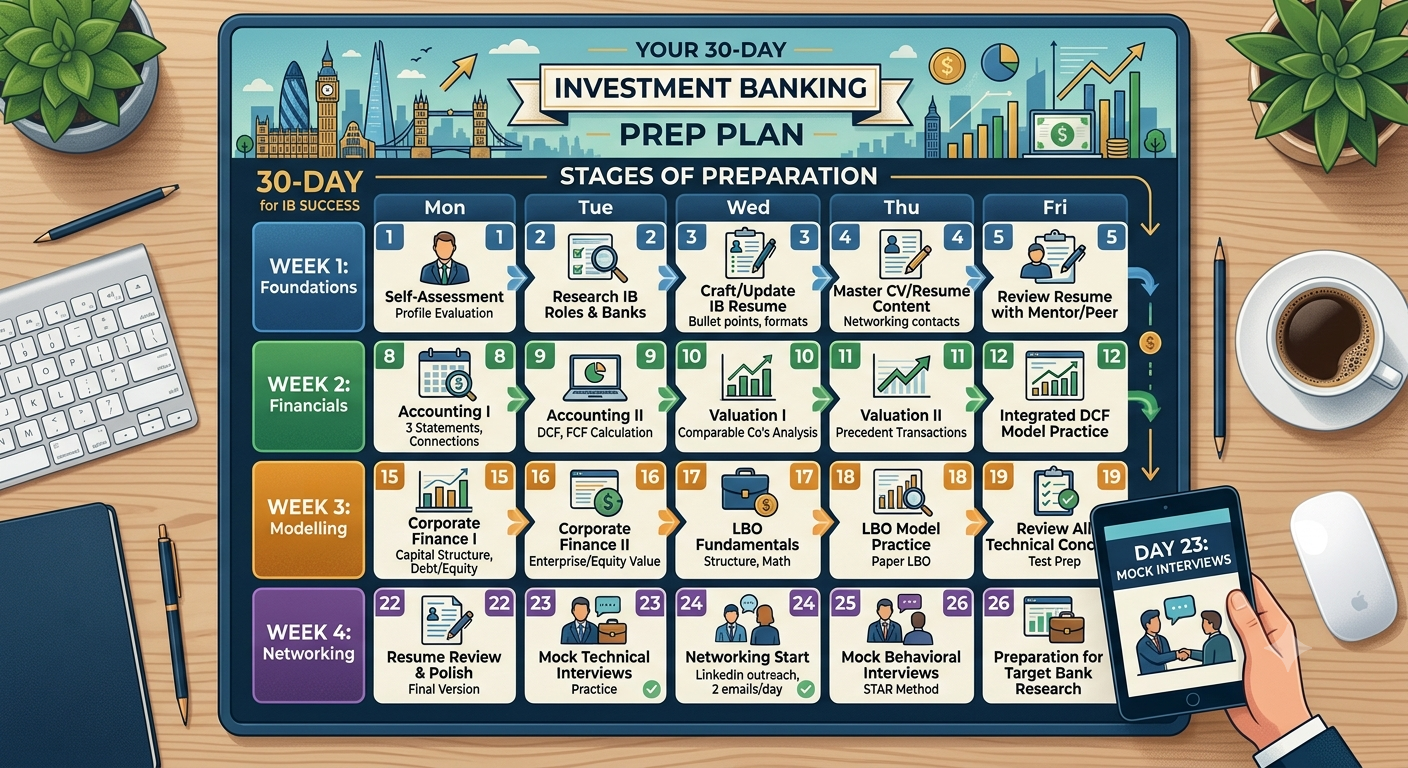
This plan is designed for someone starting with little to no finance background who wants to build a solid foundation before pursuing internships or entry-level roles.
1st Week: Foundations (Days 1–7)
- Days 1–2: Learn the basics of what investment banks do and the major service lines (M&A, ECM, DCM, sales and trading, restructuring).
- Days 3–5: Study the three core financial statements — income statement, balance sheet, and cash flow statement — and how they connect.
- Days 6–7: Review basic accounting concepts (revenue recognition, depreciation, working capital) and how they show up in financial statements.
2nd Week: Valuation Fundamentals (Days 8–14)
- Days 8–9: Learn the logic behind Discounted Cash Flow (DCF) analysis.
- Days 10–11: Study Comparable Company Analysis (trading comps) and how multiples are used in valuation.
- Days 12–13: Learn Precedent Transaction Analysis and how it differs from trading comps.
- Day 14: Review and quiz yourself on all three valuation methods — practice explaining each one out loud.
3rd Week: Modeling and Excel Skills (Days 15–21)
- Days 15–16: Practice essential Excel shortcuts and formulas used in financial modeling.
- Days 17–19: Build a simple three-statement financial model from scratch, following a guided tutorial.
- Days 20–21: Learn the basic mechanics of an LBO model and attempt a simplified version.
4th Week: Interview Prep and Networking (Days 22–30)
- Days 22–23: Compile a list of common technical interview questions and write out clear, concise answers.
- Days 24–25: Draft and refine your personal “Why investment banking?” story.
- Days 26–27: Research 3–5 target banks, including recent deals and group specialties.
- Day 28: Do a mock interview with a peer, mentor, or career advisor.
- Day 29: Update your resume using strong action verbs and quantified achievements.
- Day 30: Reach out to 3–5 professionals for informational interviews to start building your network.
Beyond Day 30
This plan builds a solid foundation, but investment banking preparation is an ongoing process. Many successful candidates spend several months to a year continuing to refine technical skills, build relationships, and gain relevant experience through internships or related roles before landing an offer.
4.5. A Beginner’s Glossary of Investment Banking Terms
- Analyst — The most junior banker role, typically held by recent college graduates, focused on financial modeling, research, and pitch book creation.
- Associate — The role above analyst, usually reached through promotion or direct MBA hiring, involving more deal execution responsibility.
- Bulge Bracket — The largest, full-service global investment banks (e.g., Goldman Sachs, JPMorgan, Morgan Stanley).
- Boutique Bank — A smaller, often specialized investment bank that focuses on specific industries or deal types (e.g., Evercore, Lazard, Moelis).
- Capital Markets — The segment of banking focused on helping companies raise money through equity or debt issuances.
- Comparable Company Analysis (Comps) — A valuation method that estimates a company’s worth by comparing it to similar publicly traded companies.
- DCF (Discounted Cash Flow) — A valuation method that estimates a company’s value based on its projected future cash flows, discounted back to present value.
- Debt Capital Markets (DCM) — The division that helps clients raise funds by issuing bonds or other debt instruments.
- Due Diligence — The investigative process of verifying financial, legal, and operational details before completing a transaction.
- Equity Capital Markets (ECM) — The division that helps companies raise funds through stock issuances, including IPOs.
- Enterprise Value (EV) — The total value of a company, including debt and excluding cash, often used in valuation multiples.
- Equity Value — The value of a company attributable to shareholders, calculated as enterprise value minus net debt (roughly).
- IPO (Initial Public Offering) — The process by which a private company first sells shares to the public.
Important Terms Used in IB
- LBO (Leveraged Buyout) — An acquisition of a company financed primarily through borrowed money, using the target’s assets or cash flow as collateral.
- M&A (Mergers and Acquisitions) — The division and process of advising companies on buying, selling, or merging with other businesses.
- Managing Director (MD) — The most senior banker role, primarily responsible for client relationships and generating deal flow.
- Middle Market — Companies typically valued between roughly $10 million and $1 billion, often served by boutique or regional investment banks.
- Multiples — Ratios (such as EV/EBITDA) used to compare company valuations relative to a financial metric.
- Pitch Book — A presentation created by bankers to pitch ideas, valuations, or recommendations to a client.
- Precedent Transactions — A valuation method based on the prices paid in similar past M&A deals within the same industry.
- Restructuring — Advisory services for financially distressed companies, often involving debt reorganization or bankruptcy proceedings.
- Sales and Trading — The division that facilitates buying and selling of securities on behalf of clients and the bank itself.
- Sell-Side / Buy-Side — “Sell-side” refers to firms that sell securities or advise sellers in a transaction; “buy-side” refers to investors, such as private equity or asset managers, who purchase securities or companies.
- Superday — A final round of back-to-back interviews conducted in a single day, common in investment banking recruiting.
- Syndicated Loan — A large loan provided by a group of lenders pooling resources to fund a single borrower.
- Underwriting — The process by which a bank helps a company raise capital by issuing and selling securities, often assuming some risk in the process.
- Valuation — The process of estimating the economic worth of a company or asset.
- Vice President (VP) — A mid-to-senior banker role responsible for managing deal execution and mentoring junior staff.
- Working Capital — The difference between a company’s current assets and current liabilities, used to assess short-term financial health.
- Yield — The income return on an investment, typically expressed as a percentage of the investment’s cost or current value.
4.6. IMPORTANT FAQ’s for BEGINNERS
After reading through this complete step-by-step guide, if you’re still unsure about what “investment banking” really means, take a look at these frequently asked questions below. They’re designed to fill in any gaps and give you a clearer, more practical understanding of the term — so if you’re considering this as a career path, you’ll have an easier time deciding whether it’s the right fit for you.
1. What does an investment banker actually do?
Investment bankers help companies raise capital, advise on mergers and acquisitions, and guide clients through complex financial transactions.
2. Is investment banking a good career?
It offers high pay and strong exit opportunities, but demands long hours and intense pressure, so it suits people who thrive in fast-paced, high-stakes environments.
3. What degree do I need to become an investment banker?
Most banks prefer degrees in finance, economics, accounting, or a related quantitative field, though candidates from other majors are hired if they show strong analytical skills.
4. Do I need an MBA to work in investment banking?
No, but an MBA is a common path for career changers or those who didn’t break in directly out of undergrad, and it often leads to associate-level roles.
5. How many hours do investment bankers work?
Junior bankers commonly work 70–90 hours a week, especially during active deals, though hours vary by bank and role.
6. What is the difference between investment banking and commercial banking?
Commercial banks serve everyday consumer and business banking needs like loans and deposits, while investment banks focus on capital raising, M&A advisory, and trading for institutional clients.
7. What is the difference between a bulge bracket and a boutique bank?
Bulge brackets are large, full-service global banks, while boutiques are smaller and often specialize in specific industries or deal types, sometimes offering comparable or higher pay at senior levels.
8. How much do investment banking analysts make?
In 2026, first-year analysts at bulge bracket banks typically earn a base salary of $100,000–$125,000, with total compensation (including bonus) reaching roughly $170,000–$190,000.
9. What skills do I need to become an investment banker?
Core skills include financial modeling, valuation, Excel proficiency, attention to detail, communication, and the ability to work well under pressure.
10. What is financial modeling?
Financial modeling is the process of building a structured representation of a company’s financial performance, often used to support valuation and decision-making.
11. What is a DCF analysis?
A discounted cash flow (DCF) analysis estimates a company’s value based on its projected future cash flows, discounted back to today’s value.
12. What is an LBO?
A leveraged buyout (LBO) is an acquisition financed primarily through borrowed money, using the acquired company’s assets or cash flow as collateral.
13. How do I get an investment banking internship?
Most candidates secure internships through campus recruiting, networking with alumni, and applying broadly across bulge bracket, boutique, and middle-market banks.
14. What is a Superday?
A Superday is a final round of back-to-back interviews conducted in a single day, typically involving multiple bankers before an offer decision is made.
15. What certifications help with investment banking careers?
The CFA designation, financial modeling certificates, and (in some regions) required securities licenses can strengthen a candidate’s profile.
16. Is the CFA required for investment banking?
No, the CFA is not required, but it can add credibility, particularly for career changers or those without a finance-heavy academic background.
17. What is the typical career path in investment banking?
Most bankers progress from analyst to associate, then vice president, director, and eventually managing director.
18. What is the difference between an analyst and an associate?
Analysts are the most junior bankers, focused on modeling and research, while associates take on more deal execution responsibility and often supervise analysts.
19. How competitive is investment banking recruiting?
It is highly competitive, with far more applicants than available positions at most banks, making internships, networking, and interview preparation essential.
20. What is networking, and why does it matter in investment banking?
Networking involves building relationships with industry professionals through informational interviews and events, and it often leads to referrals that significantly improve a candidate’s chances.
21. Can I break into investment banking without attending a target school?
Yes, though it typically requires more proactive networking, strong internships or related experience, and a compelling, well-prepared application.
22. What industries do investment banks work with?
Investment banks work across virtually every industry, though many bankers specialize in sectors like technology, healthcare, energy, or industrials.
23. What is the role of AI in investment banking today?
AI is being used to automate research, draft pitch book content, and support due diligence, helping boost front-office productivity without replacing bankers outright.
24. Will AI replace investment bankers?
Most industry experts believe AI will change how junior bankers spend their time rather than replace them, shifting focus toward oversight, strategy, and client relationships.
25. What is equity research?
Equity research involves analyzing public companies and industries to produce reports with earnings forecasts, valuations, and investment recommendations.
26. What is restructuring in investment banking?
Restructuring advisory helps financially distressed companies reorganize debt or navigate bankruptcy to stabilize or improve their financial position.
27. What is the difference between the buy-side and sell-side?
The sell-side includes banks that advise companies and sell securities, while the buy-side includes investors like private equity firms and asset managers who purchase securities or companies.
28. How long does it take to become a managing director?
It typically takes over a decade of progressively senior roles, strong deal performance, and relationship-building to reach managing director.
29. What is the best way to prepare for investment banking interviews?
Combining strong technical knowledge (accounting, valuation, modeling) with well-practiced behavioral stories and mock interviews tends to produce the strongest results.
30. Do investment bankers need to be good at math?Strong quantitative reasoning helps, but the math involved is generally more about applying formulas and interpreting data quickly than advanced mathematics.
31. What is the difference between M&A advisory and capital markets?
M&A advisory focuses on helping companies buy, sell, or merge with other businesses, while capital markets focuses on helping companies raise money through debt or equity issuances.
32. Can I switch from investment banking to private equity?
Yes, moving from investment banking to private equity is a well-established and common career transition, especially after two to three years as an analyst.
33. What is the work culture like in investment banking?
The culture is typically fast-paced, deadline-driven, and hierarchical, with a strong emphasis on precision, responsiveness, and professionalism.
34. How is investment banking compensation structured?
Compensation typically includes a fixed base salary paid regularly, plus a variable year-end bonus tied to individual and firm performance.
Final Thoughts
Breaking into investment banking requires more than academic qualifications. Employers seek professionals who combine technical expertise with curiosity, discipline, teamwork, and strong communication skills. While the path is competitive, it remains accessible to driven individuals willing to put in the work — regardless of background — through internships, related experience, and a well-executed recruiting strategy.
Success does not happen overnight. It comes from consistent learning, gaining practical experience, building meaningful professional relationships, and preparing thoroughly for every opportunity.
The finance industry continues to evolve, creating new opportunities for professionals who are willing to learn, adapt, and embrace change. By investing in your knowledge and skills, you position yourself for long-term success in one of the world’s most influential and respected professions.