

Understanding the difference between assets and liabilities is one of the most important steps toward building long-term financial stability. It sounds basic, but most people — even those with steady incomes — get this distinction wrong, which is often why high earners can still struggle financially while others with modest salaries build lasting wealth.
Here’s a clear, practical breakdown of both concepts and how to apply them to real financial decisions.
Table of Contents
What Is an Asset?
In simple financial terms, an asset is anything that puts money into your pocket over time, either through income, appreciation, or both. The defining feature of a true asset isn’t how much it costs or how impressive it looks — it’s whether it generates value for you without requiring your constant labor.
Common examples of assets include:
- Rental properties that produce monthly income
- Dividend-paying stocks or index funds
- A business that generates profit without your daily involvement
- Bonds or interest-bearing investments
- Royalties from intellectual property, such as books, music, or patents
- Peer-to-peer lending or interest-generating savings instruments
The key test for any asset is simple: does it make you money, or cost you money, over time?
What Is a Liability?
A liability is essentially the opposite — anything that takes money out of your pocket on an ongoing basis. Liabilities aren’t inherently bad; almost everyone has some. The issue arises when liabilities are mistaken for assets, leading to poor financial decisions.
Common examples of liabilities include:
- A mortgage on a home you live in (not one that generates rental income)
- Car loans, especially on depreciating vehicles
- Credit card debt
- Personal loans
- Ongoing subscription costs or high-maintenance possessions (boats, luxury items, etc.)
Even something as seemingly practical as a personal vehicle is a liability in this framework, since it depreciates in value and requires ongoing costs like insurance, fuel, and repairs — all outflows, not inflows.
The Real Impact on Your Financial Health
Understanding the difference between assets and liabilities is the foundation of sound financial planning.
In simple terms, an asset is anything that puts money into your pocket — savings, investments, real estate, or a business that generates income.
A liability, on the other hand, takes money out of your pocket, such as loans, credit card debt, or a car payment.
Many people mistakenly treat liabilities as assets, especially when it comes to depreciating items like vehicles or luxury goods. This confusion can quietly erode wealth over time.
True financial health comes from consistently growing your assets while minimizing or eliminating unnecessary liabilities. The wealthier you become is often measured not by income alone, but by the gap between what you own and what you owe.
Start today: track your assets, reduce bad debt, and build a future rooted in financial freedom rather than financial pressure.
Types of Assets and Liabilities
Assets are resources owned by a person or business that hold economic value and can generate future benefits. They are broadly classified into three categories:
- Current Assets – Short-term resources expected to be used or converted into cash within a year, such as cash, inventory, and accounts receivable.
- Fixed (Non-Current) Assets – Long-term resources like land, buildings, machinery, and equipment used over several years.
- Intangible Assets – Non-physical assets such as patents, trademarks, copyrights, and goodwill that still hold significant value.
Liabilities, on the other hand, represent financial obligations or debts owed to others. They fall into two main types:
- Current Liabilities – Short-term debts due within a year, including accounts payable, short-term loans, and outstanding bills.
- Long-Term Liabilities – Obligations extending beyond a year, such as mortgages, bonds payable, and long-term loans.
Understanding assets and liabilities helps individuals and businesses maintain a healthy balance sheet, make informed financial decisions, and plan for sustainable growth and stability.
20 Key Differences Between Assets and Liabilities
Understanding assets and liabilities isn’t just an accounting exercise — it’s the foundation of building real, lasting wealth.
Below are 20 clear, practical differences between the two, covering cash flow, risk, mindset, and long-term financial impact.
1. Direction of Cash Flow – An asset puts money into your pocket over time. A liability takes money out of your pocket over time.
2. Effect on Net Worth – Assets generally increase your net worth as they grow or generate income. Liabilities typically reduce your net worth, especially if they carry interest or depreciate in value.
3. Ongoing Costs – Assets often generate income that can cover their own costs (or more). Liabilities usually come with continuous expenses — interest, maintenance, insurance — with no income to offset them.
4. Appreciation vs. Depreciation – Many assets, like property or stocks, have the potential to increase in value over time. Most liabilities, like cars or consumer purchases, tend to lose value the moment they’re acquired.
5. Purpose – Assets are usually acquired to generate income, grow wealth, or provide long-term financial security. Liabilities are often acquired for lifestyle, convenience, or immediate personal use.
6. Impact on Financial Freedom – The more income-generating assets you own, the closer you move toward financial independence. The more liabilities you carry, the more of your income is committed to upkeep and debt repayment.
7. Risk Profile – Assets can carry investment risk (market fluctuations, tenant vacancies, business performance) but with the potential for reward. Liabilities carry financial obligation risk — missed payments can lead to penalties, damaged credit, or repossession.
8. Tax Treatment – In many cases, assets like real estate or business ownership come with tax advantages (depreciation write-offs, deductions). Liabilities typically offer little to no tax benefit unless directly tied to a business expense.
9. Long-Term Wealth Contribution – Assets compound over time, often accelerating wealth growth the longer they’re held. Liabilities tend to compound costs instead, particularly high-interest debt.
10. Examples – Assets: rental property, dividend stocks, bonds, business equity, royalties. Liabilities: mortgages on personal homes, car loans, credit card balances, personal loans.
Assets Vs Liabilities Comparison
These are two essential components of personal and business finance. Assets are resources that have value and can generate income or appreciate over time, such as cash, real estate, investments, equipment, and intellectual property. They strengthen financial health and increase net worth.
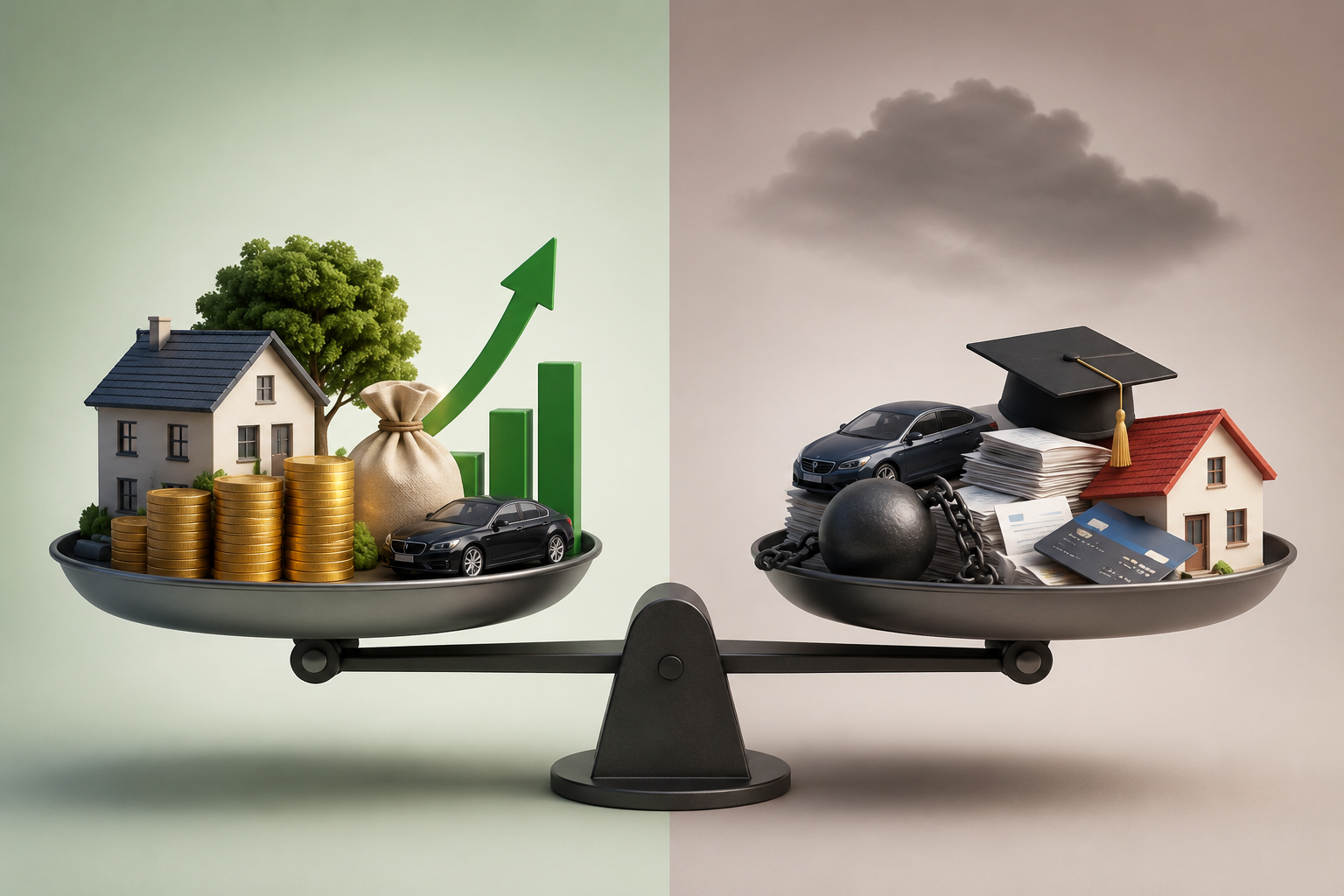
Liabilities, on the other hand, are financial obligations or debts that must be repaid, including loans, credit card balances, mortgages, and unpaid bills. While assets contribute to wealth creation, liabilities reduce available resources and can increase financial risk if not managed properly. Maintaining more valuable assets than liabilities is key to achieving long-term financial stability and growth.
11. Relationship to Passive Income – Assets are the primary source of passive income — money earned with little to no active effort. Liabilities never generate passive income; they only consume active income.
12. Effect on Monthly Budget – Assets can add extra income to a monthly budget. Liabilities typically appear as a fixed monthly expense that must be paid regardless of other financial goals.
13. Perception vs. Reality – Assets are not always visually impressive — a modest rental property or index fund won’t turn heads. Liabilities are often flashy and visible, like luxury cars or oversized homes, which can create a false impression of wealth.
14. Liquidity – Some assets, like stocks, can be converted to cash relatively quickly. Liabilities generally cannot be “cashed out” — they can only be paid off or refinanced.
15. Role in Retirement Planning – Assets are the core building blocks of a sustainable retirement, since they can continue generating income without active work. Liabilities work against retirement planning, since they require continued income to maintain.
ASSETS and LIABILITIES Looking Same But Having Different Meanings!
16. Debt Classification – Some liabilities can indirectly support assets (for example, a mortgage on a rental property that generates income) — this is sometimes called “good debt.” Other liabilities exist purely for consumption and offer no return, often called “bad debt.”
17. Growth Potential – Assets have theoretically unlimited upside — a business or investment can keep growing in value or income. Liabilities have a fixed or worsening cost structure, especially with compounding interest.
18. Effect on Credit and Borrowing Power – A strong asset base can improve borrowing power and access to better loan terms. A high liability load can reduce borrowing capacity and increase perceived financial risk to lenders.
19. Mindset Association – Kiyosaki and other financial educators often associate wealth-building mindsets with prioritizing asset acquisition first. Conventional consumer spending habits often prioritize liabilities and lifestyle purchases first, delaying asset-building.
20. End Goal – The long-term goal with assets is accumulation — continuously acquiring more income-generating resources. The long-term goal with liabilities is minimization — paying them down and avoiding unnecessary new debt.
Understanding Equity: How It Connects to Assets and Liabilities
Every business, no matter its size, rests on three financial pillars: assets, liabilities, and equity. Understanding how these three elements interact is essential for anyone trying to read a balance sheet, run a company, or simply make smarter financial decisions.
The Basic Relationship
At its core, equity represents ownership. It is what remains after you subtract everything a business owes from everything it owns. This relationship is captured in one of the most fundamental formulas in accounting:
Assets = Liabilities + Equity
Rearranged, this becomes:
Equity = Assets − Liabilities
Assets are the resources a business controls — cash, inventory, equipment, property, or accounts receivable. Liabilities are the obligations a business owes to others, such as loans, unpaid bills, or mortgages. Equity, then, is the residual value that belongs to the owners or shareholders once all debts are settled.
A Practical Example
Imagine a small bakery. It owns equipment worth $40,000, has $10,000 in cash, and is owed $5,000 by customers — giving it total assets of $55,000. On the other side, the bakery has a $20,000 business loan and owes $5,000 to suppliers, totaling $25,000 in liabilities.
Using the formula:
Equity = $55,000 − $25,000 = $30,000
This $30,000 represents the owner’s stake in the business — the true value they would walk away with if all assets were sold and all debts paid off.
Why This Matters?
Equity isn’t just an accounting figure; it reflects financial health. Rising equity over time usually signals that a business is growing profitably or paying down debt. Falling equity, on the other hand, can indicate mounting losses or excessive borrowing.
For individuals, the same principle applies to personal finance. Home equity, for instance, is the difference between a house’s market value and the remaining mortgage balance — a concept investors and homeowners alike track closely.
Why the Distinction Gets Confusing?
Knowing whether you are buying an asset or taking on a liability helps you make smarter financial decisions.
The reason so many people misclassify their liabilities as assets comes down to appearance versus cash flow.
A large house, an expensive car, or a closet full of designer items can look like signs of wealth, but if they don’t generate income and instead create ongoing costs, they’re liabilities dressed up as assets.
This is why some people who earn very high incomes still feel financially stretched — their money is tied up in liabilities that create the appearance of success without actually building wealth.
The Cash Flow Perspective
A more advanced way to think about assets and liabilities is through cash flow rather than net worth alone. Two people can have the exact same net worth on paper, but very different financial futures depending on where their money is flowing:
- Someone whose money flows into income-generating assets is building compounding wealth over time.
- Someone whose money flows out toward liabilities — car payments, credit card interest, high-maintenance property — is often working just to maintain their current lifestyle, with little left over to invest.
This is sometimes referred to as the difference between building wealth and simply appearing wealthy.
How to Apply This in Real Life
- Track where your money actually goes each month. Categorize expenses honestly — which ones generate future income, and which ones are pure cost?
- Prioritize acquiring assets before increasing liabilities. Before taking on a new loan or big purchase, ask whether it will generate income or simply cost money over time.
- Reinvest income from assets back into more assets. This is how compounding wealth accelerates over the years.
- Be honest about “hidden” liabilities. Subscriptions, financing plans, and lifestyle upgrades often quietly become liabilities without much notice.
- Reassess periodically. What counts as an asset can change — a property that once generated rental income might become a liability if costs rise or if it sits vacant.
Common Misconceptions About Assets and Liabilities
When it comes to personal finance, few terms are as misunderstood as “assets” and “liabilities.” Many people assume they know exactly what these words mean, yet the way they apply them in real life often leads to poor financial decisions. Clearing up these misconceptions can make a real difference in how you build wealth.
Misconception 1: Anything You Own Is an Asset
A common belief is that everything you purchase automatically becomes an asset simply because you own it.
In reality, an asset is something that puts money into your pocket or grows in value over time.
A car, for example, is often treated as an asset, but it depreciates and drains money through fuel, insurance, and maintenance.
True assets—like income-generating investments or appreciating property—work for you, not against you.
Misconception 2: Your Home Is Always an Asset
Many people list their primary residence as their biggest asset.
However, if a home isn’t generating income and instead requires mortgage payments, taxes, and upkeep, it behaves more like a liability from a cash flow perspective.
This doesn’t mean buying a home is a bad decision, but it’s important to separate emotional value from financial classification.
Misconception 3: Debt Is Always Bad
Not all liabilities are harmful. Debt used to acquire income-producing assets, such as a loan for a rental property or a business investment, can be a strategic tool.
The real danger lies in liabilities that fund depreciating purchases or lifestyle expenses with no return.
Misconception 4: Net Worth Tells the Whole Story
A high net worth doesn’t always mean strong cash flow. Someone can appear wealthy on paper while struggling monthly because most of their assets are illiquid or non-income-generating.
Final Thoughts
The asset-versus-liability framework isn’t about eliminating all liabilities from your life — most people will always have some, like a personal home or a car.
The real goal is awareness: understanding which parts of your financial life are working for you and which are working against you.
Building long-term wealth typically comes down to steadily increasing the assets column while keeping liabilities in check, rather than judging financial success purely by appearances.